


The SMB Barometer 2025 shows that a lack of knowledge and expertise is slowing down the adoption of artificial intelligence
Artificial intelligence is one of the biggest technological revolutions since the widespread adoption of the internet. Its potential for streamlining business operations and improving competitiveness is enormous, but the SMB Barometer 2025 shows that SMBs have not yet adopted the technology on a large scale. The biggest obstacle is a lack of knowledge and expertise, which is particularly pronounced in Northern Savo.
The SMB Barometer was carried out by the Federation of Finnish Enterprises, Finnvera Plc and the Ministry of Economic Affairs and Employment, and 4,553 SMBs responded to the survey, 181 of which were from Northern Savo. The survey reflects the actual sectoral breakdown of the businesses: services 56 percent, retail 13 percent, construction 18 percent and manufacturing 13 percent.
You can read the SMB Barometer 1/2025 on Yrittäjät’s website.
- There is interest in artificial intelligence in Northern Savo, but its practical application is proving difficult
- Northern Savo at risk of falling behind in the adoption of artificial intelligence
- Businesses need low-threshold services to help them discover the potential of artificial intelligence
- Artificial intelligence is a critical competitive factor
- Support is available for the implementation of artificial intelligence
- The use of artificial intelligence is about maintaining competitiveness
There is interest in artificial intelligence in Northern Savo, but its practical application is proving difficult
According to the SMB Barometer, businesses in Northern Savo are slightly more interested than average in utilizing artificial intelligence. Eleven percent of companies in the region are considering adopting AI applications and software robotics, whilst the national average is 9 percent. This indicates that interest in artificial intelligence has grown since the previous survey.
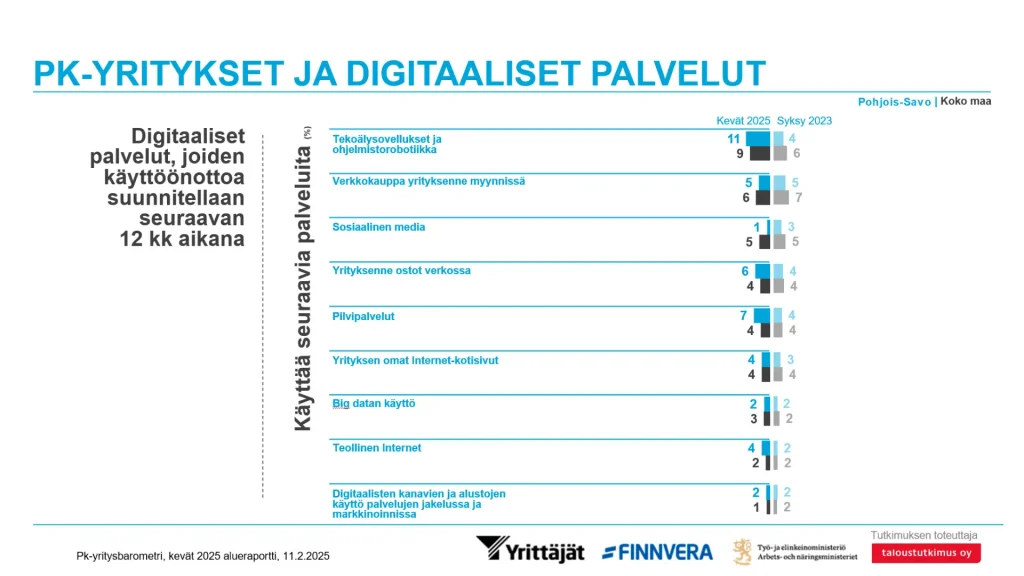
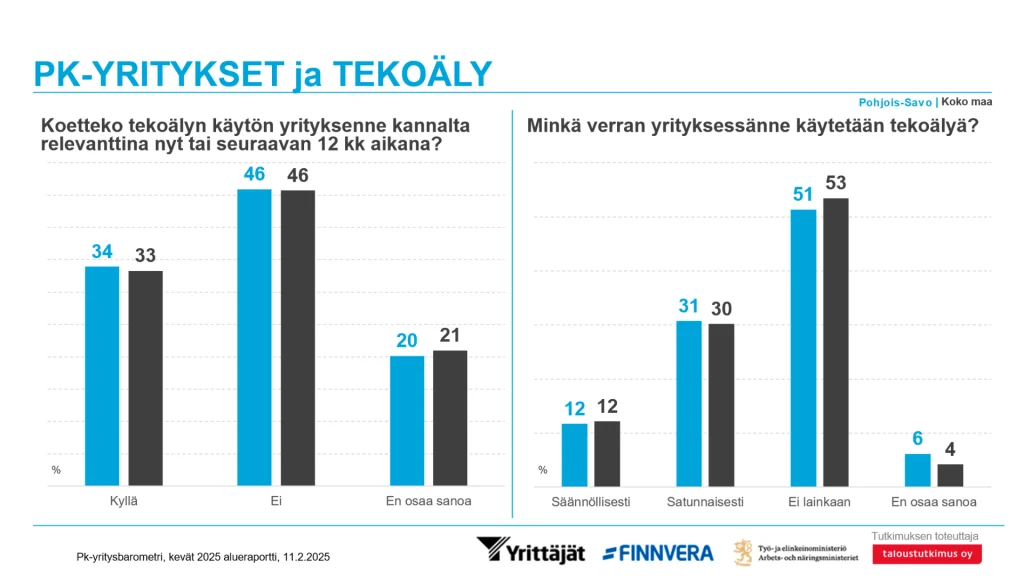
However, the study reveals a significant barrier to the adoption of artificial intelligence: as many as 46 percent of companies in Northern Savo do not consider artificial intelligence to be relevant to their business over the coming year. This figure is identical to the national average and shows that, although there is much talk of AI, its practical benefits remain unclear to many companies. Furthermore, only 12 percent of companies in Northern Savo use AI on a regular basis, whilst 51 percent do not use it at all
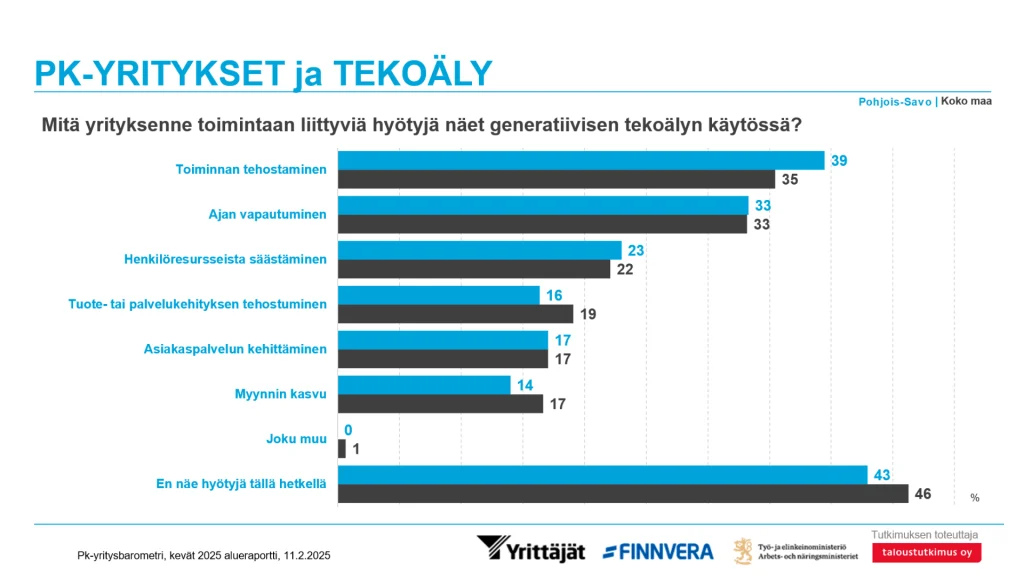
The benefits that companies have experienced from artificial intelligence are mainly linked to improving operational efficiency and developing business, but a significant proportion do not recognize the benefits of artificial intelligence at all. This indicates that awareness of the potential of AI remains limited, and many companies do not have a clear understanding of how the technology could genuinely benefit their business.
According to the study, a lack of awareness and expertise remains a significant challenge. Without clear use cases and concrete examples, artificial intelligence may remain merely a theoretical possibility within companies, which they do not know how to, or dare to, utilize in practice.
Northern Savo at risk of falling behind in the adoption of artificial intelligence
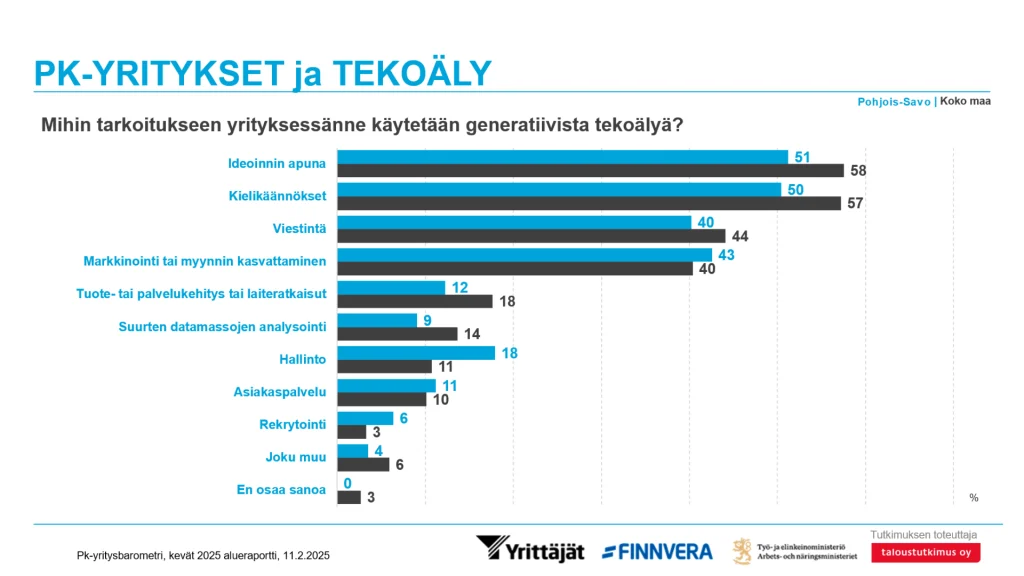
Although interest in artificial intelligence has grown, its adoption is not progressing quickly enough. The vast majority of companies do not see artificial intelligence as relevant to their business, and their use of it remains superficial. This is worrying, as the potential of AI extends far beyond individual tools such as machine translation or text generation. Data analysis, automation and the development of customer service are areas where AI can genuinely streamline operations and improve competitiveness – yet it is precisely in these areas that its use remains limited.
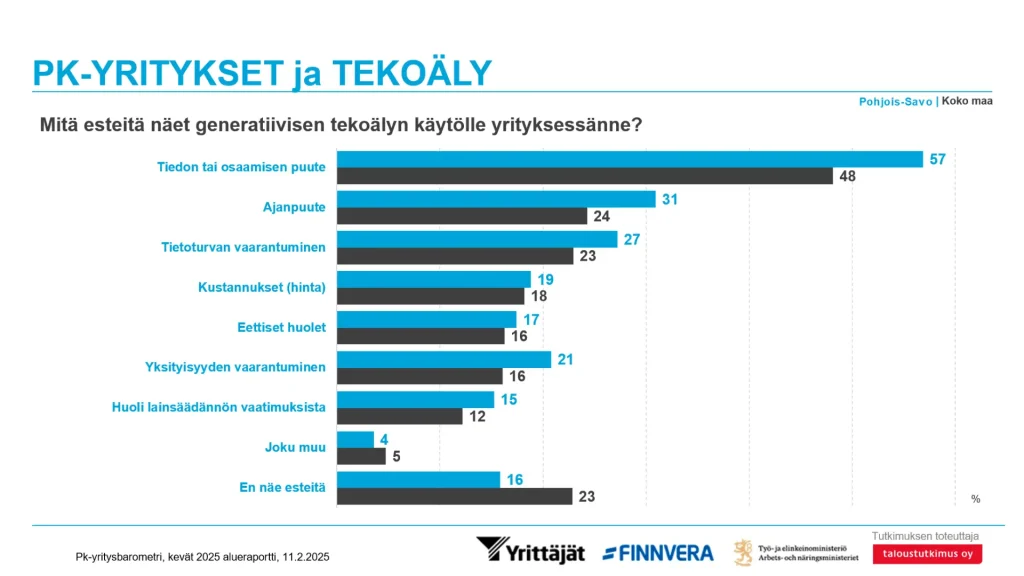
Businesses in Northern Savo also face greater challenges in adopting artificial intelligence than elsewhere in Finland. 57% of companies in the region cite a lack of information or expertise as the most significant barrier, whilst the national average is 48%. At the same time, only 16 percent feel that there are no barriers to utilizing AI – the corresponding figure for the whole country is 23 percent. This suggests that growing interest alone is not enough if companies lack concrete means of utilizing AI.
Businesses need low-threshold services to help them discover the potential of artificial intelligence
To ensure that Northern Savo does not fall behind, more training, practical examples and low-threshold opportunities for AI trials are needed. Without these, it is difficult for businesses to see how the technology could genuinely support their operations in the long term.
If businesses do not receive the necessary support to adopt artificial intelligence, they will lose their competitive edge to regions and operators that integrate artificial intelligence into their core business operations. Building up skills and knowledge is critical if companies in Northern Savo are to keep pace with developments.
In order for businesses in the region to make effective use of artificial intelligence, there is a need for more training, expert support and practical examples of how AI can be applied. Making use of funding instruments, such as grants from the ELY Centre and Business Finland, could also lower the threshold for businesses to try out AI solutions.
Companies that limit the use of artificial intelligence to just a few, easy-to-use applications are missing out on a large part of its potential. AI is not just a tool for content creation; it can also be used to automate business processes and make better, data-driven decisions.
Artificial intelligence is a critical competitive factor
Back in 2023, Bill Gates wrote in his blog that artificial intelligence is just as revolutionary an invention as computers, mobile phones and the internet. We are therefore not just talking about a technological step forward, but a fundamental change in the way companies operate, compete and create value.
Companies that adopt artificial intelligence at an early stage can gain a competitive advantage by speeding up decision-making, improving customer service and freeing up resources through the automation of routine tasks. Early adoption also enables the continuous development and application of AI across different areas of the business, whereas latecomers will find themselves having to play catch-up with the pioneers, who already have established operating models and a better understanding of how to utilize the technology.
There is no point in delaying the adoption of artificial intelligence. Technological development is advancing rapidly, and companies that sit back and wait may find themselves in a situation where their competitors are already well ahead and the market landscape has changed permanently. Artificial intelligence offers the opportunity to build a stronger and more efficient business, but making the most of it requires courage and a forward-thinking approach. Now is the time to act, so that your company does not fall behind but secures its place in the market of the future.
Support is available for the implementation of artificial intelligence
Implementing artificial intelligence may seem complex and time-consuming, but there are many ways to make the process easier for SMBs. Various organizations offer training, consultancy and practical tools to help businesses explore the potential of AI and find solutions that suit their needs.
At Hurja, we have developed the AI Sprint service, which helps companies recognize the potential of artificial intelligence and identify practical applications for business development. The process is designed to deliver results quickly and focus on the essentials without the need for extensive research. At the same time, we offer support for further development and piloting to ensure that AI solutions are successfully implemented.
Artificial intelligence is still a new technology, and making the most of it requires constant iteration. We have already integrated AI into our clients’ software, but as with the technology sector as a whole, the long-term implications are still taking shape. In practice, we have been working on, among other things, intelligent AI chatbots that enhance customer service and sales, speech recognition technology and handwritten text recognition. In addition, we have utilized AI tools in our own processes to streamline software development, project management, sales and marketing.
At present, the focus is particularly on issues relating to the ethics of artificial intelligence, such as establishing our own ethical principles and preparing for the EU’s AI legislation. AI is developing rapidly, and it is important for companies to understand how the technology can be utilized responsibly and in a way that genuinely supports their business operations.
The use of artificial intelligence is about maintaining competitiveness
The SMB Barometer 2025 confirms what was already to be expected: the adoption of artificial intelligence is progressing slowly, and the main reason is that businesses lack sufficient knowledge or expertise to make use of it.
Companies that start using artificial intelligence now will gain a head start over their competitors. Small-scale trials and concrete use cases make the technology more familiar and lower the barrier to its wider adoption. Training, expert support and funding are also crucial in ensuring that companies have the necessary capabilities to utilize AI.
Now is the right time to take action so that your business doesn’t fall behind.
Further information
Vili Härkönen, Hurja Solutions Oy, CEO, 044 0653 700, vili.harkonen@hurja.fi
Hurja is a software company that delivers on its promises – we are a reliable partner that helps our clients succeed. Hurja employs over twenty professionals who are passionate about their field. Every member of the Hurja team is committed to ensuring that projects exceed expectations – from the very first meeting to the very last line of code. We don’t just develop software; we give our clients a head start in a rapidly changing digital world. We write code that matters today and tomorrow.
Shall we get started?
"*" indicates required fields

You might also like these articles

6 winning use cases for AI – how to find where it really pays off
Read more

Generative artificial intelligence (GenAI) in business
Read more

The AI Act – the artificial intelligence legislation – sets out the rules for the use of artificial intelligence
Read more

AI for businesses – a practical guide to getting started
Read more
 Further development and modernization of a PHP system