


What does DevOps mean?
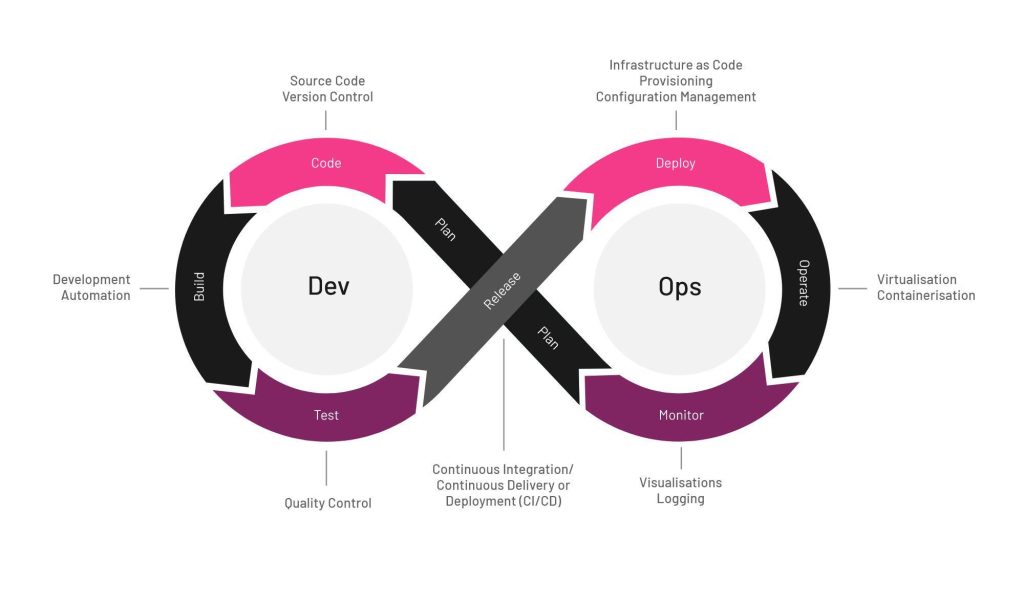
DevOps is a methodology for software development and IT operations that brings together development and operations by automating workflows. DevOps is a portmanteau of the words “development” and “operations”. DevOps is a philosophy, an approach and a set of practices that aims to bring development and operations teams closely together.
DevOps speeds up and improves the system development lifecycle. DevOps supports agile development and emphasizes shared ownership, automation and rapid feedback. Its practices are widely applied across different architectures and aim to reduce the time taken from making changes to deploying them into production, while ensuring high quality. DevOps also influences organizational culture by improving collaboration between different teams, promoting rapid delivery and high-quality service in line with business objectives.
Imagine that the development team is building a house and the operations team is maintaining it. Traditionally, these two teams operate in their own silos, communicating only rarely and sometimes running into problems that could have been avoided through close collaboration. DevOps aims to break down these silos, build bridges and foster collaboration. It is therefore not just about technology, but also a cultural shift. In this article, we take a comprehensive look at the IT term ‘DevOps’.
- How is DevOps implemented at Hurja?
- How does DevOps help speed up time-to-market?
- DevOps and automation lead to more efficient processes with less effort
- The importance of collaboration in DevOps
- Measurement and Monitoring in a DevOps Environment
- The benefits of DevOps
- Challenges of DevOps
- Cloud services and DevOps – integrating cloud services into DevOps processes
- DevSecOps – risk management and security in DevOps environments
- Efficiency, innovation and sustainable competitive advantage, with digitalisation at the heart of it all
How is DevOps implemented at Hurja?
At Hurja, we offer our clients the opportunity to decide whether to adopt DevOps principles in their project. If a client chooses DevOps, we aim to automate all stages of the project right from the start. This automation speeds up the development process and streamlines workflows, which supports the goals of DevOps, such as agile development, shared ownership and continuous feedback. For example, thanks to automation, we can reduce the time taken from making changes to deploying them to production, while maintaining a high standard of quality throughout the process.
Although introducing automation at the start of projects may initially slow down implementation while the DevOps infrastructure is being set up, it yields significant benefits in the long term. Furthermore, by applying DevOps principles, we utilize various serverless platforms, which are quick to set up and offer flexibility and scalability without the challenges associated with maintaining traditional server infrastructure. Leading serverless platforms include AWS (Lambda) and Google (Cloud Run).
The extensive use of DevOps offers our clients a number of tangible benefits, which are reflected in the quality and speed of our services. By automating project development processes right from the start, our clients benefit from faster delivery times. This means that customers can access new features and updates more quickly than when working with traditional development methods.
How does DevOps help speed up time-to-market?
The DevOps model emphasizes continuous integration (CI) and continuous delivery (CD) practices. These are important because they speed up development processes and minimize risks when software is deployed to production. Continuous integration (CI) refers to the regular merging of code changes into a shared version control system to ensure that the code meets the quality requirements set for the project. Continuous Delivery (CD), on the other hand, extends this principle by automating the deployment of code to the production environment, which speeds up the release process and improves the availability of services to customers. As a result, organizations can respond more quickly to market changes and user feedback, providing a competitive advantage in a rapidly changing digital operating environment.
DevOps and automation lead to more efficient processes with less effort
Automation is a key element of the DevOps philosophy. It not only speeds up routine and repetitive tasks, but also minimizes the risk of human error. Examples of DevOps automation include infrastructure as code, where server environments are created and managed automatically using code, and configuration management tools, which ensure consistent and repeatable system settings.
We have extensive experience in setting up CI/CD automation pipelines on both GitHub and GitLab. Automation allows teams to focus more on innovation and developing new features, while maintenance tasks and repetitive processes are handled automatically. In our experience, this leads to higher productivity and enables a more efficient use of resources.
The importance of collaboration in DevOps
DevOps is not merely about technology and processes; it is a transformation brought about through continuous improvement and technological advancement. At its heart lies cross-team collaboration, where development, testing and operations teams work seamlessly together. This collaborative approach not only speeds up product development but also improves product quality and reliability, as different perspectives and areas of expertise are brought together at an early stage. A cultural shift towards openness, continuous learning and mutual support is a critical factor in the success of DevOps.
Measurement and Monitoring in a DevOps Environment
Continuous measurement and monitoring are critical components of DevOps, as they enable continuous improvement and performance optimization. Effective monitoring tools collect real-time data on system operation and performance, enabling teams to identify and resolve issues quickly. Furthermore, by measuring various performance metrics, such as response times, errors and user activity, organizations can gain valuable insights into how well their services meet users’ needs and expectations. This information helps to guide development decisions and continuously improve the quality and usability of services.

The benefits of DevOps
- Automation and streamlining workflows: DevOps emphasizes the importance of automation in all processes, such as code integration, testing and deployment. Automation reduces errors, speeds up processes and enables more frequent releases.
- Cultural change and teamwork: DevOps promotes open communication and collaboration between developers, testers and IT operations. The aim is to create a culture in which all parties take joint responsibility for software quality and delivery speed.
- Continuous use of feedback: DevOps emphasizes the continuous collection and use of feedback at every stage of the development process. Rapid feedback enables problems to be identified and rectified quickly, and helps organizations adapt to changing requirements and markets.
The tangible benefits of DevOps practices can be illustrated through a number of stages. For example, an automated continuous integration and continuous delivery (CI/CD) pipeline enables code to be deployed to production more quickly and securely. Automated tests, such as unit and integration tests, ensure code quality in real time, which reduces the need for manual work and speeds up the development cycle. Furthermore, Infrastructure as Code (IaC) helps maintain consistency across environments and speeds up the deployment of new servers.
Challenges of DevOps
However, the adoption of DevOps also involves challenges, such as a cultural shift within the organization, which can be painful. Traditional divisions of labor between developers and IT departments can fuel a spirit of rebellion and resistance to new ways of working. Managing cultural change requires commitment from senior management, training and open communication between teams. This is where successful change management comes into play. Technical challenges, such as tool integration and the modernization of legacy systems, also require careful planning and resources. Companies must recognize these challenges and develop strategies to overcome them, such as mentoring programs and ongoing staff training.
Cloud services and DevOps – integrating cloud services into DevOps processes
The use of cloud services has become an integral part of DevOps strategies, as they offer scalability, flexibility and improved resource management. Cloud-based platforms, such as AWS, Azure and Google Cloud, enable rapid deployment environments and dynamic scaling capabilities, which are essential for maximizing the efficiency of CI/CD pipelines. Cloud services also enable cost-effective capacity management, with payment based on usage, which reduces organizations’ infrastructure costs and improves financial flexibility.
DevSecOps – risk management and security in DevOps environments
As the pace of development increases and systems become more complex, the importance of security and risk management is emphasized in DevOps processes. DevOps promotes the integration of a security mindset into all stages of software development, a concept known as DevSecOps. This approach involves designing for security from the outset and ensures that security is an integral part of every CI/CD pipeline. In addition, automated security tests and vulnerability analyzes are carried out regularly, enabling a rapid response to potential threats and minimizing potential security risks. DevSecOps, which combines DevOps practices with the integration of information security into the development process, offers significant benefits to our clients, particularly in terms of information security and application reliability. In practice, this means that we focus on security right from the development stage by integrating automated dependency checks and various security scanners into our development process.
There are also a number of free and paid security scanners available on GitHub and GitLab, designed to analyze code and dependencies. These tools help developers identify and fix potential vulnerabilities and security risks as early as the development stage. Free scanners offer basic security features, such as detection of the most common security flaws and dependency analyzes. Paid versions, on the other hand, offer more extensive features, such as automated remediation recommendations, continuous monitoring and more in-depth analyzes covering a wider range of security and offer integrations with other security tools. They may also include advanced features such as automated remediation, customizable alerts and detailed reporting tools that help organizations comply with security standards and regulations. Such security scanners are vital components of a development team’s toolkit, as they significantly reduce the likelihood of security risks and ensure a high level of software security.
Efficiency, innovation and sustainable competitive advantage, with digitalisation at the heart of it all
DevOps is significant from a business perspective. It helps companies respond quickly to market changes and customer demands by delivering new features and updates more rapidly. This not only improves customer satisfaction but also strengthens a company’s competitiveness in an ever-changing digital landscape. DevOps also promotes innovation, as teams can focus on creativity and problem-solving while automation reduces routine tasks.
DevOps is an approach that transforms the way organizations operate and their culture, breaking down traditional functional silos and emphasizing collaboration and open communication. However, it is more important to understand that DevOps is an ongoing process, not an immediate goal, and it requires long-term commitment and dedication.
So, while the IT sector may be full of cryptic terms and complex concepts, DevOps is one that truly deserves attention. Not only does it improve organizations’ efficiency and their ability to deliver value to customers more quickly, but it also helps businesses thrive in this era of digitalization.
We’re always on hand to help you achieve your business objectives using the methods best suited to your project. So, if you’re looking for expert software development services, please don’t hesitate to get in touch!
Shall we get started?
"*" indicates required fields





 Programming is much more than just writing code