




AI for businesses – a practical guide to getting started
Artificial intelligence for businesses – opportunities we could not have imagined before. In this article, we examine how artificial intelligence (AI) can help businesses transform their business processes, improve the customer experience and create new, innovative ways to succeed. We also present some concrete examples of how we have integrated artificial intelligence into solutions implemented for our customers.
We are living in an era where artificial intelligence is no longer the future for businesses, but today’s reality. Artificial intelligence technology not only supports business, but actively shapes it. AI is at the forefront of this change, offering businesses opportunities that were unimaginable just a few years ago.
At Hurja, we offer our customers software development services that utilise the latest technologies, including the possibilities offered by artificial intelligence. In this way, we support our customers in transforming their businesses and promote sustainable growth, ensuring that our solutions are always at the forefront of technology.
- The potential of generative artificial intelligence for businesses
- A brief overview of developments in artificial intelligence and changes in the business environment
- AI maturity of Finnish SMEs
- Artificial intelligence for businesses – assess your organisation’s level of AI utilisation
- Applications of artificial intelligence in different industries
- Areas of application for artificial intelligence in companies
- How should artificial intelligence be approached in a company?
- AI for businesses – practical implementations where artificial intelligence streamlines processes and services
- When the possibilities of artificial intelligence are difficult to grasp, Hurjan AI Sandbox makes them visible.
- Artificial intelligence security and ethical considerations and limitations
- We help companies find the best ways to utilise artificial intelligence
The potential of generative artificial intelligence for businesses
Generative AI in particular, a subfield that focuses on creating new, original content, is revolutionising the way we think about creativity and automation. AI enables companies to automate complex processes, improve decision-making and create highly personalised customer experiences, for example.
Generative AI not only streamlines operations, but also creates new innovations and provides ways to differentiate from competitors, giving rise to new types of products and services, such as automatically generated content, personalised experiences and unprecedented interactions.
A brief overview of developments in artificial intelligence and changes in the business environment
The first large language model (LLM) developed by OpenAI was released in 2018. However, the broader breakthrough in artificial intelligence came in 2022 with the release of ChatGPT 3.5.
The service quickly gained a large number of users, demonstrating the widespread interest in and practical value of artificial intelligence. With this development, artificial intelligence is expected to significantly change business in the coming years. The effects will extend to all industries, companies and individual jobs.
The significance of artificial intelligence is evident in its rapid spread across various industries. The era of artificial intelligence is considered to have begun in the early 2020s, and its effects are already visible in industry and society at large. The pace of change has been surprisingly rapid.
The widespread adoption of artificial intelligence requires companies to adopt new operating methods, strategies and technologies. At the same time, it offers significant opportunities for gaining a competitive advantage. Artificial intelligence can be utilised in companies of all sizes and in almost all functions. It is suitable for core functions, strategic development and support functions.
In strategic planning, artificial intelligence helps to better understand the business environment. It can be used to anticipate trends and identify early signs of change. In addition, artificial intelligence is suitable for demanding analyses, among other things, which can speed up and streamline research and development work.
AI maturity of Finnish SMEs
Against this backdrop, it is reasonable to examine the stage Finnish SMEs are at in terms of utilising artificial intelligence. For example, the SME Barometer 2025 showed that although the importance of artificial intelligence in business transformation is widely recognised, its implementation is still in its early stages in many companies.
According to the barometer, the utilisation of artificial intelligence is slowed down in particular by a lack of information and expertise. Many SMEs do not yet consider artificial intelligence to be relevant to their own business, and only a small proportion use it regularly. The use of artificial intelligence is focused on individual experiments and limited efficiency measures, while broader applications, such as process automation and data analysis, are less common.
Findings show that the potential of artificial intelligence has been recognised, but incorporating it into everyday activities requires more practical examples, skills development and support. As the operating environment for businesses changes, the use of artificial intelligence is increasingly becoming a factor that affects the ability of SMEs to maintain and develop their competitiveness.
Artificial intelligence for businesses – assess your organisation’s level of AI utilisation
Artificial intelligence plays a significant role in modern business, and it can be utilised at several different levels. In some organisations, the use of artificial intelligence may be limited to utilising ready-made models, such as ChatGPT, to streamline processes. Others integrate AI more deeply into their own business processes, improving customer service, marketing and analytics, for example.
In the most advanced organisations, artificial intelligence is a key part of applications and processes. Organisations develop and train their own artificial intelligence models, which are optimised to meet their specific needs. Artificial intelligence for businesses – the whole concept boils down to practical benefits in business.
The following set of questions will help you assess how deeply artificial intelligence is utilised in your organisation and what kind of impact different levels can have on your business.
How advanced is your organisation in utilising artificial intelligence?
- The early stages of artificial intelligence:
- Your organisation is just starting to utilise artificial intelligence. The use of artificial intelligence tools has not yet begun, or it is sporadic and limited to simple applications.
- Basic use of artificial intelligence:
- You use ready-made artificial intelligence models, such as ChatGPT, as part of your own processes or services. At this stage, you do not make any major changes to the models, but utilise them as they are.
- Advanced use of artificial intelligence:
- Integrate artificial intelligence more extensively into various business processes. For example, customer service, marketing, data analysis and other operational areas can utilise artificial intelligence to improve efficiency and support decision-making.
- Advanced use of artificial intelligence:
- Artificial intelligence is a key part of an organisation’s applications and processes. This can mean complex integrations and customised solutions developed for the specific needs of the organisation. Advanced use also includes training and developing your own artificial intelligence model. You develop and train your own AI models that are optimised specifically for your organisation’s needs. This may include deep learning models, natural language processing enhancements, and other advanced AI solutions. It also involves using your own data and continuously improving your models.
Applications of artificial intelligence in different industries
Artificial intelligence offers versatile application possibilities in almost every industry, improving efficiency, accuracy and customer experience. Today, artificial intelligence does not mean a single ready-made solution for companies, but rather a whole that adapts to the needs of the industry – whether it be manufacturing, retail or education. Below are examples of how artificial intelligence can bring concrete benefits to companies in different business environments.
- Industry
- In the industrial sector, AI helps companies improve the efficiency of their production processes and reduce downtime through predictive maintenance. Large amounts of data analysed by AI can reveal hidden patterns and trends that help optimise production and reduce waste. Robotics and automation, which are increasingly driven by artificial intelligence, also enable the automation of demanding and repetitive tasks, freeing up employees’ time for more demanding and creative tasks.
- Retail sales
- Artificial intelligence helps companies better understand customer behaviour and optimise inventory management and pricing strategies. For example, artificial intelligence can be used to predict seasonal demand spikes, enabling real-time inventory adjustments and reducing the risk of overproduction. In addition, personalised recommendation systems can offer customers products that match their preferences, increasing the likelihood of purchase and improving customer loyalty. This makes shopping smoother and increases customer loyalty – and is an excellent example of how artificial intelligence in companies can support both sales and customer relationship management.
- Field of education
- In education, AI can revolutionise teaching methods and personalise the learning experience. AI-based learning platforms can tailor teaching materials to students’ individual needs and learning speeds, making learning more effective and meaningful. In addition, AI can help teachers monitor student progress in real time and identify areas where additional support is needed, thereby improving learning outcomes. Virtual assistants can also provide 24/7 support to students, answering questions and guiding them through their homework, which promotes independent learning.
Areas of application for artificial intelligence in companies
Artificial intelligence offers companies a huge range of applications that can be used to streamline operations, improve customer experience and create new business. Artificial intelligence for companies – solutions built on practical needs.
Below are some practical examples of how artificial intelligence can affect different areas of a company’s operations:
- Chatbots and virtual assistants: Artificial intelligence can automate routine customer service tasks by providing fast and consistent responses to customer inquiries. This frees human employees to focus on more complex and higher-value tasks.
- Personalised customer experience: With the help of AI analytics, companies can tailor their services and offers more precisely by utilising customers’ previous purchase data and preferences. This enables the creation of individual experiences that match each customer’s needs and expectations. As a result of personalisation, customer satisfaction and engagement improve significantly. Today, many services include AI features that provide companies with deeper insights into customer behaviour.
- Predicting and personalising the user experience in real time: AI can predict a user’s next actions and offer tailored content even before the user requests it. For example, an online store can automatically show products that are most likely to interest the user based on their browsing history and purchasing behaviour.
- Predictive analytics: Artificial intelligence can be used to forecast demand and optimise inventory management by analysing historical data and market trends. This helps reduce overstocking and minimise waste.
- Route and delivery optimisation: AI can calculate optimal routes and delivery schedules in real time, reducing transportation costs and improving delivery speed.
- Content creation for marketing materials: AI can automatically generate basic content such as product descriptions, blog posts, or newsletters using natural language processing (NLP) technologies. This frees up the marketing team’s time for more creative and strategic work.
- Content optimisation: AI can analyse existing content and suggest improvements for search engine optimisation (SEO) or adapt the content for different target audiences.
- Using AI in visual design: AI-powered editing of images and videos can help create more visually appealing materials designed to capture the interest of specific target audiences.
- Rapid prototype iteration: AI can simulate and test new product ideas with prototypes quickly, shortening the product development cycle and reducing development costs.
- Customised products: AI enables the efficient and scalable creation of products tailored to customers’ needs and preferences.
- Analytics to support decision-making: AI can analyse large volumes of data quickly, helping management make informed, data-driven decisions.
- Risk prediction and management: AI can identify potential risks and recommend actions to manage them, reducing possible losses and improving organisational resilience.
- Process automation: AI can automate repetitive and time-consuming processes such as invoicing and reporting, improving operational efficiency and reducing errors.
- Workforce management: AI can help optimise workforce utilisation by predicting staffing needs and planning work schedules more efficiently.
How should artificial intelligence be approached in a company?
Often, the implementation of artificial intelligence fails when it is approached from a technological perspective rather than a business perspective. The best results are achieved when artificial intelligence is viewed as part of processes, systems and decision-making.
A good starting point is to answer three questions:
- where in the work process does the most manual effort or delay occur?
- what information is already being collected but not utilised
- which decisions require a faster or better basis
Artificial intelligence is not a single feature, but a way to build smarter systems and services.
Experiments and first steps
The utilisation of artificial intelligence can begin with small-scale experiments that focus on the automation of simple, repetitive tasks or data analysis. For example, Make offers a user-friendly platform that can be used to automate many business processes by connecting different services and applications without extensive programming skills. With Make, you can easily create workflows that connect different services, such as Google Sheets and email programmes, making your daily routines easier.
Integrating the ChatGPT API enables more advanced linguistic interaction in applications and services. For example, customer service can benefit from ChatGPT, which is able to respond to customer queries quickly and accurately, freeing up human colleagues to handle more complex enquiries. The ChatGPT API can also be used to create intelligent chatbots that help users navigate websites or provide 24/7 support.
Google APIs offer a wide range of tools for analysing and processing data. The artificial intelligence and machine learning solutions offered by Google Cloud, such as Vision API and Natural Language API, enable the use of image recognition and natural language understanding in various applications. The Google Sheets API can be used to automate and integrate spreadsheet calculations with other business processes, thereby streamlining data processing and reporting.
By combining different AI tools and services, companies can build customised solutions that not only improve efficiency but also provide deeper insight into the state of the business and help make better decisions. Even small-scale implementation of automation and artificial intelligence can bring significant improvements in operational efficiency and competitiveness in the long term.
In each of these examples, AI not only enhances operational performance, but also creates new opportunities for innovation and service development that meet the ever-growing expectations of customers. By embracing AI technologies, companies can not only keep pace with their competitors, but also surpass them by bringing unprecedented services and products to market.
How to identify the most valuable applications of artificial intelligence for your company
When a company is considering where to utilise artificial intelligence, the first step is to stop and define the requirements for the solution. Accurately describing use cases at this stage helps to identify the processes or functions where AI can generate the most value – whether it be customer service, production optimisation or maintenance efficiency. OpenAI’s guide Identifying and Scaling AI Use Cases provides a three-step model for identifying AI use cases.
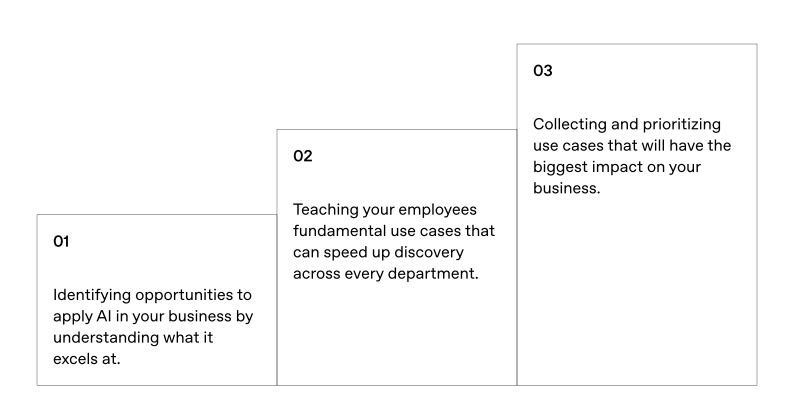
A three-step model for companies to identify use cases for artificial intelligence
- Identifying opportunities
Review your company’s processes and look for areas where AI could provide value. Typical indicators include repetitive manual work, large volumes of data, slow processes, or fragmented information needed for decision-making.
- Teaching basic use cases within the organisation
When employees learn to recognise basic AI use cases, they are also better able to propose new ideas. This lowers the threshold for adopting AI and accelerates innovation across the organisation.
- Collecting and prioritising use cases
Not all ideas can be implemented at once. Prioritisation helps focus resources on the initiatives with the greatest impact. A simple Impact/Effort framework, presented in the guide, works well for this purpose. It helps teams start with projects that have high impact but are still relatively easy to test and implement.
Six basic use cases are good starting points for brainstorming AI solutions.
According to OpenAI, most of the benefits of artificial intelligence are concentrated in six core areas:
- Content production – reports, instructions and marketing materials
- Automation – automation of repetitive tasks and processes
- Research and analysis – summarising, structuring and observing data
- Programming tasks – code creation, testing and optimisation
- Data analysis – identifying trends and supporting decision-making
- Brainstorming and strategy work – developing new concepts and business scenarios
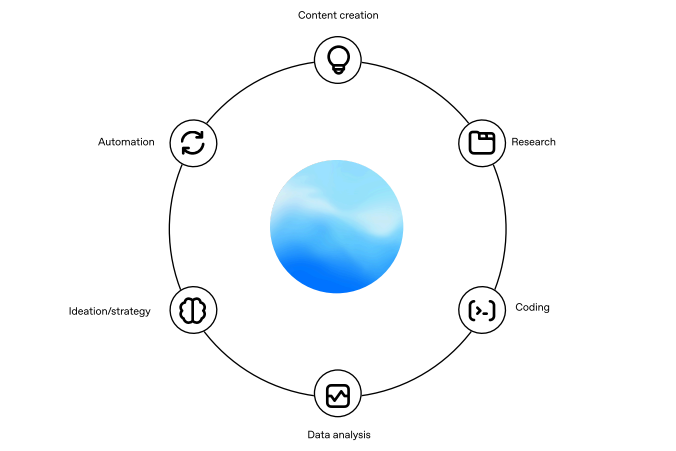
These six areas provide a good starting point for identifying the real value creation points of artificial intelligence in practice.
AI for businesses – practical implementations where artificial intelligence streamlines processes and services
Below are three concrete examples of how artificial intelligence is integrated into systems and everyday processes. In these solutions, artificial intelligence does not function as a separate tool, but as part of business logic and existing systems.
Case 1: Odoo AI order processor – from email straight to ERP
In many organisations, orders still arrive by email in various formats. The information must be interpreted, extracted and entered into the ERP system manually. This is time-consuming and prone to errors.
In our solution, an artificial intelligence agent reads incoming messages, identifies order details and converts them into a structured format. The user is shown a preview before saving, after which the information is automatically transferred to Odoo ERP as sales orders.
Artificial intelligence is used specifically for interpreting data. Business rules, validations and integrations are handled at the system level. The architecture is built in such a way that the same agent base can also be utilised in other Odoo processes, such as CRM, customer service and reporting.

Case 2: Spoken – from speech to structured text
The application developed for Spoken utilises OpenAI Whisper speech recognition as part of the customer’s own service.
When users submit speech material, it is processed in a customised system. Artificial intelligence converts speech into raw text and identifies, for example, changes in speakers. This serves as the basis for final products such as transcripts and subtitles.
Artificial intelligence speeds up the heavy basic stage, but the final quality is ensured by humans. This combines the speed of machines with human judgement. Customers can offer their own customers faster and more consistent service.
Case: AI security agent
Information related to information security is constantly being generated from a variety of sources. Monitoring new vulnerabilities and alerts requires experts to have the time and ability to separate the essential from the vast amount of information.
The AI security agent reads information from various sources, identifies relevant changes and compiles clear summaries of them. Reporting is done automatically, for example to Slack, giving experts an up-to-date overview of the situation without the need for constant manual monitoring.
The language model acts as an analytical layer here. It does not make decisions on your behalf, but helps you focus your attention on the observations that have the greatest impact on risk management.
When the possibilities of artificial intelligence are difficult to grasp, Hurjan AI Sandbox makes them visible.
For many organisations, the biggest challenge is not that they are not interested in utilising artificial intelligence. The challenge is that artificial intelligence can easily seem abstract. Where could it be used? What does AI look like in practice? And what is it capable of doing today?
That is why Hurja uses the AI Sandbox demo environment, where we present ready-made AI demos that solve real-life challenges. The demos illustrate how artificial intelligence:
- automates manual routines
- interprets documents in natural language
- analyses and summarises data
- makes recommendations at the right point in the user journey
- streamline internal processes and decision-making
AI Sandbox is a quick and concrete way to see, through various demos, what can already be built with artificial intelligence and what kinds of applications could also be found in your services.
Artificial intelligence security and ethical considerations and limitations
When companies adopt artificial intelligence technologies, it is critical to ensure that all solutions comply with strict data security and privacy standards. This includes processing data in secure environments and adhering to ethical guidelines to maintain customer trust and ensure transparency in business processes.
When integrating artificial intelligence into our customers’ applications, we ensure that all AI solutions comply with strict data security and privacy standards. Here you can read more about the AI Act (Artificial Intelligence Act), the European Union’s artificial intelligence regulation that governs the use of artificial intelligence in the EU.
There are also situations where AI may not be the most cost-effective or efficient solution. For example, specialised robotic systems may be a better option for large, complex production facilities where high precision and repeatability are required. In this case, technological integration, such as robotics, can offer greater benefits than artificial intelligence.
We help companies find the best ways to utilise artificial intelligence
We help companies find the best ways to utilise artificial intelligence in business development. At Hurja, we focus on solutions that provide genuine benefits in everyday life and support the company’s long-term goals.
Artificial intelligence delivers rapid benefits when:
- the use case is clear
- implementation fits into the process and systems
- information security and responsibilities have been modelled
- impact is measured, not just “tried out”
At Hurja, we help companies identify the potential of artificial intelligence and put it into practice. For example, our AI Sprint workshop helps you find the best ideas and applications where artificial intelligence really adds value, and implement solutions in a controlled manner. If you want to brainstorm where to start, we will go through the processes in a remote meeting and find the next practical steps.
Artificial intelligence (AI) refers to computer systems and algorithms that are capable of performing tasks that normally require human intelligence. AI is not a single solution but rather a collection of different technologies and methods. For companies, it is important to choose the right AI solution for different business needs.
Artificial intelligence (AI) refers to technologies and systems that can perform tasks that previously required human intelligence. Examples of such tasks include understanding and generating language, recognising images and speech, analysing data, and making predictions and recommendations.
In business use, AI is often based on machine learning, where the system learns to recognise patterns in data and improves its performance over time through experience. AI does not operate independently without guidance; instead, it uses the data, rules, and objectives provided to support decision-making and automate selected processes.
Functional AI refers to artificial intelligence that not only analyses information or generates content but also performs concrete actions based on predefined goals and rules. It combines decision-making, automation, and system integrations into practical operations.
Functional AI can, for example, interpret incoming data, select an appropriate course of action, and initiate the next step without separate human intervention. In companies, this often appears as AI agents that process orders, manage workflows, update systems, or support customer service as part of everyday processes. Its value comes from the seamless combination of analysis and action within the same system.
Shall we get started?
"*" indicates required fields