


AI agents as part of processes – how to get started?
In this article, we explain what artificial intelligence agents are, how they work in practice, and how they are utilised in production as part of business processes. We also provide concrete case examples and current solutions.
In recent years, the development of artificial intelligence in companies has progressed to a stage where the focus is shifting from individual tools to entire functional systems. There is increasing talk of artificial intelligence agents that are capable of performing tasks independently or semi-automatically as part of a company’s processes. Artificial intelligence agents combine large language models (LLMs), context, rules and integrations in a way that enables continuous operation without constant human guidance.
This development is no coincidence, but part of a broader evolution in artificial intelligence, in which language models have reached sufficient maturity to serve as the core of decision-making and interpretation even in more complex contexts.
- The stages of AI development in the background – why AI agents are on the rise now
- What does an artificial intelligence agent mean in practice?
- From single AI agents to multi-agent systems
- Swarm intelligence and distributed collaboration
- Orchestration makes agents producible
- How does an artificial intelligence agent work in practical processes?
- Personal AI agents and a step towards a truly functional “Siri”
- Why context determines the reliability of AI agents
- How to get started with AI agents
- Prioritisation, pilot projects and implementation in everyday life
- Case studies of AI agents in Hurja projects
- The benefits and limitations of AI agents in business use
- We assist companies in implementing artificial intelligence agents.
The stages of AI development in the background – why AI agents are on the rise now
OpenAI and other players in the field have described the development of artificial intelligence in stages. Understanding these stages helps to explain why agent-based artificial intelligence has become so topical right now.
In simple terms, the stages of development can be described as follows:
- Step 1: Conversation-based models
- The first chatbots were capable of understanding and producing natural language, but mainly functioned as individual question-and-answer tools.
- Large language models are already capable of human-level problem solving, understanding complex entities, and deeper reasoning.
- Step 3: Agents
- Artificial intelligence operates as part of the process. Artificial intelligence agents make observations, initiate actions, utilise integrations and respond to their environment within a limited operating framework. This phase is currently transitioning to large-scale production use in enterprise systems.
- Step 4: Innovators
- Agents participate in brainstorming, planning and solution development. They are able to combine information across individual tasks and support strategic thinking alongside people.
- Step 5: Organisations
- Artificial intelligence is capable of handling entire workflows and organisational functions through the collaboration of multiple agents, with humans acting in a guiding and supervisory role.
In business use, the focus is currently on phase three. Artificial intelligence agents have moved from trials to real-life processes, where they support everyday tasks and decision-making. At the same time, phase four features are already clearly visible in the development, such as the ability of agents to suggest alternative solutions and combine information from multiple sources. However, the large-scale utilisation of these capabilities is still based on controlled agent-based solutions.
What does an artificial intelligence agent mean in practice?
An artificial intelligence agent is a system that performs tasks independently in a predefined operating environment. It is not just a chatbot, but part of a larger entity in which artificial intelligence is linked to business rules, workflows and systems.
Typically, an artificial intelligence agent consists of the following components:
- a language model that interprets inputs and forms conclusions
- context and memory, which limit and guide behaviour
- rules and restrictions that define what an agent is allowed to do
- integrations through which the agent influences systems
- supervision and approval, which keep people involved in the process
The strength of AI Agent comes from the fact that these parts work together. The language model provides flexibility and understanding, while the structures ensure controllability and reliability.
From single AI agents to multi-agent systems
In complex situations, one artificial intelligence agent is not enough. In such cases, a multi-agent system is used, in which several agents work together.
In multi-agent systems:
- agents are assigned different roles
- the work is divided into smaller parts
- agents can transfer tasks to each other
- the whole process proceeds in a controlled manner from one stage to the next
This approach is particularly useful when the process combines interpretation, validation, integration and reporting.
Swarm intelligence and distributed collaboration
Swarm intelligence extends multi-agent thinking in a decentralized direction. It is based on the idea that several relatively simple artificial intelligence agents can together form an effective whole without centralized control.
The key features of swarm intelligence are:
- decentralised decision-making
- local rules and responsibilities
- high fault tolerance
- good scalability
In business systems, swarm intelligence provides a model for situations where the operating environment changes rapidly and the system must adapt to disturbances without manual control.

Orchestration makes agents producible
The number or intelligence of agents alone does not determine success. The decisive factor is orchestration, i.e. how the actions of agents are structured into a whole.
A well-designed orchestration defines:
- roles and responsibilities of agents
- workflow stages and transitions
- approval and review stages
- error handling
- the role of humans as part of the process
Orchestration resembles the predecessor model: agents handle operational work, while humans focus on supervision, exceptions and decisions.
Orchestrating AI agents in practice – examples from OpenAI and Anthropic
The same phenomenon can also be seen in the latest solutions from artificial intelligence providers. OpenAI presents a model on its Frontier platform in which agents act as digital co-workers: they have a shared context, clear access rights and limits, and the ability to learn through feedback. The aim is to move agents from individual pilots to become part of the organisation’s actual work.
In Anthropic’s Claude Code environment, this thinking is reflected in agent teams. One agent acts as a coordinator, dividing the work into parts and compiling the final result, while the other agents work in parallel in their own contexts. This model emphasises the importance of orchestration: without a clear division of labour and supervision, parallelism can easily increase complexity.
How does an artificial intelligence agent work in practical processes?
In practice, the agent’s actions often follow a recurring pattern:
- the agent receives input, such as a message, event or data
- the language model interprets the situation based on the given context
- the agent makes a conclusion or suggestion
- the specified function starts, such as data recording or reporting
- the result is recorded, reported or submitted for approval
Personal AI agents and a step towards a truly functional “Siri”
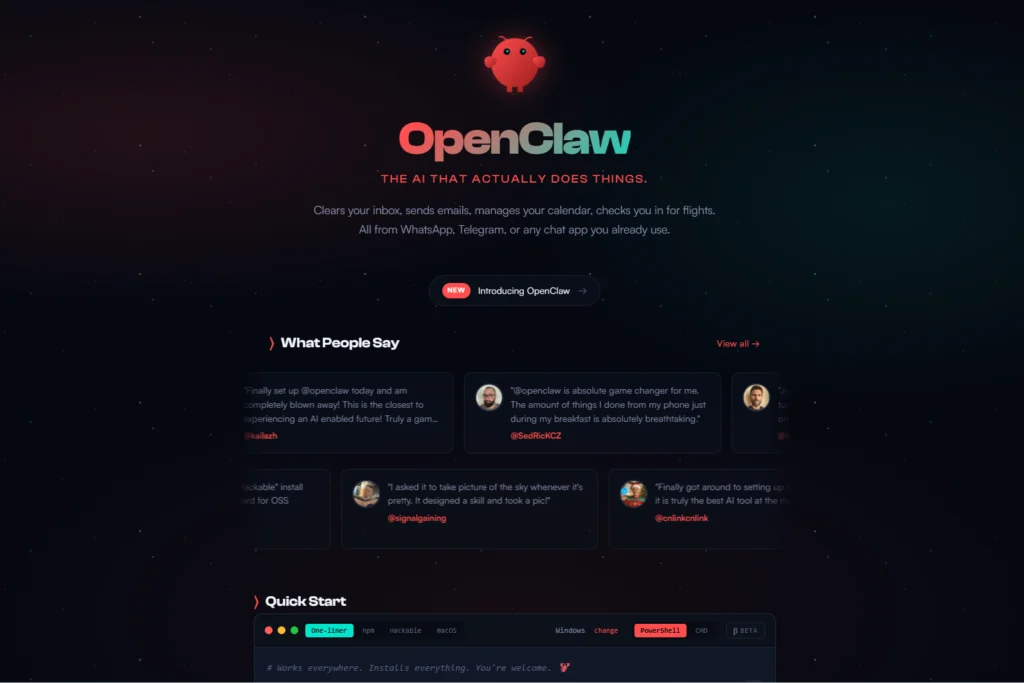
The same operating model can now also be seen in personal AI agents. In a solution such as OpenClaw, for example, the agent no longer waits for a single command but operates on a scheduled basis as part of everyday life. The agent can be programmed to check emails every morning at a specific time, identify relevant messages and prepare draft replies. The process follows the same logic as in enterprise systems: input, interpretation, action and monitored outcome.
Humans remain involved, particularly in exceptional situations, approval stages and monitoring. This makes AI agents safe to use even in critical processes and sets them apart from previous voice assistants. This is not a reactive question-and-answer model, but a functional agent that independently but controllably carries out agreed tasks.
Why context determines the reliability of AI agents
The operation of AI agents is strongly based on context engineering thinking. A simple prompt is not enough; a systematic way of defining what information the agent can rely on and how it can operate is needed.
Context engineering covers:
- task assignment and role description
- limiting the data used
- Permitted tools and integrations
- rule-based restrictions
- terms and conditions relating to data security and responsibility
When the context is carefully defined, the agent produces more consistent and reliable results. This is particularly evident in RAG solutions and multi-agent environments.
How to get started with AI agents
The implementation of artificial intelligence agents works best when built in stages as a whole that is directly linked to everyday processes. AI agents bring the most value to tasks where work progresses in clear stages and information moves between multiple systems or people.
Identify the appropriate starting points for artificial intelligence agents
Good starting signals for agent solutions include, for example:
- repetitive manual work that takes up experts’ time
- information that arrives in various forms (e-mail, attachments, documents)
- processes in which decision-making is slowed down due to fragmented material
- situations where the same work is done in parallel by different teams
In these cases, the AI agent can take responsibility for interpreting, pre-processing or preparing the information for the next stage.
Describe use cases before implementation
Once potential agent targets have been identified, it is advisable to describe them as use cases. Use cases help to structure the agent’s role and limitations even before technical implementation.
A well-described agent use case answers questions such as:
- at what point in the process does the agent operate
- what it does itself and what it leaves to humans
- what information it uses and from which sources
- when operations are suspended or require approval
Use case definition checklist
The table helps to ensure that each use case is defined with sufficient precision before implementation. Based on IBM’s Use case specification outline.
| Sub-area | Description and instructions | Questions to help you get started |
| Name of use case | Name the use case clearly. The name indicates the objective of the function or the visible end result. | What does the user do and what changes after successful completion? E.g. “Record maintenance work in the mobile application” or “Create an automatic order report”. |
| Brief description | Describe the role and purpose of the use case: why this function exists and what business need it serves. | Why is this function important? Whose problem does it solve? |
| The course of events | Present the main steps of the use case. Describe how the user and the system interact. Avoid details of the user interface and focus on what information is exchanged. | What does the user do first? What does the system respond? What information is transferred? |
| Basic travel | Describe the ideal situation, i.e. the basic process in which everything proceeds as planned. This is the case in which the system operates by default. | How does the process proceed when everything goes right? |
| Alternative costs | Describe any deviations or errors, such as incorrect input or missing information. | What happens if the user enters incorrect information? What if the connection is lost? |
| Special requirements | List non-functional requirements related to the use case, such as quality, security, performance, or regulatory factors. | Does the system have any specific performance or safety requirements? Do any laws or standards need to be taken into account? |
| Requirements | Describe the situation or conditions that must be in place before the use case can begin. | What needs to be done or ready before this process can begin? |
| After-conditions | Describe any states or results that the system may have after the end of the use case. | What changes in the system or what information is created when the process ends? |
| Extension points | Identify points where another use case relates to this one or continues from it. | Where does this use case link to other processes? E.g. “Recording a maintenance report” → “Starting invoicing”. |
Prioritisation, pilot projects and implementation in everyday life
It is not practical to implement all agent ideas at once. Prioritisation helps to select the first pilots in a controlled manner.
Use cases should be examined from the following perspectives, for example: impact, effort, data quality and risk level. Often, the best starting points are situations where the impact is clear and implementation can be limited to a pilot.
A limited pilot makes the agent’s role visible in the right context. During the pilot, the quality of interpretation can be tested, acceptance and control models can be verified, and the impact on everyday work can be assessed. When the agent operates reliably in a limited environment, expansion into production and new use cases is smooth.
In production use, agents begin to shift the focus of their work towards handling exceptions, checking and decision-making. Previously established limitations and management models support expansion and the construction of new agents on top of the existing foundation.
Case studies of AI agents in Hurja projects
Case: Odoo AI order processor
In many companies, customer orders still arrive by email as free-form messages, attachments or even images. Interpreting and entering orders into the ERP system takes time and is prone to errors.
In Hurja’s Odoo AI order processor, an artificial intelligence agent reads incoming emails, identifies order details and converts them into structured information. Before the information is saved, the user is offered a preview and approval, after which the order is automatically logged into the Odoo ERP system.
In this solution, the language model is responsible for interpreting data, while business rules, validations and integrations are clearly limited to the system level. This makes the whole solution producible and scalable.
Case: AI security agent
Information related to information security is constantly being generated from a variety of sources. Monitoring new vulnerabilities and alerts requires experts to have the time and ability to separate the essential from the vast amount of information.
The AI security agent reads information from various sources, identifies relevant changes and compiles clear summaries of them. Reporting is done automatically, for example to Slack, giving experts an up-to-date overview of the situation without the need for constant manual monitoring.
The language model acts as an analytical layer here. It does not make decisions on your behalf, but helps you focus your attention on the observations that have the greatest impact on risk management.
The benefits and limitations of AI agents in business use
The key benefits of AI agents include time savings in routine tasks, better utilisation of information, continuous operation and scalability. At the same time, it is important to recognise limitations, such as the importance of context, the impact of errors without supervision, and issues related to information security and responsibilities. A balanced approach makes agents a sustainable part of the overall system.
The key benefits of artificial intelligence agents are:
- time savings in routine tasks
- better use of information
- continuous operation without load
- scalability as processes grow
At the same time, it is important to recognise the limitations:
- quality depends on context and limitations
- the impact of errors is accentuated without supervision
- Information security and responsibilities require careful planning.
A balanced approach makes agents a sustainable part of the company’s overall system.
We assist companies in implementing artificial intelligence agents.
AI agents bring together large language models, integrations and business rules in a way that makes artificial intelligence an active part of everyday life.
We help companies identify processes where AI agents can bring real benefits and build solutions in a controlled manner into existing systems. We always approach AI agents from a business perspective and ensure that solutions are secure, scalable and practical.
When AI agents are built on business terms, they become a reliable part of everyday life and a clear competitive advantage. If you are wondering how AI agents could support your organization, we are happy to help you understand the big picture and turn your ideas into viable solutions.
Shall we get started?
"*" indicates required fields





 How can you get more out of Odoo ERP with AI?