
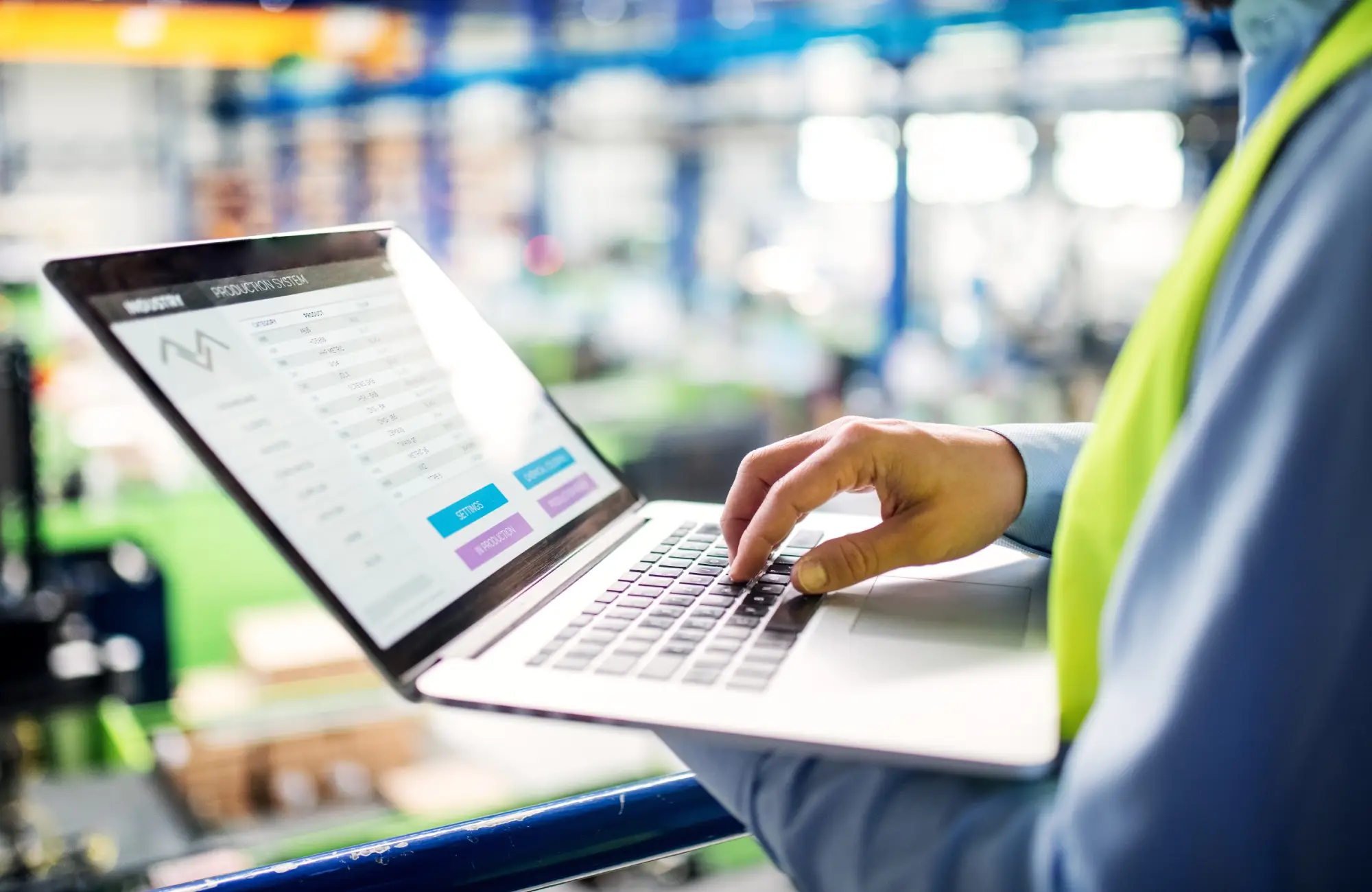
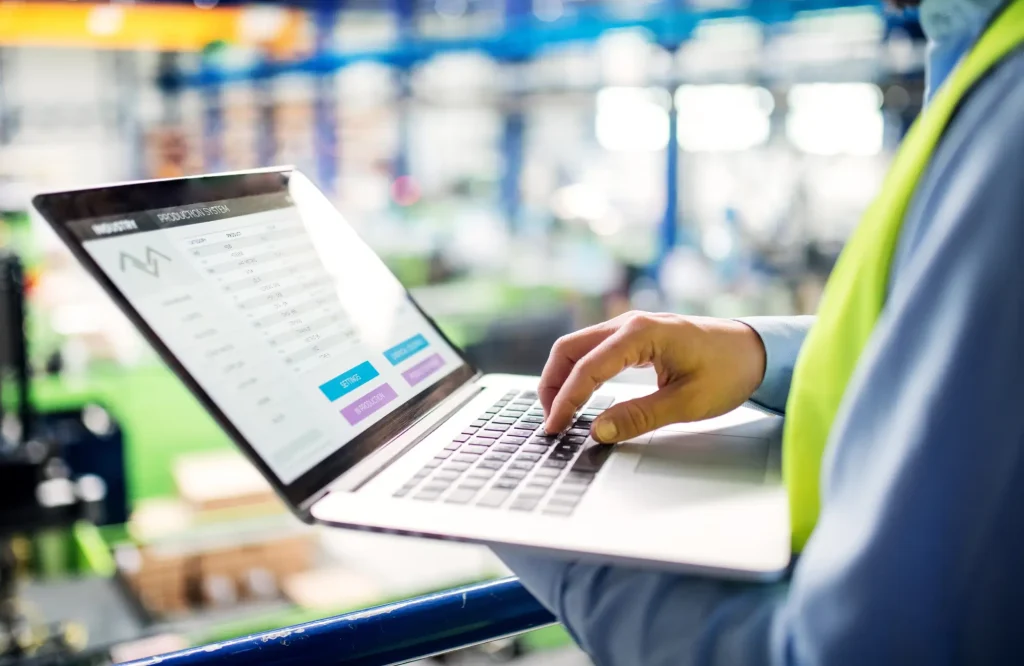
Digitalization of production management and reporting – efficiency and growth
In many companies, production management and reporting are still partly manual processes – often involving the use of Excel. The transfer of data between different systems is slow or goes completely unused, which causes delays in decision-making, makes it difficult to optimize resources and increases operational costs.
The digitalization of production management and the seamless integration of systems provide access to real-time data, automate processes and enable operations to be scaled up without creating additional administrative work. There are many ways to achieve digitalization – an enterprise resource planning (ERP) system is one option, but a solution could just as easily be standalone software designed for production monitoring, system integrations or an entirely new custom-built application that brings different systems together into a single platform.
- Real-time data improves production planning and reporting
- Integrations to ensure smooth production management
- Case: PetterSteel – digitalization of production management and reporting
- Artificial intelligence and analytics supporting the digitalization of production
- How could your production management benefit from digitalization?
Real-time data improves production planning and reporting
Without accurate and up-to-date information, it is difficult to manage production. Manual reporting processes cause delays, and it is not possible to optimize the use of resources effectively. By introducing digital tools into production management, a company can make full use of data and make better decisions, including from a cost perspective. Real-time data enables, for example, more accurate post-production calculations, which helps to identify material waste and overcapacity, and to achieve savings directly in labor and material costs.
The benefits of digitalizing production are undeniable:
- Real-time visibility into the production process and resource utilization
- Improved delivery reliability and more efficient capacity management
- Less manual reporting and minimization of errors
- Seamless flow of information between different systems
- More flexible production management and greater responsiveness to change
- The possibility of post-calculation and, as a result, tangible savings in material and labor costs
Integrations to ensure smooth production management
In industry, the flow of information between systems is a critical factor in terms of production efficiency and competitiveness. If data is scattered across different systems or transferred manually, this leads to delays, errors and extra work. Integrations enable different software programs and production control systems to work seamlessly together, allowing data to flow in real time and ensuring it is always available to support decision-making.
Although financial management is already integrated as part of the overall system in many ERP systems, the interaction between systems is not always seamless. When ERP is effectively integrated with, for example, supply chain management or customer relationship management, the overall picture of business operations becomes clearer and production planning can be optimized more precisely. Financial management integrations, whether within or outside the ERP system, enable, for example, automated invoicing and reduce the need for manual data entry. Industry-specific systems can also be integrated into production management, allowing data to flow directly from production to the order management system without unnecessary intermediate steps.
Integrations enable companies to achieve significant benefits:
- Less manual work: Automation reduces the need for manual data entry and data transfer between systems.
- Improved reporting and analytics: Real-time data from various systems enables more accurate monitoring of production and more effective decision-making.
- More efficient supply chain management: Material flows and stock management can be optimized more effectively when systems communicate with one another.
- Improved customer service: When information on orders, production status and delivery times is available to everyone, customer service becomes faster and more accurate.
- Predictive maintenance: IoT sensors and smart remote management, combined with ERP and production management systems, enable maintenance needs to be identified before production stoppages occur.
Integrations are not merely technical projects; they are solutions that are central to business development. They enable the automation of processes, reduce costs and ensure that production runs efficiently even as the business grows.
Case: PetterSteel – digitalization of production management and reporting
PetterSteel is a Finnish pioneer in the construction sheet metal industry that has invested heavily in digital tools. The company’s production management is steered by the PetterNet system, which comprehensively covers the business’s critical processes.
Our collaboration with PetterSteel began when their previous software development partner withdrew from the market. The company needed a reliable technology expert who could ensure the system’s maintenance and further development. We took over PetterNet and set about developing it further together, so that PetterSteel could streamline its operations.
Development measures:
- Implementation and further development of the ERP system
- Integrations with the Procountor financial management system and the industry-specific Bendex field system
- Development of automated invoicing
- Design and implementation of a new quotation tool
- Adding a monitoring tool to monitor system performance
Results:
- The decline in manual labor and automation
- Integrations and system development have significantly reduced manual work, sped up processes and reduced errors.
- Better decision-making with real-time data
- The management of work orders and work cards, together with the smooth flow of information between different systems, has enabled more precise resource management and a faster response.
- Business growth without additional resources
- PetterSteel has been able to manage its growing order volumes without having to expand the size of the organization.
- Continuous development and the expansion of automation
- The next objective is fully automated invoicing, which will further streamline operations and reduce administrative work.
Artificial intelligence and analytics supporting the digitalization of production
Artificial intelligence and analytics bring a new level of predictability and efficiency to production management. Real-time data analysis helps to identify production bottlenecks, optimize resource utilization and reduce errors without compromising quality.
Predictive maintenance is one of the greatest benefits of artificial intelligence. For example, Stockholm Exergi uses Caverion Intelligence’s Anomaly Detection solution, which analyzes thousands of signals and detects anomalies using machine learning. This helps to prevent unplanned production downtime and optimizes the plant’s performance.
Bosch has utilized artificial intelligence in quality control for the real-time monitoring of production processes, which has improved the quality of its end products and reduced the risk of product recalls.
Siemens has developed artificial intelligence solutions for optimizing energy efficiency, which can be used to reduce energy consumption in factories and cut carbon dioxide emissions. Gebwell’s G-Power® Smart district heating distribution center also utilizes artificial intelligence to optimize heating in buildings based on real-time weather and environmental data.
When analytics and artificial intelligence are integrated into production management, companies can make better decisions, increase flexibility and ensure that production runs optimally in all circumstances.
How could your production management benefit from digitalization?
At Hurja, we develop systems that support companies’ digitalization and help them streamline their production. We build software solutions and integrations, and take over existing systems, so that your company can focus on growth and improving its competitiveness.
Among other things, we do the following:
- Custom-built production management systems
- Development and maintenance of existing ERP systems
- Integrations with systems such as financial management, customer relationship management and supply chain systems, among others
- AI-based solutions for production optimization
- Systems that support real-time reporting and data-driven management
Digital solutions are not merely technical investments; they are a means of ensuring a company’s efficiency and competitiveness in the future. Do you want to get rid of manual processes and information trapped in silos? Or, for example, do you want to move away from Excel and automate reporting in real time?
Get in touch, and we’ll design a solution tailored to support your business!
Ready to get started?
"*" indicates required fields

You might also like these articles

AI-enhanced system modernization brings speed and cost efficiency
Read more
Digital quality assurance in industry – less paper, more transparency
Read more
Smart remote management in industry – up to 30% savings on maintenance
Read more
Digitalization of production management and reporting – efficiency and growth
Read more
 Digital quality assurance in industry