


Good software isn’t created by chance – a service design workshop can help
Why is a service design workshop the best way to spend your time before starting software development? Larger software development projects, where a completely new solution is being built, usually involve significant investments – in terms of time, money and resources. Yet all too often, software projects are launched without a sufficient understanding of what users really need and how business objectives will be achieved.
Indeed, the biggest pitfalls in software development projects often stem from a failure to take sufficient account of the user experience or business objectives at the start of the design phase. This can lead to uncertainty, unnecessary iterations and, at worst, project failure.
Investing time in a service design workshop right at the very start offers a solution to this problem. The workshop clarifies ideas and objectives, produces concrete prototypes, enables ideas to be tested quickly and ensures that development work is on the right track from the very start. In addition, the ideas themselves become clearer. Many people may have a somewhat vague notion of a digital service or functionality, but it only crystallizes into a clear whole during the workshop. After the workshop, it is easier to grasp the idea and take it forward.
Furthermore, prototypes created through service design can play a key role in securing funding. When your idea is transformed into a tangible prototype, it becomes easier for investors and funders to understand. A prototype can demonstrate not only the technical and visual features of the product, but also the value it brings to the business and end users. This makes your project more credible and sets it apart from the competition – which can be decisive when it comes to funding decisions.
- Service design workshops are always tailored to your needs
- Define your objectives clearly – you’ll save time and money even before you write your first line of code
- What if the aim is to improve an existing service?
- A practical process that delivers results
- Why is this effective?
- How can service design save you thousands of euros on your software development project?
- An example of the costs of rectifying errors, based on the study
- What does this mean in practice?
- Now you know why a service design workshop is the best way to spend your time
Service design workshops are always tailored to your needs
As every project is unique, here at Hurja we do not run service design workshops using a one-size-fits-all approach. The content and structure of each workshop are always tailored to the client’s needs. Sometimes this may involve mapping out detailed user journeys; at other times, it may involve assessing technical feasibility or exploring the potential of artificial intelligence. Our clients often find that an outside perspective and the challenge to their ideas are beneficial in service design workshops.
For some clients, it has been particularly important to be able to discuss matters with experts or external parties who can challenge their own thinking and offer new perspectives. This helps to refine an idea into something even better, as issues are examined from a variety of angles and perspectives. There’s no need to bang your head against a brick wall on your own; instead, by working together, we can find new solutions and gain clarity.
A few clients have in fact said that, before the workshop, their thoughts on the subject were ‘a bit stuck’. However, the workshop provided a much-needed boost and a fresh sense of enthusiasm, as things became clearer and a concrete direction for solutions emerged.
One of the most popular methods is the Design Sprint, a five-day intensive process in which an idea is developed into a concrete prototype and tested with users. The Design Sprint is an excellent way to quickly gain clarity and obtain tested results, which without the Design Sprint could take months to achieve.

However, not all projects require a five-day sprint. Service design workshops can be organized on different scales and with different focuses – from mapping out user journeys to assessing technical feasibility. In such cases, any prototype development can be agreed upon separately once the specifications have been finalized. We always select the methods and approaches based on what will deliver the greatest added value for your specific project.
Define your objectives clearly – you’ll save time and money even before you write your first line of code
The greatest value of a service design workshop lies in its ability to bring all key stakeholders together around the same table to tackle real problems. Objectives, pain points in the user experience and business priorities are clarified through collaboration. Rather than spending time in development work guessing at users’ needs or business objectives – which would lead to unclear planning or misunderstandings – the workshop helps to establish a shared understanding of the project’s objectives.
What’s the benefit of this?
- You minimize guesswork: Objectives and priorities are clearly defined, so the development team knows exactly what is being aimed for.
- You build a shared understanding: The workshop brings together the business, the development team and end users behind a common goal.
- You save resources: Problems and unrealistic ideas are weeded out before time and money are spent on them.
What if the aim is to improve an existing service?
A service design workshop is not just a tool for new projects – it is also an effective tool for analyzing and improving existing services. User feedback and data reveal where the pain points lie, and the workshop can help you find solutions to them before the problems turn into major obstacles. This ensures that your current services better meet users’ needs and support your business objectives.
A practical process that delivers results
A service design workshop is not just a discussion – it is a step-by-step process that produces clear results. During the workshop, ideas are refined into workable concepts and, if you wish, into prototypes, so that their functionality can be tested with real users. This not only reduces the risks associated with the project, but also helps to identify what should be prioritized within the project.
Whether it’s a question of developing new software or improving an existing service, a service design workshop offers a clear and systematic way to tackle challenges. Improvements can be planned and tested before implementation, which saves time and money – and, most importantly, ensures that the service meets users’ expectations.
The content of a service design workshop is always tailored to the objectives.
What might happen during the workshop and afterwards, for example?
- Problem definition: Let’s clarify what we want to solve and for whom. This stage ensures that the development work focuses on the right issues.
- Mapping out user journeys: We define how users navigate the service and how the service meets their needs. In addition to user journeys, this stage also involves examining the service’s functionalities in detail. What should the user be able to do, and where? What happens at each stage? These considerations are used to design the service’s navigation paths and ensure that the user experience is smooth and clear in all usage scenarios.
- Brainstorming and prioritization: We brainstorm solutions and select the most important areas for development from among them. We assess the feasibility of the ideas and their value to the business.
- Creating a prototype: Following the workshop, a concrete, visual prototype will be created and tested with users.
- Testing: The prototype is tested with real users, and the feedback received guides the next steps.
- Iteration and next steps: Based on user feedback, the solutions will be improved and the next stages of development will be planned.
Why is this effective?
During the workshop, all the key elements of the project – user experience, business objectives and technical feasibility – are brought together. This provides a clear direction and certainty for the next stages of the project. Furthermore, at Hurja, alongside the UI/UX designer, we usually have a technical expert – that is, one or more software developers – on hand so that we can immediately assess the feasibility of the proposed solutions. The developer contributes their perspective on which solutions make technical sense and what risks or challenges are worth being aware of.
In the case of further development of an existing client’s service, a developer who is already familiar with the client’s project and environments is usually involved. This is a major advantage, as this familiarity enables work to progress more quickly and reduces misunderstandings.
How can service design save you thousands of euros on your software development project?
Service design can be used to identify and rectify potential errors in a software project as early as the design phase, which can lead to significant cost savings.
According to an IBM study, the further development progresses, the significantly more it costs to rectify errors. In a service design workshop, these pitfalls can be identified before software development even begins, which saves a significant amount of money.
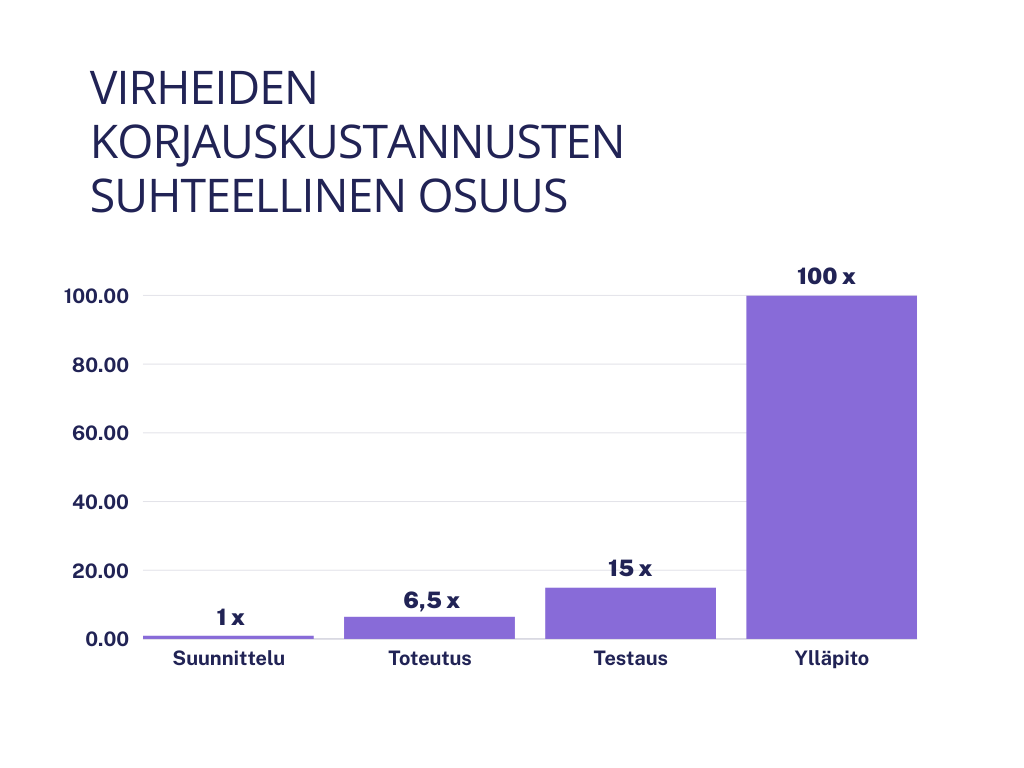
An example of the costs of rectifying errors, based on the study
Correcting errors therefore becomes more expensive the further the project progresses. Here is a concrete example of the costs:
- Correcting an error at the design stage costs around €1,000.
- During the implementation phase, correcting the same error will cost as much as €6,500.
- During the testing phase, costs will rise to 15,000 euros.
- During the maintenance phase, repair costs can run to as much as €100,000.
What does this mean in practice?
A service design workshop helps to identify potential pitfalls even before the design of the application has begun. This prevents problems from carrying over into the implementation or maintenance phases, where rectifying them would be considerably more expensive. The following calculation illustrates the significant savings this can bring.
A hypothetical example showing how service design can help avoid pitfalls
Without a workshop:
A number of critical issues may arise during the project which are only identified during the development phase:
- One problem during the implementation phase: €6,500
- Two problems during the testing phase: 2 x €15,000
- One problem during the maintenance phase: €100,000
Total costs:
€6,500 + €30,000 + €100,000 = €136,500
A project launched through a service design workshop:
The workshop identifies potential pitfalls and resolves them before the design and development of the application begins:
- Four problems are resolved at the design stage, which means more time is spent on the design work: 4 × 1,000 € = 4,000 €
- Cost of the workshop: €5,000 (indicative estimate)
Total cost:
€4,000 (resolving pitfalls) + €5,000 (workshop) = €9,000
Savings achieved through
the service design workshop: €136,500 (without the workshop) – €9,000 (with the workshop) = €127,500
A service design workshop is therefore a small investment that pays for itself many times over, as it helps to:
- To prevent errors that would otherwise result in significant additional costs.
- To speed up the development process when the objectives and plans are clear from the outset.
- To improve the quality of the project and the user experience, as any pitfalls are identified and resolved at an early stage.
Now you know why a service design workshop is the best way to spend your time
By taking the time to attend a service design workshop before starting software development, you’re doing yourself, your team and your project a favor. The workshop is where visions take shape, ideas are tested and objectives are clarified. It creates a solid foundation upon which the entire development process is built – clear objectives, concrete prototypes and solutions based on user feedback make the project run much more smoothly.
The benefits are therefore not limited to saving time. Service design ensures that you focus on the right things and get them right from the outset. Investing in a service design workshop helps you avoid guesswork, unnecessary tweaking and the wrong choices. This is a smart way of working – goal-oriented, efficient and transparent.
Ready to successfully bring a new idea to fruition or improve an existing service? Get in touch and let’s set your project on the right track right from the start!
Shall we get started?
"*" indicates required fields




 Hurja has been awarded the carbon neutrality symbol by Koodia Suomesta ry