


Hurja’s sustainability work progressed to carbon footprint calculation
Our sustainability work is progressing, and we have calculated Hurja’s carbon footprint with the help of Carbon Wise Oy. The first step towards carbon neutrality has now been taken. The next stage in the environmental responsibility aspect of our sustainability work involves reducing emissions and identifying and selecting offset projects.
Our vision: meaningful code that meets the demands of a changing world
We have selected three UN Sustainable Development Goals as the focus areas of Hurja’s sustainability program, which we are committed to promoting through our operations. The UN Sustainable Development Goals we have chosen are: decent work and economic growth, reduced inequalities, and climate action. Hurja’s aim is both to promote the achievement of these goals and to reduce their associated negative impacts. The goals selected for the sustainability program cover the dimensions of social, economic and environmental responsibility.
Responsibility is a key part of Hurja’s strategy. Our vision is to create meaningful code, and our mission is to provide a head start in a changing world. Meaningfulness in our vision encompasses the concept of responsibility. At Hurja, responsibility means that we strive to ensure every employee feels their work is meaningful, while we aim to code positive change into the world. In other words, we create code that matters today and tomorrow.
The climate and environmental impacts of the ICT sector globally
According to the Finnish Transport and Communications Agency’s climate and environmental strategy for the ICT sector, various sources indicate that the ICT sector accounts for between approximately 4 and 10 per cent of global electricity consumption, while its greenhouse gas emissions amount to around 3–5 per cent. The level of emissions varies depending on the sources of electricity generation used. Therefore, even in the ICT sector, we cannot shirk our responsibility for our impact on the global climate and environment.
The strategy for promoting climate- and environmentally-friendly ICT infrastructure outlines, among other things, the development and use of energy-efficient solutions and the utilization of carbon-free electricity sources. The proposed measures also include utilizing waste heat and taking environmental considerations into account in network construction and the promotion of shared use. To promote the climate and environmental friendliness of the data economy, it is recommended that greater consideration be given to energy aspects in the design and procurement of software and services, and that climate- and environmentally-friendly ICT solutions be developed.
To promote the sustainability of material flows and the circular economy, it is proposed to extend the service life of equipment, improve the efficiency of its collection and recycling, and promote the use of sustainable primary materials. To expand the knowledge base and improve measurement, it is proposed to improve the monitoring of energy consumption in data centres and networks. One proposed measure is also to increase knowledge regarding the sustainability of material flows in the ICT sector and the life-cycle impacts of digital solutions.
To raise consumer awareness and improve their knowledge, it is recommended that efforts be made to raise awareness of the environmental impact of ICT services and to improve skills in the use of climate-friendly devices. To harness emerging technologies and address the challenges they present, the policy outlines a need to increase understanding of the climate and environmental impacts of emerging technologies, as well as to enhance the potential for the ecologically sustainable use of these technologies and their applications.
What does Hurja’s carbon footprint consist of, and what are we doing to reduce its negative impact?
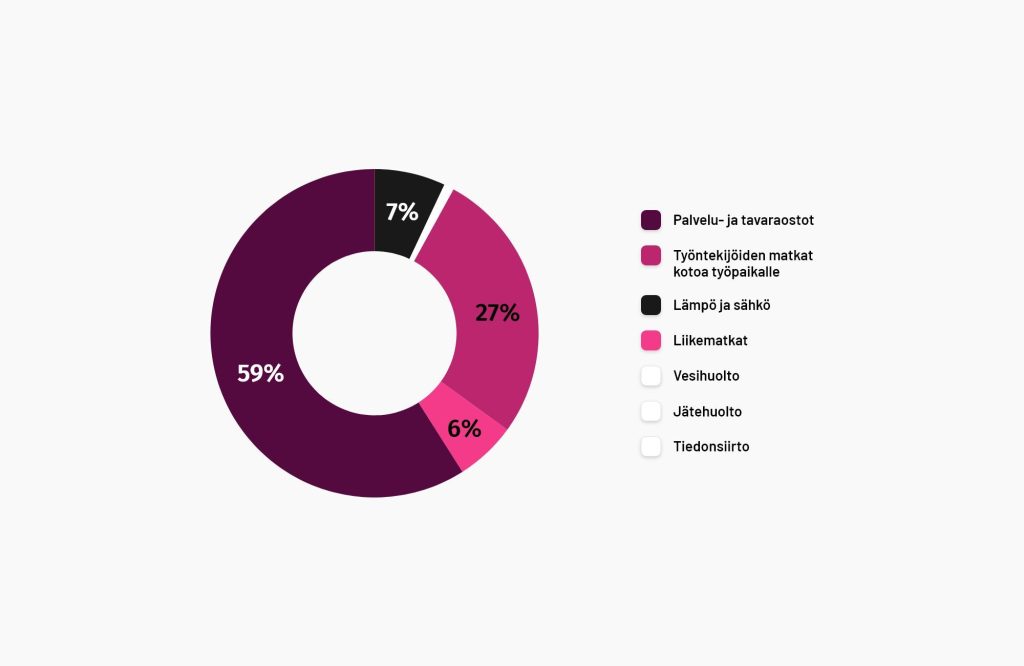
Hurja’s carbon footprint in 2023 was approximately 39,600 kilograms of carbon dioxide equivalent (CO2eq). The calculation took into account Hurja’s energy consumption, water and waste management, business travel, employees’ commutes to and from work, data transfer and server usage, as well as purchased services.
Purchased services accounted for the largest share of emissions, making up 60% of the carbon footprint. Another significant source of emissions was employees’ commutes to work (27%). Other sources of emissions had a smaller impact on total emissions. Heating and electricity emissions accounted for 7% and business travel for 6%. Waste management, data transmission and water supply together accounted for less than 1% of the total carbon footprint.
Towards a smaller carbon footprint and climate action
The next step in Hurja’s sustainability work, specifically in the area of environmental responsibility, is to reduce emissions and to identify and select offset projects. To reduce Hurja’s climate impact, we are, for example, exploring the possibility of centralizing service procurement with low-emission suppliers. We are also looking for ways to encourage employees to use low-emission transport. At present, remote working is already possible whenever the nature of the work allows.
For Hurja, the most significant opportunities to reduce its own direct emissions relate to business travel, particularly hotel accommodation, the use of diesel vehicles and air travel. Although these emissions account for a relatively small proportion of total emissions, by choosing lower-emission travel options and utilizing accommodation services committed to reducing emissions, we can still steer Hurja’s operations towards a more environmentally friendly direction and thus contribute to the ‘climate actions’ target of our sustainability program.
Hurja’s sustainability work is still in its early stages, but in addition to our environmental responsibilities, we have also taken steps to fulfil our social and economic responsibilities in areas such as digital equality, data security and corporate governance. We will be sharing more information on these topics, among others, at a later date.
Line by line, towards greater impact and a more sustainable future – meaningful code to meet the demands of a changing world!
Shall we get started?
"*" indicates required fields

You might also like these articles

Hurja Solutions’s corporate social responsibility program has been published
Read more
Hurja published a VSME-compliant sustainability report
Read more

Hurja has been awarded the carbon neutrality symbol by Koodia Suomesta ry
Read more

Carbon footprint offsetting and other climate initiatives at Hurja in 2024
Read more
 Hurja Solutions Oy’s board of directors has been confirmed