


Cloud service models: PaaS, IaaS, BaaS and SaaS
Cloud services have revolutionized the way in which companies develop, use and manage their IT infrastructure. Nowadays, businesses have the opportunity to utilize various cloud service models in software development, which offer flexibility, scalability and cost-effectiveness. The three key cloud service models are PaaS (Platform as a Service), IaaS (Infrastructure as a Service) and SaaS (Software as a Service). In addition, BaaS (Backend as a Service) has become increasingly common, particularly in the development of mobile and web applications.
In this blog post, we’ll look at the different cloud service models and how they differ, as well as how leading cloud service providers such as Amazon Web Services (AWS), Microsoft Azure and Google Cloud Platform (GCP) fit into these models. By understanding the strengths and distinctive features of these providers, businesses can make informed decisions about which platform best suits their business needs and software development projects. This knowledge will help you choose the cloud service solution best suited to your specific project and make the most of the benefits it offers.
- The cloud service models PaaS, IaaS, BaaS and SaaS offer a range of solutions to meet businesses’ needs
- Customer story: The cloud-based MyAllas service enables Allas Pools members to enjoy a better digital customer experience.
- Choosing the right service model
- A comparison of Amazon Web Services, Azure and Google Cloud
- Amazon Web Services (AWS), Microsoft Azure and Google Cloud Platform (GCP) services, categorized by service model
- Cloud services are essential for businesses that want to remain competitive
The cloud service models PaaS, IaaS, BaaS and SaaS offer a range of solutions to meet businesses’ needs
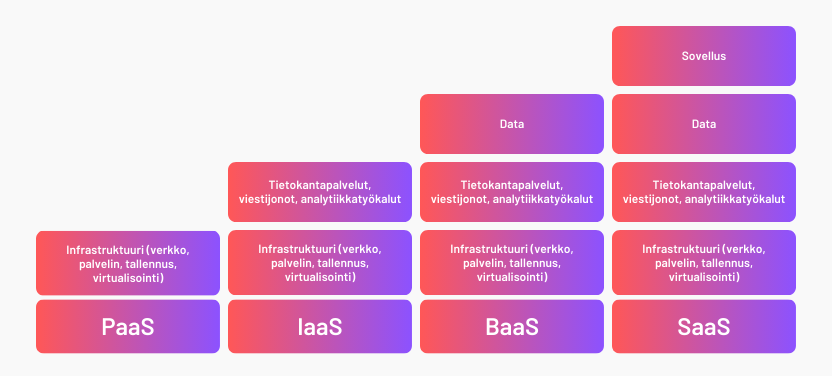
The main cloud service models are PaaS (Platform as a Service), IaaS (Infrastructure as a Service), BaaS (Backend as a Service) and SaaS (Software as a Service). These service models offer a range of solutions to meet businesses’ needs, simplifying the management of IT infrastructure and improving cost-effectiveness.
- PaaS (Platform as a Service) provides a platform that enables developers to build, test and run applications without having to manage the underlying infrastructure. PaaS services provide development tools, databases and server environments designed to facilitate application development. Well-known PaaS services include, for example, Google App Engine and Microsoft SQL Azure. PaaS speeds up application development and enables scalability, as developers can focus on writing code and innovating rather than having to manage server environments.
- IaaS (Infrastructure as a Service) is a cloud service model in which customers can rent IT infrastructure, such as virtual machines, storage space and network resources, according to their needs. IaaS services offer flexibility and scalability, as customers only pay for the resources they use. This reduces the need to invest in their own servers and hardware. Examples of IaaS providers include Amazon Web Services (AWS), Microsoft Azure and Google Cloud Platform (GCP). IaaS enables businesses to gain rapid and cost-effective access to a comprehensive IT infrastructure that can expand or contract in line with business needs.
- BaaS (Backend as a Service) is a service model in which pre-built backend services are provided and managed as a cloud service. Customers can access these backend services via the internet without having to build and maintain them on their own servers. This service model is specifically designed to facilitate the development of mobile and web applications by providing, for example, database management, user authentication and push notifications as ready-made solutions. Examples of BaaS solutions include Firebase and Supabase. BaaS enables developers to focus on developing the front-end of the application, while the complexity and management of the back-end systems are outsourced to the service provider. This speeds up the development process and significantly reduces development costs and time.
- SaaS (Software as a Service) is a service model in which software is delivered and managed as a cloud service. Customers can access the software via the internet without having to install or maintain it on their own devices. This service model is used for off-the-shelf software. Examples of SaaS solutions include email services such as Gmail and business applications such as HubSpot. SaaS enables rapid deployment and reduces the burden on the IT department, as the service provider takes care of all maintenance, updates and security.
We do not offer off-the-shelf software to Hurja, but our range of services does include, for example, integrations with such software.

Customer story: The cloud-based MyAllas service enables Allas Pools members to enjoy a better digital customer experience.
We built a cloud-based IT infrastructure on Amazon Web Services (AWS) to meet Nordic Urban’s needs. Using AWS enables resources to be scaled as required and ensures a flexible IT environment. The infrastructure built using AWS not only meets current needs but also provides a solid foundation for future growth and the development of new systems. Find out more about MyAllas!
Choosing the right service model
When starting a new software project, one of the things to consider is whether it makes more sense to build the system on top of PaaS (Platform as a Service), IaaS (Infrastructure as a Service) or BaaS (Backend as a Service).
PaaS is well suited to clearly defined systems, such as web interfaces and their back-end systems. PaaS enables rapid deployment and makes efficient use of the service provider’s capacity, often offering the best combination of benefits, cost-effectiveness and quality.
IaaS, on the other hand, is suitable for solutions that do not require a rapid response to changes and where vendor independence is important. IaaS offers greater freedom and flexibility in the use of resources, which can be a decisive factor in more complex projects. It is also possible to combine PaaS and IaaS into a hybrid model. For example, the system’s user interface could run on PaaS while the back-end system runs on IaaS. This approach can offer the best of both worlds, particularly when the database seamlessly integrates both components.
BaaS offers pre-built backend services, particularly for mobileand web application developers, reducing the complexity of the backend system. This model is well suited to situations where there is a need to quickly develop applications for various business needs, even without programming skills.
PaaS solutions are currently popular, as they are a highly effective way of utilizing cloud services. At Hurja, we actively use this model, as these services enable a rapid development cycle and greater cost-effectiveness. This makes PaaS solutions an attractive option for many companies and projects.
A comparison of Amazon Web Services, Azure and Google Cloud
In software development, the choice of cloud services can be a decisive factor in the success of a project. Amazon Web Services (AWS), Microsoft Azure and Google Cloud Platform (GCP) are the three leading platforms, each with its own strengths and areas of specialization. In this section, we’ll look at the features offered by each platform and how they differ from one another in terms of use cases and infrastructure.
All three major cloud service providers offer a wide range of services covering all the cloud service models we mentioned earlier. This versatility enables businesses to choose the solutions best suited to their needs and to take advantage of the benefits offered by cloud services, such as flexibility, scalability and cost-effectiveness.
- Amazon Web Services (AWS)
- Amazon Web Services (AWS) is the market’s oldest and most comprehensive cloud computing platform, offering over 200 fully managed services. AWS’s range of services covers everything from computing power and databases to machine learning and IoT solutions. Its strengths include an extremely wide range of services, in-depth documentation and a robust security framework, making it a reliable choice for a wide variety of businesses and applications.
- AWS is particularly well suited to large enterprises and technology-driven start-ups that require versatile and scalable cloud services. It is an excellent choice when extensive international coverage and high performance are required, such as for maintaining global web services and large, data-intensive applications.
- Microsoft Azure
- Microsoft Azure stands out in the market, particularly thanks to its solutions designed for business use. Its ability to integrate seamlessly with existing Microsoft products makes it the ideal choice for businesses that have already invested in the Microsoft ecosystem. Azure offers extensive support for a wide range of programming languages and technologies and provides a highly reliable option for those seeking hybrid cloud solutions.
- Azure is particularly popular among large enterprises that require robust support for business applications such as SAP and other ERP systems. Its ability to integrate seamlessly with other Microsoft services, such as Office 365 and SharePoint, makes it an excellent choice for organizations that require close collaboration and information sharing.
- Google Cloud Platform (GCP)
- Google Cloud Platform (GCP) stands out in the market, particularly in the fields of data analytics, machine learning and container technologies. The services it offers, such as BigQuery for analytics and TensorFlow for machine learning, are at the forefront of the industry. GCP offers competitive pricing for processing large volumes of data, as well as innovative technological solutions, such as Kubernetes for container management, which provide attractive benefits for technology-focused companies.
- GCP is the ideal choice for companies that are strongly focused on data and analytics and require advanced machine learning models. It is also a popular choice among technology companies developing next-generation applications and services, such as mobile apps and gaming platforms, by leveraging Google’s robust infrastructure and scalable services.
Amazon Web Services (AWS), Microsoft Azure and Google Cloud Platform (GCP) services, categorized by service model
IaaS (Infrastructure as a Service)
- AWS EC2 (Elastic Compute Cloud): AWS offers scalable computing capacity that can be tailored to a company’s needs without the need for significant initial investment in hardware.
- Azure Virtual Machines: Azure offers virtual machines that support a wide range of operating systems and configurations to suit a variety of needs.
- GCP Compute Engine: GCP Compute Engine provides scalable virtual machines that support a variety of computing needs and workloads.
PaaS (Platform as a Service)
- AWS Elastic Beanstalk: This service enables you to deploy and manage applications without having to worry about managing the infrastructure.
- Azure App Service: Azure App Service provides a platform for developing and maintaining web and mobile applications quickly and easily.
- GCP Google App Engine: Google App Engine helps developers build and run applications on Google’s infrastructure, enabling rapid scalability and reliability.
BaaS (Backend as a Service)
- AWS Amplify: AWS Amplify provides developers with ready-to-use backend services, such as authentication and database management, which make it easier to develop mobile and web applications.
- Azure Mobile Apps: Azure offers services for mobile app development that simplify the management of the back-end system.
- Firebase (GCP): Firebase is Google’s BaaS solution, which provides real-time databases, authentication and push notifications for the development of mobile and web applications.
SaaS (Software as a Service)
- AWS WorkSpaces: AWS provides virtual desktops that allow users to access applications and files from anywhere.
- Microsoft Office 365: Office 365 is Microsoft’s comprehensive suite of office tools, available as a cloud service, which enables collaboration and improves productivity.
- Google Workspace: Google Workspace offers a range of productivity applications, such as Gmail and Google Drive, which support effective collaboration and information sharing.
These service providers cover all the key cloud service models and offer businesses flexible and efficient solutions for managing IT infrastructure and developing applications.
Cloud services are essential for businesses that want to remain competitive
The integration of cloud services into software development processes is now a necessity for companies that wish to remain competitive and innovative in the digital environment. Platforms such as AWS, Azure and Google Cloud offer powerful solutions that not only speed up development processes but also improve the reliability, security and scalability of applications. Choosing the right cloud platform enables companies to reap the full benefits of the technology, accelerating innovation and strengthening their market position.
Although the differences between cloud services are minor, each service and service model has its own distinctive features and strengths. Understanding these differences is important when looking for the most suitable solution for a particular project. Major cloud service providers offer a comprehensive range of solutions, but it is crucial to evaluate services on a case-by-case basis, as the details can have a significant impact on the end result.
At Hurja, we’re always on hand to help you choose the technologies and methods best suited to your project, which will help you achieve your business objectives. If you’re looking for an expert software development service, don’t hesitate to get in touch with us!
Shall we get started?
"*" indicates required fields




 What is a cloud service?