


An app that adds value – 5 success stories
An application, or app, is a computer program that helps the user carry out a specific task.
Nowadays, a company’s growth and competitiveness are not based solely on its products or services, but also on how efficiently information and processes flow. Many companies have realized that the solution lies in their own digital tool, tailored to their needs – an application that makes work easier and improves the customer experience.
An app is not just about technology. It is a way of solving problems and building better practices. When digital solutions are designed correctly, they become strategic investments: they improve productivity and the customer experience, reduce manual work and help you stand out from the competition
What is an app?
An app is a piece of software that users run on a mobile device, in a web browser or on a computer. It could be an online store, a booking system, an educational platform or a mobile payment app. They all have one thing in common: they make it quicker and easier to carry out tasks digitally.
From the user’s perspective, an application is a user interface, but behind the scenes there is often an extensive software architecture that handles the storage, sharing and integration of data with other systems. All applications are therefore also software; they simply appear more tangible to the user.
- What is an app?
- Various application options and technologies
- How do applications support business growth?
- How does Hurja develop apps?
- 5 successful applications
- FaceImage – A mobile app that brings beauty treatments into everyday life
- Taxi1 – A mobile app designed to deliver a first-class taxi experience
- University of Oulu – OV-info to support changes in ownership
- Finspection – digitizing industrial inspection processes
- Our Shared Saimaa Ringed Seal: the LIFE – AR app in support of nature conservation
- Apps are more than just code
- When digitalization becomes part of everyday life, it creates real value
Various application options and technologies
The type of application and the technology used are chosen based on the desired user experience and functionality. Sometimes a browser-based tool is needed that works on all devices; at other times, a mobile app is required that makes the most of the phone’s features and works even when offline. The most important thing is to find a solution that serves the user seamlessly and supports the business’s objectives.
| Application type | Description and intended use | Benefits and features |
| Web application | Works in a web browser without the need for a separate installation. Users can access the app on any device with an internet connection. | Quick and cost-effective to develop, works on a range of devices and is easy to maintain. Well suited to services that do not require the performance of a native app. |
| Cross-platform application | We’ll build it using a single codebase, for example using React Native or Flutter, and release it for both iOS and Android devices. | Enables applications to be developed for multiple platforms from the same source code. Reduces development time and lowers overall costs. |
| Hybrid application | Combines the features of web and mobile apps. Distribution takes place via app stores such as the App Store or Google Play. | Quick to develop and maintain, it works on multiple platforms and makes use of mobile device features such as the camera and GPS. |
| Mobile app (native) | We build directly for a specific platform, such as Android or iOS. | Offers the best performance and the deepest integration with the device’s features. Suitable for long-term, demanding applications and helps to engage users. |
| XR and AR applications | They use augmented and mixed reality on mobile devices or AR glasses. | They enable interaction between the real and virtual environments. They are suitable, for example, for training, maintenance work or experiential marketing. |
How do applications support business growth?
A company’s competitiveness depends increasingly on how well it is able to use digital solutions. When information flow, processes and customer service work seamlessly together, day-to-day operations become more efficient and decision-making is made easier.
An app is one of the most effective ways to support this development. It can help reduce manual work, integrate different systems and provide customers with an even smoother user experience. When a solution is designed with the company’s objectives and users’ needs in mind, it simplifies day-to-day operations and lays the foundations for growth.
A well-designed application strengthens a company’s operations on many levels: it improves work efficiency, increases customer satisfaction and paves the way for continuous development in the future.
Examples of the technologies we use:
TypeScript, React.js, PHP/Laravel, Next.js, Dart/Flutter, Vue.js, Angular, Node.js, C#/.NET, Unity, Python/Django, Symfony, HTML5, SASS, jQuery. You can also find more of the tools we use here.
How does Hurja develop apps?
At Hurja, application development always begins with the question: what problem are we trying to solve? Once the user’s needs and the business objectives are clear, we design a solution that is both technically sound and practically useful.
We use agile methods and work in close collaboration with the client throughout the project. Applications are not simply left to run on their own on the server after launch; instead, their development and maintenance continue so that they remain up to date and grow alongside the client’s business.
The development process proceeds in stages:
- 1. Mapping out objectives and needs – defining what we want to achieve and for whom the solution is being developed.
- 2. Design and prototyping – outlining the user interface, functions and user experience.
- 3. Development and testing – we build the application, test it and continuously improve it.
- 4. Release and further development – monitoring usage, gathering feedback and further developing the solution.
5 successful applications
FaceImage – A mobile app that brings beauty treatments into everyday life
FaceImage Oy is a family-run business that aims to serve its customers in matters relating to beauty and well-being in an eco-friendly way. The company already had a WordPress-based online course platform, but the aim was to improve the user experience and make it easier for customers to incorporate the courses into their daily lives on their mobile device.
Hurja developed a mobile app for them based on Flutter technology, which allows users to take courses anywhere and at any time. The app uses the existing LearnDash course management system, so there is no need to maintain the content in two places.
A WordPress plugin was developed for administrators, enabling them to post announcements and messages and update course content without needing to know how to code. Users, for their part, can set goals, take notes and track their own progress within the app.
The app quickly rose to number 7 in the App Store’s lifestyle apps chart, and user feedback has been excellent. The project is a prime example of how a mobile app can help build customer loyalty. Read more about the project!
Taxi1 – A mobile app designed to deliver a first-class taxi experience
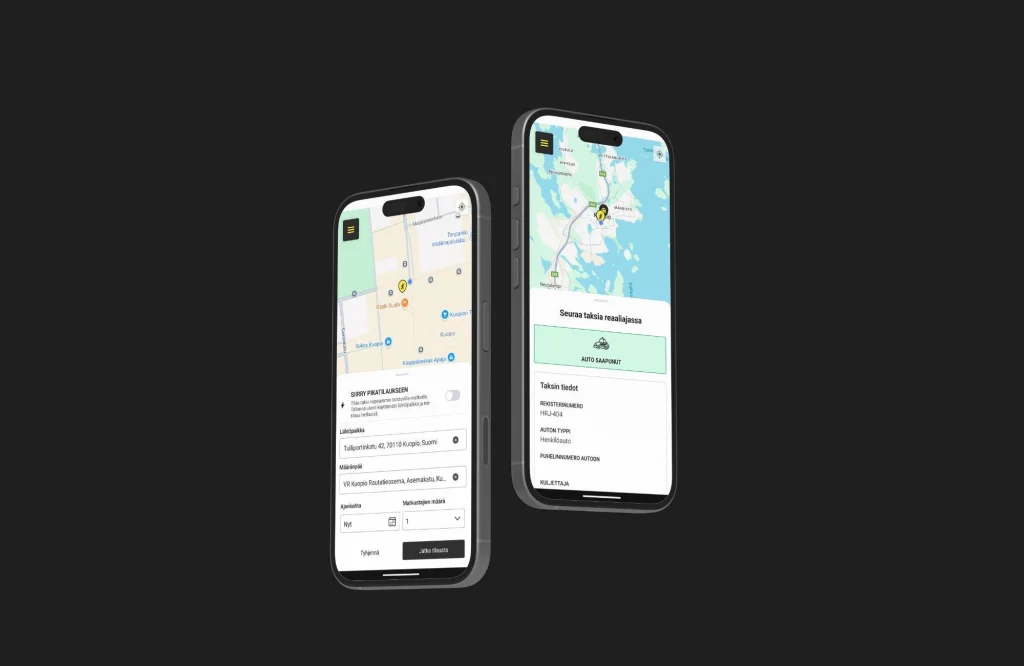
Taksiykköset needed a new solution to replace its outdated browser-based booking system, which did not work well enough on mobile devices. Hurja designed and developed the Taksi1 app, which is built using React Native and Expo technologies and integrated directly into the Movit back-end system.
The app works on both Android and iOS devices, and allows users to book a taxi, track its progress and pay for their ride conveniently via their mobile. During development, particular attention was paid to the map view, the ease of booking and a clear visual design.
The user interface was prototyped in Figma, and the infrastructure was built on the AWS cloud service. The project also made use of artificial intelligence; for example, ChatGPT was used for content creation and as a design aid.
Following its launch, the app rose to sixth place in the Auto & Vehicles category on Google Play, and it has been well received by both customers and drivers. Taksi1 is a concrete example of how a mobile app can improve both the customer experience and a company’s internal processes. Read more about the project!
University of Oulu – OV-info to support changes in ownership
The OV-info service is part of the VALO project led by the University of Oulu, which aims to support ownership transfers in SMBs. Ownership transfers are often complex and time-consuming processes, so there was a need for a digital platform that clarifies the steps involved and provides information in an easily understandable format.
Hurja, in collaboration with Huld, implemented a solution as a WordPress-based service that combines learning pathways, self-assessment tools and an extensive knowledge base. The user interface was designed to be accessible and user-friendly, ensuring the service is suitable for different user groups, such as entrepreneurs, buyers and advisors.
The service’s visual design and gamified elements, such as animations and step-by-step progression, support learning and keep the user engaged throughout the process. OV-info has succeeded in making a complex topic clear and accessible. Read more about the project!
Finspection – digitizing industrial inspection processes
Finspection provides inspection and repair services for pressure equipment to the industrial sector; previously, much of this work was done out manually. Data was scattered, reporting was time-consuming and there was a high risk of errors.
Hurja designed and developed a cloud-based inspection application that enables customers and field staff to manage qualifications, inspections and documents in one place. The solution uses Laravel and Vue technologies, as well as AWS infrastructure.
The application includes reminders regarding the validity of qualifications, reporting tools, electronic signatures and QR codes for managing certificates. In addition, artificial intelligence was used during the development process, and preparations were made for its future use in text recognition (Google Document AI).
The results are immediately evident in day-to-day operations: inspections are completed more quickly, errors are reduced and customers receive their certificates sooner than before. The project demonstrates how a digital application can genuinely make industrial processes more efficient. Read more about the project!
Our Shared Saimaa Ringed Seal: the LIFE – AR app in support of nature conservation
Our Shared Saimaa Ringed Seal LIFE is an EU-funded project coordinated by Metsähallitus, which aims to raise awareness of the conservation of the Saimaa ringed seal. Hurja developed a web AR application for the project, which provides tourists with information about the Saimaa ringed seal in an easy-to-use format.
Users can scan the QR code at the information points, which opens a 3D map view in their browser and allows them to view animations depicting the life of the ringed seal throughout the different seasons. The solution works on all devices and has been designed to be accessible to people with special needs; for example, support for screen readers and clear navigation paths were taken into account during development.
The project is based on web AR technology, which enables an augmented reality experience directly in the browser without the need to download an app. The result is an experience that makes nature conservation engaging and accessible. Read more about the project!
Apps are more than just code
The applications described above illustrate well the many ways in which technology can support operations in various sectors. Each project has been implemented in a different environment and to meet different needs, but they all share the same underlying principle: an application is a tool for solving practical problems and improving processes.
When development work is done out in collaboration with the client and the end-user’s needs are understood, the application becomes genuinely useful. It can make work easier, improve access to information or enhance interaction between people and their environment. The best applications evolve over time, adapt to new needs and continue to deliver value long after their release.
When digitalization becomes part of everyday life, it creates real value
Digitalization is progressing in stages, and every step forward moves the company towards more efficient and integrated operations. When digital solutions are integrated into day-to-day processes, they begin to deliver real benefits: information flows more freely, work becomes more efficient and the customer experience improves.
Applications provide tangible support for this development. They bring information together, help to manage complex processes and make operations more transparent. A well-designed application evolves alongside the business, adapts to its needs and retains its value over the long term.
When digitalization is implemented in a systematic manner and the user is involved from the outset, the resulting solutions do not become obsolete quickly. A good application stands the test of time, adapts to new needs and continues to deliver value well into the future.
At the heart of Hurja’s work is the desire to build solutions that make a real difference. Technology is constantly changing, but our goal has remained the same: to develop digital tools that support businesses and make people’s work easier.
Shall we build an app for you that really adds value?
Shall we get started?
"*" indicates required fields

You might also like these articles
App development – modern methods deliver a competitive edge
Read more

An app or piece of software tailored to a company’s needs brings business benefits
Read more
Application development as an enabler of business growth and digitalization – cost, benefits and implementation
Read more
Flutter – Google’s alternative for mobile development
Read more
 Artificial intelligence is not a divine being, but a tool built by humans