

AI Solutions
Looking to automate time-consuming tasks, make better use of your company’s data, or develop new services? We build custom AI solutions that streamline workflows, improve operational efficiency, and support business growth.

Bring AI into your everyday operations
Processing orders, searching for information, and handling repetitive tasks take up valuable time in many companies. Custom AI solutions automate processes, speed up information processing, and help businesses get more value from their data.
We develop AI agents that process orders, AI chatbots that use your company’s own documents, and intelligent features integrated into existing software.
At Hurja, we combine AI development with our expertise in software development and integrations. This ensures that the solution goes beyond a standalone experiment and becomes a functional part of your company’s systems and daily operations. We take responsibility for the entire process, from planning and implementation to ongoing development.
Custom AI solutions tailored to your business needs
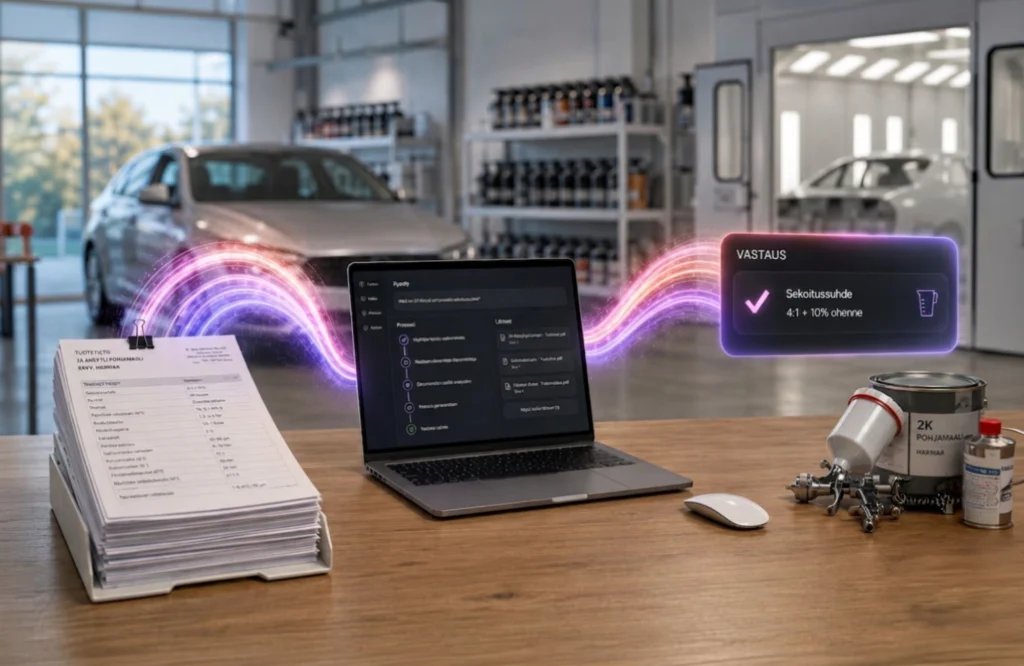
Manual product information searches replaced by instant AI chatbot answers
AI helps automate complex workflows, improve access to information, and enhance software functionality.
We build AI solutions that leverage your company’s own data and integrate seamlessly with your existing systems, such as ERP, CRM, or web services.
AI agents perform tasks, process information, and interact with business systems as part of defined workflows. We use them to automate processes such as order handling, document processing, data updates, and reporting.
In our Odoo AI Order Processor, an AI agent reads orders received by email, extracts the necessary information from messages and attachments, and transfers approved orders to an ERP system.
We develop the integrations, validation mechanisms, and approval steps AI agents need to operate reliably in production. We have also developed an AI security agent that monitors security vulnerabilities and automatically reports relevant findings.
Important business information is often scattered across documents and different systems. We develop AI chatbots powered by retrieval-augmented generation (RAG) that retrieve answers from your company’s own data and make information easier to access.
These chatbots understand questions written in natural language and find relevant information based on meaning, not just matching keywords. Responses can include source references, allowing users to verify the original information.
An AI chatbot can support customer service, technical sales, and internal knowledge management. The AI chatbot we developed for Cora Refinish helps customers, resellers, and employees find technical product information across hundreds of documents.
Learn more about RAG-powered AI chatbots
AI can also enhance your existing software and digital services. We develop features that recognize and process documents, analyze data, generate recommendations, and make software easier to use.
For example, we integrated OpenAI Whisper speech recognition into Spoken’s subtitling and transcription service. AI speeds up the most labor-intensive initial stage, while a human ensures the quality of the final result.
We connect AI models to the necessary data sources and software through APIs. Well-designed integrations ensure smooth data flow between systems and enable new functionality within your existing software environment.
In manufacturing and industrial operations, AI supports production optimization, predictive maintenance, and quality control. These solutions make use of data collected by business systems and equipment. Explore the opportunities AI offers for manufacturing and industry.
“The work delivered has been high quality, and the collaboration has been flexible and agile. Everything agreed has always been delivered as promised and on schedule, which has been important to us in a long-term partnership.”
Valtteri Veromaa
IT Project Manager, Saka Finland Oy
Want to see what we’ve already built? Check out our work to see the results and hear the stories of satisfied clients.
From AI idea to production-ready solution
Explore AI Sprint
Every AI project starts with identifying the problem to solve and the business value to achieve. We assess your available data, existing systems, and technical requirements to determine the most suitable approach.
If you are still exploring potential use cases, our AI Sprint helps identify and prioritize AI opportunities for your business. This practical AI consulting service includes a preliminary questionnaire, a workshop, and a written action plan.
Our development process
We define the solution’s functionality and technical implementation. When needed, we test the idea through a focused prototype or pilot and evaluate its performance using real data.
We develop the AI application, user interfaces, and necessary integrations. Before deployment, we test the solution’s functionality, security, and data processing.
We take care of deployment and ongoing development. We monitor performance and improve functionality based on user feedback and evolving business needs.
AI Sandbox brings AI possibilities to life
AI Sandbox is our development environment for building and testing AI solutions for different business needs. Through working demos, you can see how AI processes information, automates tasks, and interacts with other systems.
Our demos cover use cases such as order processing, document analysis, speech recognition, and forecasting. They also provide a practical starting point for exploring which AI solutions would work best for your business.
Explore our AI Sandbox demos
This demo automates incoming email orders directly into an ERP system such as Odoo. It recognizes orders in various formats – whether it’s a PDF, Excel file, image, or plain email text – and converts the data into a consistent format before entering it into the system. This eliminates manual entry and the errors that come with it.
The benefits are immediate: order processing time drops from minutes to seconds, errors decrease, and employees gain more time for other tasks. The solution works equally well with small and large order volumes, scaling as your business grows and improving customer experience through faster and more accurate order handling.
This demo uses AI to process training and educational materials. Documents such as guidelines, onboarding materials, or extensive technical manuals can be uploaded into the system, after which users can interact with the content through AI. This makes heavy materials easy to approach and brings interactivity to training, accelerating learning.
In industrial companies, the AI Trainer can be used for onboarding new employees, internalizing safety instructions, or learning machine operation manuals. In service industries, it supports continuous learning and helps keep skills up to date.
The result is faster onboarding, fewer misunderstandings, and more consistent competence across the organization.
This solution enables users to search and ask questions directly from large documents such as maintenance manuals, technical guides, or contracts. A user can ask in natural language: “What does this maintenance manual say about the safety inspection of part X?” The AI then retrieves the correct section and provides an answer.
It speeds up information retrieval, reduces errors, and supports decision-making in environments where data is scattered and critical.
This demo converts meeting recordings or field reports into text using the OpenAI Whisper model. In industrial contexts, it accelerates maintenance documentation by eliminating the need for technicians to write reports manually. In service operations, it saves time by transcribing and analyzing customer service calls.
The benefits include faster workflows, less manual documentation, and more accurate data that can be used later in analytics.
This demo reads text from images and scanned documents. In industrial settings, it can be used to digitize handwritten maintenance reports, old drawings, or paper forms. Elsewhere, OCR speeds up the processing of documents such as contracts and invoices.
The result is less manual data entry, fewer errors, and easily searchable and usable digital data from archived materials.
This demo summarizes customer feedback or lengthy reports into clear overviews. In industrial use, it can quickly highlight key insights from supply chain reports or production quality data. In service businesses, it can process customer surveys efficiently.
The main benefit is faster decision-making since there’s no need to read entire documents the most important insights stand out immediately.
The trend analysis demo predicts the development of sales data and visually presents upcoming trends. In industrial contexts, it helps with demand forecasting, resource planning, and reducing downtime. In service businesses, it can be used to evaluate the results of marketing campaigns.
The benefits come from better forecasting and more efficient resource use, allowing the right decisions to be made in time rather than afterwards.
The customer analysis demo reviews a potential customer’s website and generates personalized outreach materials based on its content. This is especially useful for B2B sales organizations that want to prepare more effectively for bids or sales meetings. For industrial companies, it means the sales team gets pre-analyzed background data on the customer’s situation.
The benefits include faster preparation, more personalized sales communication, and higher success rates in the sales process.
This demo analyzes financial statements and long-term maintenance plans (KPTS) using AI. While originally built for real estate use, the same model applies to industrial financial reports or other large document analyses. The bot highlights key figures and risk areas, speeding up report handling and supporting decisions with clear, comparable data.
The benefits include more transparent data management and faster financial decision-making.
This demo shows how AI can control systems through natural language. The user gives a command, for example, “Scan Kuopio market square with drones 1–5,” and the AI interprets the instruction, assigns it to the drones, and simulates their operation on a map.
The solution illustrates how a language model can act as an interface for complex processes. The same principle can be applied to warehouse robots, production lines, or logistics chains. The benefits are ease of use, faster decision-making, and reduced human error.
Security and reliability built into AI development
See our work: Odoo AI Order Processor
Business AI solutions often handle confidential information and automate critical business processes. That is why we address security, data privacy, and system reliability from the earliest planning stages.
We define what information AI can access, how permissions are managed, and which tasks require human review. We also implement error handling, testing, and monitoring.
Our solutions combine AI models with application logic and appropriate validation mechanisms. Our work is also guided by our AI ethics principles, which emphasize responsibility, transparency, and the safe use of artificial intelligence.
Examples of AI integration
Read also: 6 winning AI use cases
In our implementations, we use technologies such as GPT models, RAG architectures and function calling to automate document processing, analytics and decision-making.
Examples of integrating AI into existing systems:
Many everyday business processes include manual, time-consuming steps that slow work down and increase the risk of errors. AI can streamline these processes and ensure that information moves through your systems faster and more reliably.
For example, the order processor we built automates orders received by email. It recognizes attachments and text content in different formats, such as PDF, Excel, images or plain email messages, converts the data into a consistent format and enters it directly into an ERP system such as Odoo. A process that used to take several minutes and was prone to errors is now handled reliably in seconds.
AI speeds up information retrieval by combining RAG technology with natural-language queries. RAG retrieves precise content from your company’s documents and databases, and the language model turns the question into the right format, so users don’t need to know SQL.
For example, our Ask a Document demo shows this in practice. A user can ask, “What does this service manual say about the safety inspection for part X?” and the AI pulls the answer directly from the right section. Information is found in seconds, errors decrease and decisions are made faster.
Companies accumulate large amounts of data, but without a clear presentation it is hard to put to use. Visualization turns numbers and tables into easy-to-understand views that support decision-making.
For example, Excel-based spreadsheets can be turned into a dashboard that brings together key production metrics. The view can track production volumes against targets, the causes and duration of downtime, the share of defective products and machine utilization.
In addition to analyzing data, AI can take an active role in your processes. OpenAI’s function calling capability extends these possibilities by connecting AI directly to different systems and automated tasks.
In practice, AI can retrieve information from multiple systems, process inputs and perform defined actions as part of an automated workflow. This speeds up and simplifies work. For example, checking inventory, logging a maintenance need and creating a report can all be handled with a single command through AI.
For every implementation, we define what information AI can access and how sensitive data is protected.
Ready to build an AI solution for your business?
See our work: RAG-based AI-chatbot
Are there tasks in your company that could save time through automation? Would you like to get more value from your business data or develop an AI-powered application?
We help evaluate your idea and design the right solution. We can also start with an AI Sprint or an introduction to our AI Sandbox demos.
Our offices are located in Kuopio, Helsinki, and Turku, Finland, and we develop AI solutions for businesses regardless of location.
FAQ
The cost of an AI solution depends on the project scope, required functionality, data, and integrations. A small, clearly defined AI solution can cost as little as a few thousand euros. Larger solutions involving multiple system integrations or complex process automation require more development work.
Every solution is tailored to the company’s needs, so we provide individual cost estimates for each project. If you are still exploring potential use cases, AI Sprint offers a structured starting point at a fixed price of €1,190 + VAT.
Data processing locations and service providers are determined during solution planning. They depend on factors such as the selected AI model, cloud infrastructure, and your company’s security and data privacy requirements.
Before development begins, we review the data involved, required permissions, and any relevant restrictions. This allows us to design an architecture that meets your company’s requirements.
A small, clearly defined pilot can be completed in just a few weeks, provided that the necessary data and system connections are available. Larger implementations require more extensive planning, integration work, and testing.
At the start of the project, we define the scope, objectives, and timeline so you know what to expect throughout development.
 Outsourcing

Case: Odoo AI order processing agent
An AI agent that processes orders into Odoo ERP automatically
Read more