

Application development as an enabler of business growth and digitalization – cost, benefits and implementation
Application development, also known as software development, is the process of creating applications, programs or software systems that run on computers or mobile devices.
The main purpose of applications is usually to make it easier to carry out various tasks or to solve various identified problems.
The price of a custom-built application starts at between €10,000 and €35,000.
Application development is a key enabler of business digitalization, which can create a significant competitive advantage. With bespoke application development, applications can be developed and tailored perfectly to your company’s needs, taking every detail into account.
Whether your aim is to gain a competitive edge, streamline processes or deliver a new kind of customer experience, bespoke applications provide solutions that will keep you at the forefront of development.
In this blog post, we’ll look at the factors that influence the cost of app development, the benefits of different technologies, and the stages of the app development process, so that you can plan your development project as efficiently as possible.
- Application development must always be driven by business objectives
- The cost of application development
- Factors affecting the cost of application development:
- The cost of app development: estimate the costs accurately
- Stages, technologies and tools in application development
- Below, we’ll tell you a bit more about the various application options and technologies
- How we have boosted our clients’ business through application development, harnessing the opportunities offered by digitalization
- Your partner for all your application development needs
Application development is a process of designing, building and maintaining applications or software that run on various devices, such as computers, mobile devices or web browsers.
Application development can encompass a wide range of different applications, including mobile apps, web applications, desktop applications and gaming applications.
The goal is to create solutions that facilitate users’ daily lives, streamline business processes or provide new services and experiences. Application development can be customized to a specific need or based on ready-made development platforms and technologies.
An application (or app) is typically a program that the end user sees and uses.
It can be, for example, an online store, a booking system, or a mobile payment app that makes everyday tasks faster and easier for both customers and employees.
Applications provide users with a fast and intuitive way to get things done. All applications are actually software as well, but not all software is an application.
However, what is more important than the definition of the terms is that the chosen solution meets your business needs and goals.
Termien määritelmää tärkeämpää on kuitenkin se, että valittu ratkaisu vastaa liiketoimintasi tarpeisiin ja tavoitteisiin.
Application development must always be driven by business objectives
For businesses, digitalization requires continuous renewal in terms of both working practices and the development of skills.
A competitive advantage can be created through the effective digitalization of your company’s business model, operations or day-to-day tasks. You can also gain an advantage, for example, through a mobile app that provides personalized service to your customers, creating a stunning customer experience. Growth, profitability and competitiveness are key business objectives, and digitalization enables the development of all of these.
We take care of everything involved in application development: application functionality and requirements specifications, data models, technologies, visual design and, of course, the necessary user interface. However, a pile of code does not bring a competitive advantage or business growth if the app’s development is not driven by business objectives. That is why we also want to be your partner in defining these objectives through service design.
In app development, you should always have a clear vision of what you want to achieve before you start developing the app. You can start testing your idea by asking yourself the following questions and looking for the answers: what, for whom and why. In other words, what processes will the app streamline, or what problems will it solve?
What value does the application deliver, and how is its success measured? Read more about this in our previous blog post on the elements of a successful software project.
The cost of application development
Our standard hourly rate for application development starts at €95/h + VAT.
However, we always provide our clients with a bespoke quote, taking into account factors such as the size of the project, the timetable, the duration, the requirements set for the team, and the appropriate project methodology (e.g. agile development). The hourly billing model is not the only option we offer.
For example, for websites built on the WordPress platform, we often offer a fixed price, as the amount of work involved in these projects is relatively easy to estimate in advance. A fixed price is best suited to short and relatively simple projects. Read more about how software development prices are determined!
If you’d like to estimate the costs of your app development, get in touch with us. We can help you define your project requirements and provide a quote that meets your company’s needs.
Factors affecting the cost of application development:
- Scope and complexity of the project: A large-scale application that includes several integrated features, such as user accounts, real-time data or complex databases, will increase the cost. Simpler applications, such as informational apps, are cheaper to develop.
- Platforms: Is the app being developed for just one platform (e.g. iOS or Android), or is a cross-platform solution required (e.g. Cross-platform)? Developing for a single platform is often cheaper, but cross-platform solutions, such as React Native or Flutter, can save costs in the long run.
- Technologies and tools used: The choice of technologies has a direct impact on the speed and cost of development. For example, open-source technologies are often cost-effective, and we favour them at Hurja too, whereas certain specialised solutions can drive up the cost.
- Developers’ experience and team size: Experienced developers may charge a higher hourly rate, but their work is often more efficient, which balances out the overall costs. At Hurja, the hourly rate for app development usually starts at €95/h + VAT, and the duration of the project plays a part in determining the final cost.
- Application lifecycle: Managing the application lifecycle involves updates, maintenance and any potential enhancements. It is also important to budget for costs after the application has been released, as ongoing maintenance ensures the application’s performance and security.
The cost of app development: estimate the costs accurately
If you are considering commissioning an app, it is a good idea to draw up a realistic budget and discuss this with the development team so that you can get a more accurate estimate of the project’s total costs.
It is possible to optimize the cost of application development by choosing the right technologies and project management models, such as Agile development, which enables more accurate monitoring of costs during the project.
Stages, technologies and tools in application development
Application development – that is, the practical process of creating an application – generally involves at least the following stages: conceptualization, specification, design, implementation, testing, deployment and maintenance.
Application development methodologies can generally be divided into three categories: the waterfall model, the rapid application development (RAD) model, and agile software development methodologies.
Application development can cover a wide range of different applications, such as mobile apps, web applications, desktop applications and games. The following explains the key stages and concepts associated with application development:
- Design
- The app’s functionalities and user experience (UX) are designed in detail. This may include user interface (UI) design, mapping out user flows and creating prototypes. See also: The benefits of Figma prototyping in a software project
- The aim is to draw up a clear plan that the development team can follow.
- Implementation
- The actual coding phase, during which the development team writes the application’s code in accordance with the chosen technologies and the plan.
- Development can be carried out using various methods, such as Agile development, in which the project is divided into smaller parts (sprints), or the waterfall model, in which the work proceeds in stages.
- Testing
- The application is thoroughly tested to ensure its functionality and quality. Testing may involve automated tests, manual tests and user tests.
- The aim is to identify and rectify errors before the application is released.
- Deployment
- Once the app is ready and has been tested, it is released to users. This may involve making the app available, for example, in app stores (such as the App Store or Google Play) or on the company’s own website.
- When an app is launched, marketing campaigns are often organised and user support is put in place.
- Maintenance
- Following its release, the app will be maintained and updated as required. This may include bug fixes, the addition of new features and performance optimization.
- User feedback is continuously collected and analysed in order to improve the app.
Application development is a multi-stage process that requires close collaboration between various specialists, such as project managers, designers, developers and testers.
The aim is to create functional, user-friendly and high-quality applications that meet users’ needs and business objectives.
At Hurja, we favor open-source solutions in application development; we use modern programming techniques and always make use of the latest technologies and web and mobile development tools. Your options include web, hybrid, cross-platform and native applications, as well as combinations of these, tailored to the needs of your business.
Below, we’ll tell you a bit more about the various application options and technologies
- Web application
- A web application runs in a browser, so it is not restricted by device manufacturers’ rules. Furthermore, application development is fast and cost-effective. A browser-based application is therefore a good option when the performance of a native app is not required.
- cross-platform app
- Cross-platform applications, on the other hand, are implemented using a cross-platform framework (e.g. React Native or Flutter), which allows mobile applications to be developed for both iOS and Android platforms from the same source code. Thanks to cross-platform technology, the same application no longer needs to be written twice. This genuinely reduces the time spent on development and the overall costs of projects, particularly when compared to native app development.
- hybrid app
- A hybrid app combines the best features of web and native apps. The app can be widely distributed via app stores (App Store, Google Play). The maintenance costs for a hybrid app are lower than those for a native app.
- A hybrid app can be compiled for both Android and iOS platforms and can make use of the mobile platform’s features. Hybrid apps offer high performance and are quick to develop.
- Mobile app
- A native – that is, a platform-specific – mobile app is the best option when there is a long-term need for the app and it solves a problem for your customers. A native app helps you build customer loyalty and thereby improve your company’s competitiveness.
- XR applications, including AR applications
- At Hurja, we also develop AR applications for both mobile devices and AR glasses. For example, the Dynamics 365 Guides app offers a complete solution for combining the real and virtual worlds, allowing users to interact in real time with objects in both worlds in what is known as ‘mixed reality’.
- AR mobile apps, on the other hand, are ideal for projects that aim to provide augmented reality experiences via a smartphone.
- Engaging AR content can also be created using Web AR technology. Find out how we developed a Web AR application for Metsähallitus to support the conservation of the Saimaa ringed seal as part of the ‘Our Saimaa Ringed Seal’ project!
Examples of the technologies we use: TypeScript, React.js, PHP/Laravel, Next.js, Dart/Flutter, Vue.js, Angular, Node.js, C#/.NET, Unity, Python/Django, Symfony, HTML5, SASS, jQuery. You can also find more of the tools we use here.
We also wrote a blog post earlier about one of the technologies used in mobile development, React Native (React Native – More efficient mobile development) . We also use Google’s newer tool, Flutter, which has developed into a highly capable tool and a handy alternative to React Native. The MVP model can also be utilized in app development to gather additional information and genuine feedback to support product development.

How we have boosted our clients’ business through application development, harnessing the opportunities offered by digitalization
Application development is a method for driving growth, cutting costs, improving operational efficiency, enhancing the customer experience and creating entirely new business models.
Some of our clients whom we have helped to advance their digitalization
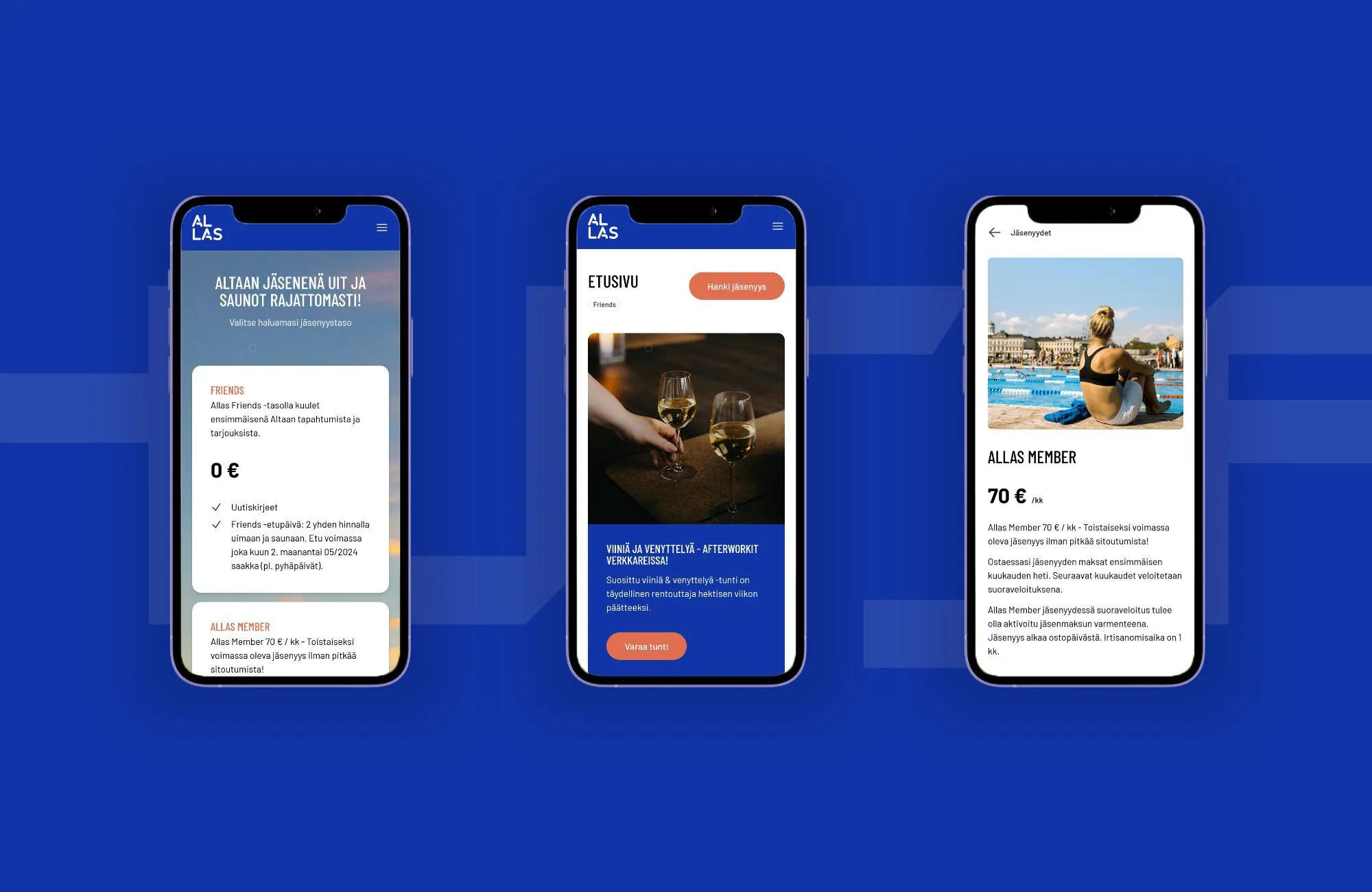
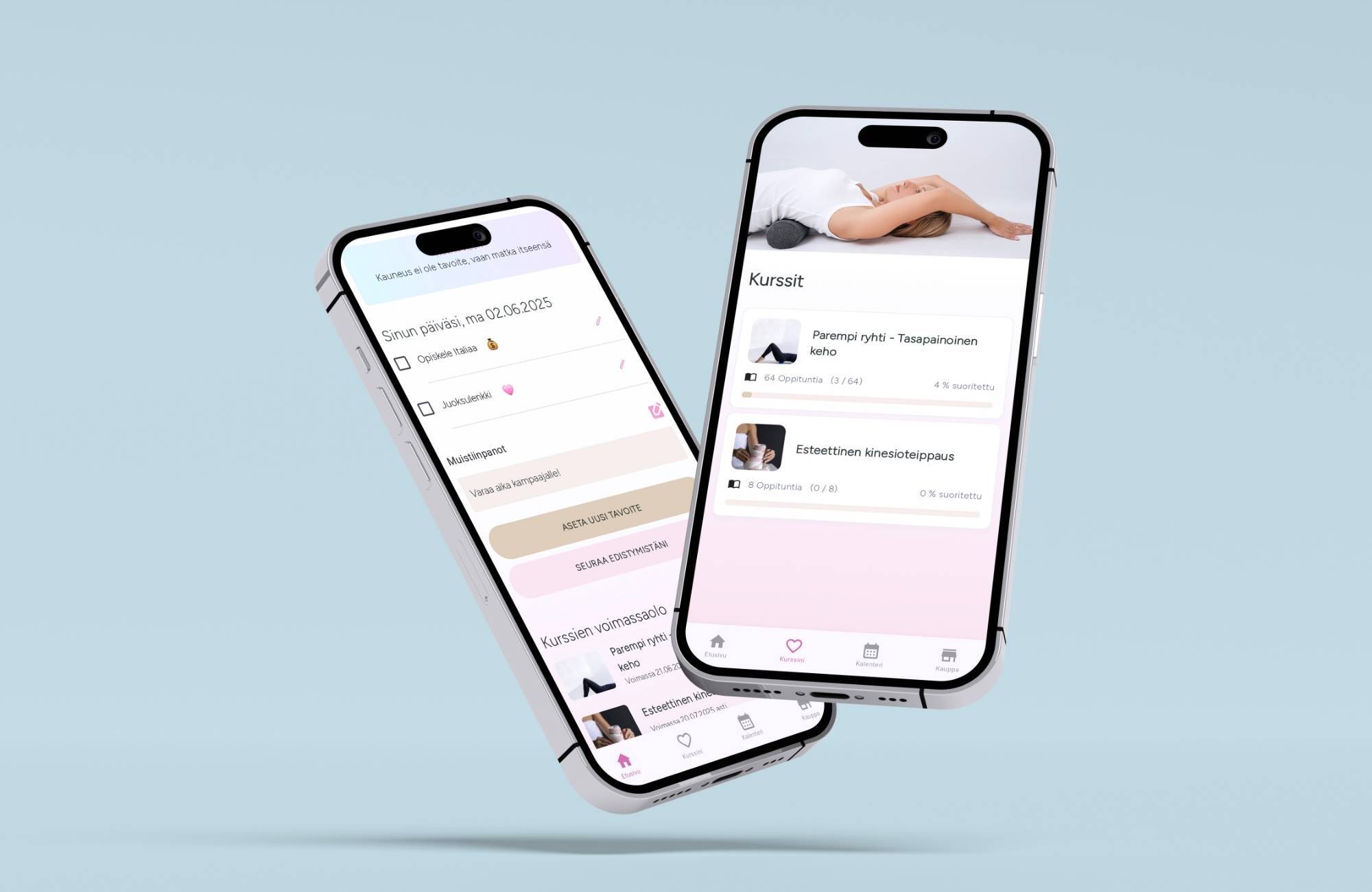
The mobile app we’ve developed enables Faceimage’s customers to enjoy a better digital customer experience. Find out more about our work!
As part of the ‘Our Shared Saimaa Seal – LIFE’ project, we developed an AR app for Metsähallitus to support the conservation of the Saimaa seal. Find out more about our work!
Auntien needed to create a solution for sales staff that was as user-friendly as possible and minimised manual work when drafting and managing sales contracts. The HubSpot & Docue integration we implemented streamlined processes and reduced costs. Find out more about our work!
Apetit has streamlined its operations through a major website overhaul. The current site makes content management significantly easier compared to the previous multi-site solution. The new site is clearer for both retail customers and staff in professional kitchens. Integrations with data repositories speed up maintenance and automate site management. Take a look at our work!
The publishing company Otava wanted to make its textbooks more engaging through a mobile app. We developed a mobile app called Otso for Otava’s Learning Services, which features a wide range of digital AR content.
The opportunities opened up by digitalization may also relate to the development of entirely new business models. Take a look, for example, at how we built Piha-Online, a web application utilizing headless technology, to connect professionals in the landscaping sector with customers, in line with the entrepreneur’s wishes. Find out more about our work!
Your partner for all your application development needs
App development should therefore always be based on the company’s needs, so that the app creates genuine value. Hurja is your partner throughout the entire application lifecycle, from specification and design, through UI and UX demos, to implementation and maintenance.
Do you need a bespoke app for your business, or could you do with some help brainstorming your idea? Get in touch!
Web applications, native applications, hybrid applications, and cross-platform applications differ in terms of development methods, performance, and user experience.
Web applications run in a browser, so they do not need to be downloaded or installed separately. They are accessible directly over the web, regardless of the device and operating system, which makes them highly flexible and easily accessible.
Web applications can provide a sufficiently good user experience for many businesses, especially when the performance or device feature access offered by native applications is not required. In addition, web application development is often faster and more cost-effective.
Native applications are developed specifically for certain platforms, such as iOS or Android, utilizing those platforms’ own programming languages and development tools (e.g., Swift for iOS and Kotlin for Android).
Because native applications are tailored precisely for a specific platform, they offer the best performance, a seamless user experience, and access to all device features, such as the camera, GPS, and push notifications.
Native applications are the best choice when the goal is to maximize the app’s speed and reliability, and to utilize hardware features to their full extent.
Hybrid and cross-platform applications, on the other hand, enable development with a single codebase that runs on multiple platforms, such as iOS and Android. Cross-platform applications are often developed using frameworks like React Native or Flutter, which allow the app to be published to both platforms from the same source code.
This significantly reduces development time and costs, but performance and user experience may lag slightly behind native applications since they are not fully tailored to individual platforms.
Hybrid applications are a combination of native and web applications. They function like a native app but use the device’s browser or web technologies (e.g., HTML, CSS, JavaScript) as the app’s user interface.
This allows the application to be developed once and run on multiple platforms. Hybrid applications can be distributed in app stores just like native applications, but they can suffer from performance issues, especially in more complex or graphics-heavy applications.
The duration of application development depends on the scope and complexity of the project. Simpler applications can be completed in a few months, whereas large and complex projects can take several months, or the application may be actively developed for even years.
The costs of application development vary depending on the scope, technologies, and requirements of the project. Our standard hourly rate for application development starts at €95/h + VAT. Try our application development cost calculator, which helps you estimate the costs of your application idea!
Application development typically includes the following stages: conceptualization, specification, design, implementation, testing, deployment, and maintenance. Each stage is important to ensure that the final result meets both business and end-user needs.
Yes! We are your partner throughout the entire application development process, from brainstorming to implementation and maintenance. We can spar with you on your idea, help develop it, and ensure that the final result serves your business goals. You can also explore Hurja’s service design services.
Examples of technologies we use: TypeScript, React.js, PHP/Laravel, Next.js, Dart/Flutter, Vue.js, Angular, Node.js, C#/.NET, Unity, Python/Django, Symfony, HTML5, SASS, jQuery. You can also find more of the tools we use here.
Shall we get started?
"*" indicates required fields



 Accessibility testing in practice