

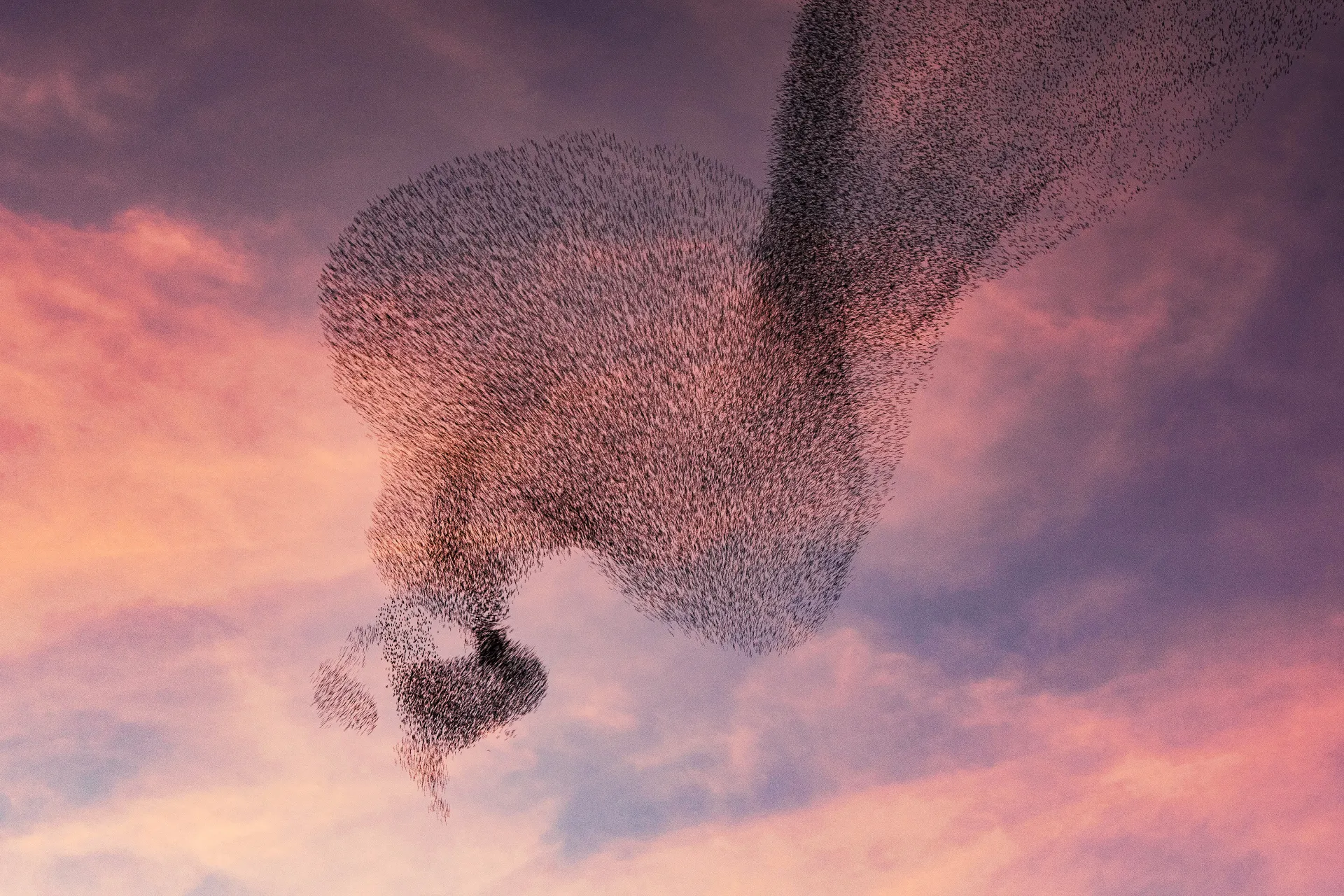
Swarm intelligence is revolutionizing software development and much more besides
Artificial intelligence has developed at a staggering pace in recent years. Initially, AI was used in simple chatbot applications that answered basic questions, but today AI agents are capable of handling increasingly complex tasks independently. As AI systems become increasingly capable, coordinating their interaction and managing them effectively are becoming critical issues. Furthermore, the use of AI raises new issues of responsibility, such as ethics, safety and data security, which are further emphasized in the decentralized Swarm framework.
The next step in this development is the orchestration of collaboration between multiple AI agents, which will enable the management of increasingly complex workflows and the transformation of software development. We are getting a glimpse of this future from, amongst other things, OpenAI’s Swarm framework, which is laying the foundations for the era of agents.
In this blog, we examine how swarm AI and multi-agent systems could revolutionize not only the world of work but also software development processes, as well as efficiency and collaboration across various sectors. We’ll also be exploring the significance of OpenAI’s Swarm framework and the new opportunities and solutions that the era of agents will bring.
- How does OpenAI view the stages of AI development?
- The era of AI agents is only just beginning
- What is a multi-agent system and swarm intelligence?
- What is OpenAI Swarm?
- In many sectors, there is already a need for AI agents
- Practical examples of the application of the Swarm framework
- Swarm intelligence in software development and process optimization
- Swarm AI in the development of customer solutions
- The impact of AI agents on jobs and roles
- A new era of distributed artificial intelligence is revolutionizing software development and processes
How does OpenAI view the stages of AI development?
The stages of AI development, as viewed by OpenAI, are set out below. According
to OpenAI, its o1-preview model, released in autumn 2024, represents stage two of AI development, which is where we are currently, according to the general consensus. The next stages of AI development relate to agent-based solutions, which will drive AI towards more deeply integrated systems capable of improving and automating even large-scale workflows at an organizational level. More information about the stages of AI can be found in our previous blog post.
- Level 1: Chatbots – artificial intelligence in conversational language
- Level 2: Reasoners – human-level problem-solving
- Level 3: Agents – systems capable of performing tasks independently
- Level 4: Innovators – artificial intelligence that can aid in inventions
- Level 5: Organizations – artificial intelligence that can carry out an organization’s work
Source: Bloomberg
The era of AI agents is only just beginning
Although AI agents are already available and their development is progressing rapidly, we are only just moving towards the true ‘age of agents’. At present, many AI systems perform individual tasks independently, but the real revolution will only take place when multiple AI agents begin to work together seamlessly, in a coordinated and efficient manner. This ‘age of agents’ will enable the resolution of increasingly complex workflows through close collaboration, in which AI systems operate flexibly both with one another and with humans.
The Swarm framework, developed by OpenAI, already offers a glimpse of this future, in which AI-based agents work as a team alongside humans and with one another. It offers the possibility of building systems in which AI agents work collaboratively, sharing tasks and optimizing processes together. However, the full-scale era of agents has not yet arrived – but it is fast approaching. It is also important to note that this era brings with it new kinds of ethical and technological challenges, such as the oversight and accountability of autonomous systems, which must be taken into account in development.
What is a multi-agent system and swarm intelligence?
In the development of artificial intelligence, multi-agent systems and swarm AI represent different ways of utilizing the cooperation between autonomous AI agents. Of the terms described above, swarm AI is a relatively new offshoot of multi-agent systems and an approach currently under development, based on nature-inspired decentralized solutions.
A multi-agent system (MAS) is an umbrella term that has long been used to describe systems in which several independent and autonomous agents work together to achieve individual or shared goals. In these systems, agents can operate either in a tightly coordinated manner or in a decentralized way. In a MAS, individual agents can be highly complex and have specific roles, making them suitable for complex and predictable processes.
Swarm intelligence Swarm intelligence consists of several AI agents that work together to solve complex tasks. Unlike a single AI agent, swarm intelligence utilizes collaboration and information sharing, which improves the efficiency, accuracy and adaptability of the AI group. This makes it an ideal solution for automating complex tasks where the limitations of a single agent become apparent.
Although swarm intelligence is still at an early stage of development, its operating model can, in theory, be compared to the way a company – such as Hurja, for example – operates. In a company, management delegates tasks to team members, who in turn carry out these tasks by communicating with one another and drawing on each other’s skills and expertise. In the same way, in swarm intelligence, autonomous agents operate in a decentralized manner based on simple, agent-specific local rules. This creates a system whose overall capability is greater than the sum of the tasks performed by the individual agents.
Swarm AI is a highly scalable and fault-tolerant solution that can potentially be utilized in areas such as robotics, and in the financial sector for processing large volumes of loan applications, as well as in industry to optimize the supply chain in order to reduce costs and improve delivery times, where rapid adaptability and operational reliability may be required. Alongside the examples mentioned, its areas of application are only just beginning to expand with new innovations, but the potential is enormous, particularly in environments that demand flexibility and agility.
What is OpenAI Swarm?
OpenAI’s Swarm is an experimental framework that enables highly organized collaboration between multiple AI agents to solve complex tasks. The purpose of the framework is to create systems in which autonomous AI agents can communicate, coordinate and make decisions together in a decentralized environment. The operation of the Swarm framework is based on a precisely defined structure: each agent has predefined roles and areas of responsibility, which are designed by the swarm builder, i.e. the coder.
Each agent carries out the tasks assigned to it and is able to recognize when it encounters a task that it is unable to perform itself. In such a situation, an agent can pass the task on to another agent that is better equipped to handle that particular type of task. Thanks to this division of roles and tasks, agents in the Swarm framework can collaboratively solve highly complex tasks efficiently and flexibly. Consequently, the Swarm system produces results that a single agent would be unable to achieve on its own, but which can be successfully achieved through a well-designed multi-agent system.
In many sectors, there is already a need for AI agents
In many sectors, there is already a need for AI agents capable of handling complex tasks independently and efficiently. Current AI systems are often focused on individual tasks and have limited capabilities; a single, all-purpose AI is not yet in use. Nevertheless, in many sectors, such as logistics, industrial automation, healthcare and finance, there is already a need for more efficient automation and smarter systems capable of managing broader and more diverse sets of tasks.
Swarm AI agents, which operate independently but in collaboration with other agents, are, in principle and by their very nature, well-suited to solving the complex problems encountered in these sectors and to automating processes in environments where rapid adaptation and decentralized decision-making are required. Swarm AI’s ability to adapt to changing situations and operate in a fault-tolerant manner makes it a particularly promising technology for resolving, for example, the automation challenges in the sectors mentioned, where the limitations of individual AI agents are becoming apparent with current technology.
Practical examples of the application of the Swarm framework
The Swarm framework has many potential applications across various sectors where a decentralized system of autonomously operating AI agents can deliver significant added value. Here are a few concrete examples of how the Swarm framework could be utilized in practice:
- Logistics: Swarm intelligence has the potential to revolutionize supply chain management by optimizing transport and route planning in real time. Autonomous agents can operate on the principle of specialization: one tracks the movement of parcels and forwards the information, another analyses the data and selects the best routes based on traffic conditions and congestion, while a third takes into account warehouse capacity constraints. This brings flexibility and responsiveness to logistics chain management, reducing delays and improving the reliability of deliveries.
- Production optimization: In production processes, Swarm agents can respond quickly and autonomously to machine failures or other disruptions. For example, if one production line comes to a halt due to a technical fault, Swarm agents can automatically redistribute tasks to other lines, ensuring that production continues despite the disruption. This decentralized operating model reduces downtime and ensures the continuity of production line operations, which in turn improves the efficiency and productivity of the production facility.
Swarm intelligence in software development and process optimization
Swarm AI offers a whole new level of flexibility and scalability for software development. When autonomous AI agents work together, they can carry out complex processes and optimize workflows without the need for human intervention in individual tasks. The Swarm framework enables software companies to build solutions that utilize autonomous agents across different systems and optimize complex workflows. For example, in logistics or production optimization, swarm AI agents can respond to changing situations immediately and in a decentralized manner. This flexible operating model can reduce manual labor, increase process efficiency and enhance system reliability.
Swarm AI in the development of customer solutions
For software companies, swarm AI offers new opportunities for developing customer solutions. The swarm framework concept can be utilized in customer service systems, where AI agents can handle multi-channel communication, coordinate tasks amongst themselves and provide customers with faster, more accurate and personalized service experiences. The decentralized operation of the agents enables flexible, cost-effective solutions in which AI agents can take over repetitive tasks, allowing experts to focus on strategic decisions. This model can also increase customer satisfaction and improve customer relationship management.
The impact of AI agents on jobs and roles
Although the concept of swarm AI is certain to transform software development and customer solutions in many ways in the future, its impact will also be evident in changes to the world of work. In the future, the widespread adoption of swarm AI in the workplace will inevitably lead to changes in job descriptions and roles. Automation will reduce routine tasks while creating new roles, such as ‘trainers’ for AI agents and ‘supervisors’, who ensure the AI agents operate correctly and guide them as necessary. This shifts the structure of work towards monitoring, optimization and analysis, where the role of humans is emphasized in a deeper understanding of AI and business operations.
Changes in the structure of work
In the future, the introduction of swarm AI could give rise to a new kind of hierarchy in the workplace, in which swarm AI agents act as operational staff. These ‘AI workers’ would operate under human supervision, and the tasks performed by the AI would range from the automation of basic processes to the handling of complex routine tasks. The person supervising and directing the swarm AI ensures that tasks are carried out to a high standard and intervenes only when necessary.
Collaboration between artificial intelligence and humans
Thanks to swarm AI, employees can get more done than before and make more effective use of tools that they do not fully master on their own. For example, experts using complex software can utilize swarm AI, which consists of AI agents, to assist them. This collaboration can boost productivity, as AI handles some of the manual work and speeds up tasks that would otherwise be time-consuming. Swarm AI acts as an additional resource, providing employees with a broader knowledge base and speeding up the completion of tasks.
New job roles include prompt designers
As artificial intelligence becomes more widespread, entirely new job roles are also emerging, such as the prompt engineer. The essence of this role is to design and refine the instructions – or prompts – given to AI, using natural written language so that the AI is able to produce accurate and relevant responses. This role is particularly crucial when using swarm AI, as effective prompts directly influence the swarm’s ability to perform its tasks correctly. Instruction designers ensure that the AI clearly understands its tasks and operates as intended, which can significantly improve workflow efficiency and the success of automation.
A new era of distributed artificial intelligence is revolutionizing software development and processes
Swarm AI offers software companies a new level of flexibility, scalability and efficiency, which are needed to manage the complex systems of the future. Agent-based solutions such as OpenAI’s Swarm framework enable interaction and decentralized collaboration between AI agents, which improves process optimization and opens up new opportunities for application development and customer solutions.
Although the era of agents is only just beginning, Swarm and multi-agent systems clearly point to the direction in which development is heading. Swarm AI not only makes current work easier, but also brings entirely new dimensions to software development and enables the creation of even smarter systems.
Shall we get started?
"*" indicates required fields

You might also like these articles
6 winning use cases for AI – how to find where it really pays off
Read more
User journeys and AI – how to build a user-centric and intelligent service experience
Read more

User stories as a tool in app design using artificial intelligence
Read more

How can you get more out of Odoo ERP with AI?
Read more
 Hurja Solutions has opened a branch office in the Graniittitalo building in Helsinki