

Design Sprint – from idea to reality
The Design Sprint is a method developed by Jake Knapp and his colleagues at Google, which has been in use at Google for a decade now due to its effectiveness. The method was developed to bring consistency to the way development projects are launched. The Design Sprint arose from the realization that getting together to brainstorm for a few days could produce almost miraculous results.
The Design Sprint method enables the rapid development and testing of hypotheses, as well as the creation of workable concepts and prototypes based on these, to kick-start development projects. The creators of the Design Sprint didn’t realize at the time, however, that they had created a global phenomenon. Today, the Design Sprint is widely used around the world by organizations such as Facebook, The New York Times and Uber – and here at Hurja too!
What is a Design Sprint?
The Design Sprint is an effective workshop method used in service design and product development. The five-day program, consisting of a series of workshops, begins by assessing the current state of the development project and defining the challenge to be addressed. Following this, the workshops involve brainstorming various solution models in collaboration with the client and Hurja’s experts, and refining these into a concept, on the basis of which a prototype is built and tested.
A Design Sprint ensures that the planned software, other service or product will definitely work for the user and that it also supports business objectives. The deliverables produced during the Design Sprint, including the prototype, will subsequently assist with the technical and visual design of the software, as well as with the technical choices appropriate for its implementation.
Using a prototype in a software project saves time and money, as the usability and functionality of the end product can be tested at an early stage. See also: The benefits of Figma prototyping in software projects.
The Design Sprint can be adapted to suit your needs by either extending or shortening its duration, and the workshops can also be conducted entirely remotely.
Why a Design Sprint?
The key advantage of the Design Sprint is that it allows work that would otherwise take months to be condensed into a single working week. The method is particularly well-suited to conceptualizing and testing a new product, service or feature. It is a quick way to turn a new idea into something tangible and to test it rapidly. A project launched using the Design Sprint is a considerably lower-risk option than rushing headlong into implementing a service. The vision for any software being developed must be clear, and this is refined during the Design Sprint.
In software development, requirements specification forms the cornerstone of the project and, although in an agile software development model, for example, specifications are refined during the course of the project, the broad outlines of the functional and quality requirements must nevertheless already be in place at the outset. Before the technical implementation of the software, there must therefore be a clear understanding of the software’s features, functions and how it should operate. After all, we certainly do not want to develop a service that is difficult to use and, as a result, fails to meet the business objectives set for it!
The stages of a Design Sprint workshop at Hurja
The workshop follows the model set out in the book Sprint: How to Solve Big Problems and Test New Ideas in Just Five Days by Jake Knapp, John Zeratzky and Braden Kowitz. In a Design Sprint, months’ worth of work is condensed into a single working week, with the process carried out in continuous collaboration with the client. During this five-day intensive workshop, we progress from defining the problem to a tested solution. Prototypes are used to solve and test the problem, and this phase does not require any coding. However, as companies’ needs vary, the duration of the Design Sprint and the extent of the client’s involvement can be tailored to suit those needs.
In some of the stages, however, it is particularly important that key personnel from the client’s side are involved in the development project, such as those responsible for the commercial side and the customer experience, as well as future users where possible. In a Design Sprint, collaboration ensures that the designed solution works for the user and that it also supports business objectives.
The end result is a clear, documented and well-founded list of development measures for the software or other service, based on the objectives, as well as implementation models tested using prototypes. Following the Design Sprint, it is safe to proceed with the actual software development, once the idea has been tested and all parties are on the same page.
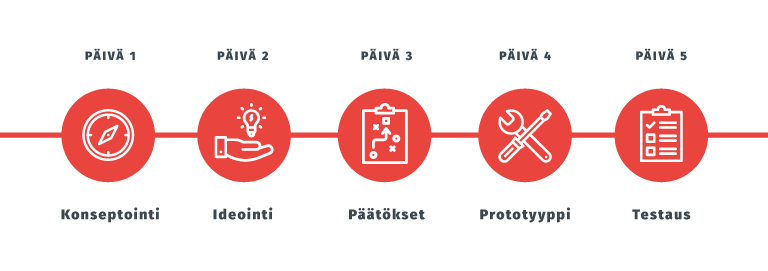
The stages of a Design Sprint
- From idea to concept: During the workshop, the idea is developed into a concept in collaboration with Hurja’s experts, the client and the software’s end users.
- From concept to brainstorming: Brainstorming in a group to solve a problem.
- From ideas to decisions: We decide which ideas to use as the basis for developing the prototype.
- From decisions to a prototype: A prototype will be produced on the basis of the decisions and to the agreed extent.
- From prototyping to testing and results: The prototype is tested both internally at Hurja and in collaboration with the client in various use cases. Finally, the end result is demonstrated to the client and plans are drawn up for further development.
Day 1: Concept development
The first day of the sprint week gets off to a flying start. In the workshop, we work together with Hurja’s experts, the client and the software’s end-users to develop the idea into a concept. On the first day, we assess the current situation and define the problem to be solved. The process takes the form of a facilitated discussion, ensuring we get the most out of the participants and maximize the benefits of the day. During the sprint, we assess the current situation, define the challenge to be tackled and set objectives for the sprint, on the basis of which we begin brainstorming solutions. The length of the day varies according to requirements.
Day 2: Brainstorming
The second day of the Design Sprint focuses on brainstorming. The day proceeds in such a way that each participant comes up with their own idea for solving the problem, and the selected ideas are visualised to make them more concrete. Storyboards, for example, can be used to illustrate user journeys.
Day 3: Decisions
On the third day, we’ll have a range of different solutions and will decide which prototype to start building and testing. At this stage, it is particularly important that the workshop includes participants from different roles, such as those responsible for the commercial side and customer experience, as well as, where possible, future users. A diverse group composition ensures that solution proposals are considered from a variety of perspectives.
Day 4: prototype
Based on the decisions made, a realistic prototype of the software to be developed is created. Applications suitable for prototyping user interfaces, such as Figma, Adobe XD and Sketch, can be used to create the prototype.
Day 5: testing
On the final day of the Design Sprint, the prototype is tested both internally at Hurja and in collaboration with the client across various use cases. Finally, the end result is demonstrated to the client and plans are drawn up for further development.
Design Sprint pricing
The cost of a Design Sprint depends, among other things, on the scope of the work and the methods used. A well-executed sprint makes moving into the implementation phase of a software project considerably less risky. The investment is sure to pay for itself during the software development phase!
Customer-focused development
A Rapid Design Sprint ensures that the planned software, other service or product will definitely work for the user and that it also supports business objectives.
If you need software that’s designed to meet your objectives right from the concept stage, please get in touch!
Shall we get started?
"*" indicates required fields

You might also like these articles
Prototyping and AI – from idea to interactive prototype in an instant
Read more

Service design in software projects and the benefits you cannot afford to ignore
Read more

Good software isn’t created by chance – a service design workshop can help
Read more

The benefits of Figma prototyping in a software project
Read more
 What does agile software development mean at Hurja?