


Accessibility testing in practice – towards an accessible user experience
Do you want to boost your business and provide a seamless user experience for all users? When it comes to online services, accessibility is the answer! In this blog post, we’ll explain how we at Hurja carry out accessibility testing in practice and what it involves. Accessibility testing can be carried out to varying degrees of scope.
The testing involved in an accessibility audit is extensive and comprehensive, and is typically carried out after publication. An accessibility audit also includes comprehensive documentation, comprising the accessibility report, the official accessibility statement and a summary of the accessibility report.
If the client so wishes, we can also carry out more limited accessibility testing as part of the development work prior to the service’s launch. In such cases, documentation is provided solely in the form of a technical document intended for developers, on the basis of which any shortcomings are rectified during the development process.
Accessible websites and mobile apps promote equality and give you a competitive edge that can help you expand your market share. Hurja’s accessibility testing service will help you get started on ensuring your online services meet accessibility requirements.
Once any shortcomings have been identified and rectified, you will be able to offer all users equal opportunities to make use of your digital services, and you won’t needlessly lose out on potential customers.
Accessibility testing and rectifying issues improves usability for all users
Accessibility is important to you, to us, to our partners and to our customers. As we get older, accessibility issues will sooner or later become relevant to each and every one of us. The WCAG criteria are divided into three levels: A, AA and AAA. Level AAA criteria are the most stringent, so they ensure accessibility for the widest possible range of people with various types of functional limitations. However, Level AAA is not the target level for all digital services, and the Digital Services Act only requires public authorities, public-law bodies and certain organisations to comply with it.
This accessible web service has been designed to meet the WCAG 2.2 Level A, AA or AAA criteria. The WCAG guidelines, developed by the international World Wide Web Consortium (W3C) ensure, above all, that the service’s technical solutions and functionalities have been implemented in accordance with best practices for accessibility. During the rigorous testing that forms part of the accessibility audit, all accessibility criteria for the selected level are checked page by page and screen by screen.
Getting started with accessibility testing
The accessibility testing that forms part of the audit begins with a joint kick-off meeting, during which we will introduce ourselves to one another, any questions you may have will be answered, a start date will be agreed, and we will go through how the project will proceed and what sort of documentation you, as our client, will receive upon completion of the accessibility audit.
Usually, the decision on which pages or screens to audit is made when assessing the workload. A selection of different recurring page templates and all relevant processes (e.g. the purchasing process) are chosen for testing to ensure that everything is covered. Downloadable files are also audited, as these must also be accessible (e.g. PDF files, PowerPoint presentations, downloadable tickets and receipts).
As part of a comprehensive accessibility audit, it is also important to examine screens and functionalities from behind the login screen – for example, profiles and purchase histories – as logged-in users sometimes have access to more features than those who are not logged in. We only require usernames from our clients for testing purposes, so that we can view, for example, the site’s purchase history without the auditor having to make any purchases. The aim is to ensure that the testing is as comprehensive as possible.
Accessibility testing requires both automated and manual testing
Accessibility testing includes automated and manual testing in accordance with the agreed scope.
Automated testing means that a programme carries out the checks. Typically, several different types of automated tests are carried out, as the programmes specialise in slightly different areas; for example, some programmes are used solely to audit PDF files. Versatile testing tools help to identify as many accessibility issues as possible.
Automated testing checks, among other things:
- structure of the service
- the presence of alt attributes
- labels
- aria attributes
However, automated tests cannot identify absolutely all flaws, nor can they check, for example, whether videos have adequate text alternatives or whether error messages are clear enough for users; such matters must always be assessed by a human. For example, Chrome’s Lighthouse may return good results from an accessibility test, but these results do not tell the whole story about the state of accessibility.
As part of the manual testing involved in the accessibility audit, Hurja’s accessibility tester systematically reviews the screens and criteria and assesses whether the factors affecting accessibility are adequate or deficient.
Manual testing includes, among other things:
- keyboard testing
- browsing the website using a screen reader
- a more detailed check of the contrasts
- Assessing the content of alt text
- testing the logical flow
- checking forms
- checking error messages
When we carry out an audit, the service is also tested using several browsers and developer tools. In addition to the desktop version, we also check the functionality and responsiveness of the mobile version of the application on a mobile device. Not all errors are immediately apparent, and accessibility testing – particularly when using a screen reader – often uncovers many errors that would otherwise easily go unnoticed.
Any issues identified during accessibility testing are recorded in the report, organised by criterion. Any issues identified during accessibility testing, along with suggested fixes, are documented in the report using screenshots and code examples, and links to sources are included in the report for further information. Developers at Hurja or the client can then easily rectify the accessibility issues identified using these guidelines.
When carrying out more limited accessibility testing as part of the development process, it is possible, for example, to test only the most critical functions, the main screens and a few key user flows of the service under development. However, this does not constitute a full audit, and in such cases not all criteria for the selected accessibility level are reported; instead, only the shortcomings are passed on to the developers for rectification.
The closing meeting and results of the audit
At the end of the audit, a joint meeting will be held to discuss the results of the accessibility testing. As the reports can be quite lengthy, a summary of the report is prepared in the form of a slide presentation to make it easier to go through the issues, thereby facilitating the review and discussion of the results.
Following the meeting, as our client, you will be provided with all the relevant documents, such as reports, accessibility statements and summaries, which will help you rectify any shortcomings identified in your services and illustrate the current state of the service’s accessibility. A separate report is produced for each audited product to facilitate the rectification of issues. Issues are categorised as ‘barring use’, ‘significant’ and ‘minor’, and at least one specific example is provided for each.
So, if you’re planning a digital service that also takes accessibility into account, we’ll consider this important aspect right from the start and incorporate accessibility testing into the development process. If, on the other hand, your existing service needs improvement in terms of accessibility, we’ll start the process with an accessibility audit, which will help us assess the current state of accessibility and suggest ways to improve it. Our experienced professionals can also rectify any accessibility issues in line with your requirements.
Please don’t hesitate to get in touch! Accessibility ensures a future in which everyone has the opportunity to use digital services without barriers!
Shall we get started?
"*" indicates required fields
You might also like these articles
Accessibility is the starting point for digital services
Read more
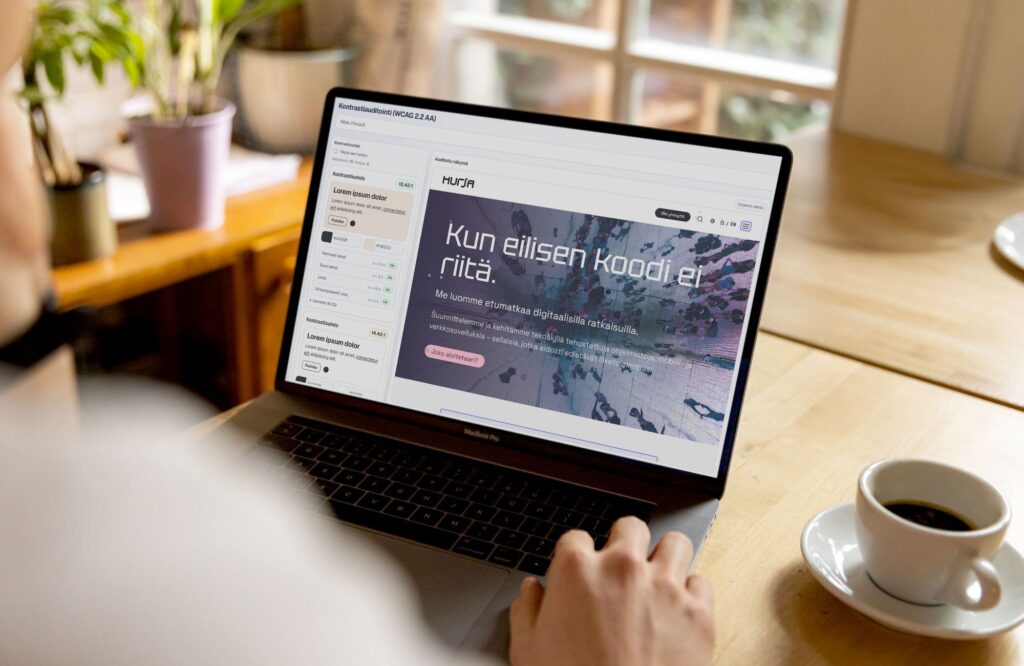
An accessibility expert coded their own contrast checker
Read more

Accessibility testing in practice – towards an accessible user experience
Read more

New legal requirement coming for online store in June – here’s what you need to know
Read more
 Hurja Solutions Oy is strengthening its board work with the help of advisors