

GEO optimization, or AI optimization: how your company shows up in ChatGPT, Gemini and Claude
GEO optimization, or AI optimization, means developing websites and content so that ChatGPT, Gemini, Claude, Google’s AI answers and other AI services find your company, understand what it does and surface it in their answers. It is built on the same things that bring visibility in Google.
More and more buyers ask AI first. When a potential customer asks AI to recommend a machine shop, an invoicing service or a Finnish food brand, the answer mentions a few companies. The rest are left out of the comparison.
Google’s AI answers have appeared in Finnish search results since 2025, and Google’s AI Mode has been available in Finnish since October 2025. At the same time, ChatGPT and Google’s Gemini are increasingly used like search engines, and Claude has also quickly become common, especially in business use.
In this article, we go through what GEO optimization means, how it differs from traditional search engine optimization and what it involves in practice, so that your company can be found in AI answers.
- What does GEO optimization mean?
- How does GEO differ from search engine optimization?
- In which situations does AI search influence purchase decisions?
- What does GEO optimization involve?
- Limitations of GEO optimization
- How we do GEO optimization at Hurja
- Can your company be found in AI answers?
- Frequently asked questions
What does GEO optimization mean?
GEO stands for Generative Engine Optimization. It is also called AI optimization, AI SEO or AEO (Answer Engine Optimization). In practice, these terms mean the same thing.
The goal is for your company’s content to become a source when AI compiles an answer to a user’s question. In practice, this means a mention in the answer text, a source link alongside the answer, or both. AI searches are carried out by, for example, ChatGPT, Claude, Google’s AI Overviews and AI Mode, Microsoft Copilot, Gemini and Perplexity.
How does GEO differ from search engine optimization?
In traditional search engine optimization, the aim is a good ranking in search results and a click through to your own page. In GEO optimization, the aim is a place in the answer itself. AI compiles its answer from several sources, and some users get the information they need without clicking anything. That makes it more important than ever that your company’s name and services come up in the answer itself.
The foundation is still the same. According to Google’s own guidance, the basic principles of search engine optimization also apply to AI features, and Google considers GEO and AEO to be part of search engine optimization. AI mostly draws its information from the same sources as search engines, so a page that a search engine cannot find or understand is likely to be missed by AI as well. GEO optimization is therefore an extension of search engine optimization that emphasizes clear answers, unambiguous information about the company and trustworthiness.
In which situations does AI search influence purchase decisions?
Buyers use AI especially at the beginning of the buying journey, when they are mapping out options and still defining the problem. Business customers ask about service providers, consumers about products and brands. The services are also used differently. Consumers use ChatGPT by far the most and Google’s Gemini second most, while in business use, Claude has overtaken ChatGPT according to international studies. The questions could be, for example, like these.
- Which machine shop manufactures welded steel structures as a subcontractor?
- Which companies provide industrial maintenance in Eastern Finland?
- What should be considered when acquiring an industrial robot for a production line?
- Which construction company renovates façades for housing companies in Kuopio?
- Which roofing material best withstands the Finnish climate?
- Which invoicing and debt collection service suits a small business?
- Which food brands use Finnish ingredients?
For your own company, the change shows up first in analytics, and the marketing director usually notices it first. Search visibility can stay the same even as the website gets fewer clicks than before, because some searchers get their answer straight from the search results page. On the buyer’s side, the change shows in where options are sought. A client company’s CEO or buyer may ask ChatGPT, Gemini or Claude for partner suggestions before requesting quotes. If your company is not mentioned in the answer, it may not even make it onto the list for a request for quotation. For a consumer brand, AI may recommend a competitor’s product before the buyer even visits a store or an online shop.
What does GEO optimization involve?
The website can be read by AI
AI services need access to the website’s content. The robots.txt file must not block the crawlers of search engines or AI services, such as OAI-SearchBot, which serves ChatGPT’s search, or Claude’s Claude-SearchBot and Claude-User. Important content must be included as text in the page’s HTML code, because information hidden in images or heavy scripts is easily left unread. We check these in our SEO/GEO audit.
You can add an llms.txt file to your website that brings together the site’s most important content for AI services. Google has stated that Google Search does not use llms.txt files and that they neither help nor harm visibility in Google. For other AI services, there is no strong evidence of their impact yet. You can add the file, but it does not replace working technology and, above all, good content.
Website speed and technical condition also matter. Read more in the article What are Core Web Vitals and how do they relate to search engine optimization?
Content answers questions directly
AI picks clear and precise information for its answers. That is why content is written so that the most important answer comes right at the start of each section, followed by the details. AI often uses individual passages of text rather than the whole page, so each section must be understandable on its own. For this reason, text is broken into short paragraphs, and each section has its own descriptive subheading.
Questions that customers actually ask work as subheadings, and service pages and articles include a Frequently asked questions section. For a B2B company, the questions often concern the price, implementation and suitability of a service; for a consumer brand, products, ingredients and availability. Concrete information sets you apart from competitors. Price estimates, schedules, stages, service areas and examples are exactly the kind of information buyers ask AI about. If your website only says “price on request”, AI will look for pricing information somewhere else.
Company information is unambiguous
AI needs to recognize your company and understand what it does and where it operates. Your company’s name, services, locations and contact details must be the same on your own website, in your Google Business Profile and in other services. Structured data (schema) tells the same things in a machine-readable format, such as company details, services, products and frequently asked questions. We implement more extensive structured data, such as markup for products, services and frequently asked questions, as an add-on service in website projects when needed.
Expertise and mentions
AI services favor sources that are knowledgeable and referenced elsewhere. The E-E-A-T principles familiar from search engine optimization, meaning experience, expertise, authoritativeness and trustworthiness, are central in AI search as well. Customer stories, named experts, industry publications and mentions in the news and on comparison sites show that your company is a credible player. Google specifically warns against artificially generated mentions, so there are no quick wins to be found here either.
Unique content makes it into answers
The importance of content grows with AI search. Generic AI-generated text (AI slop) still does not help you appear in AI answers, because AI can write the same text itself. According to Google’s guidance, content with its own perspective and information based on expert experience stands out in AI features, while recycling what has already been said elsewhere adds no value. Pages produced at scale only to influence search results or AI answers violate Google’s policies.
Unique content includes, for example, your own customer stories, real price and schedule examples, your own data and experts’ insights. AI cannot find these anywhere else.
Measurement and tracking
AI search results are measured partly differently from traditional search. Below are examples of tools you can use to track AI visibility. Google Analytics 4 shows how many visitors come from sources such as chatgpt.com, gemini.google.com, claude.ai, perplexity.ai or copilot.microsoft.com. Google Search Console’s report on generative AI features, in turn, shows how your site appears in Google’s AI answers.
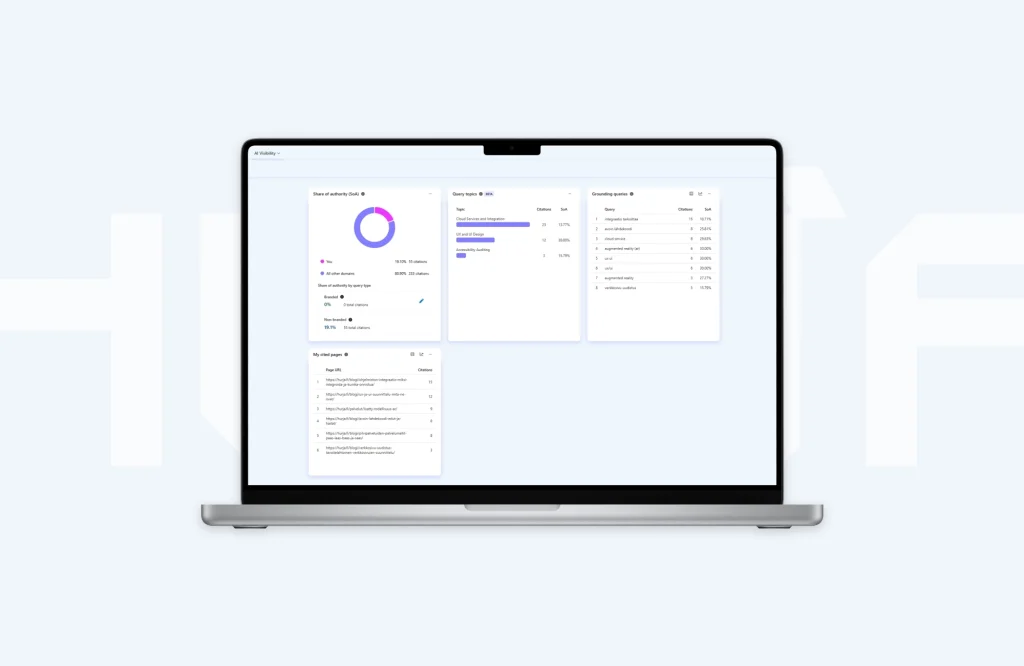
Microsoft Clarity’s AI Visibility report shows how often Microsoft’s AI services, such as Copilot, use your website as a source, which queries they use to find your content and which of your pages receive the most citations. The report also shows what share of the citations goes to your website compared with other websites mentioned in the same answers. In addition, Clarity lets you see how visitors who come from AI services use your website.
In addition, you need to track prompts, meaning the questions put to AI, for which there are dedicated tools such as HubSpot’s AEO tool. You choose questions your customers are likely to ask, for example “which company does electrical contracting for industrial halls”. The tool asks the same questions regularly from different AI services, such as ChatGPT, Gemini and Perplexity, and reports whether your company is mentioned in the answer, which competitors are mentioned and which sources the answer is based on.
AI services do not reveal what they are asked or how often, so the questions are chosen based on other data. When we handle SEO/GEO optimization for a client, we use keyword search volumes, question-type queries in Search Console, the queries shown in Clarity and the questions customers ask in sales and customer service.
Limitations of GEO optimization
AI answers vary depending on the user, the wording of the question and the time. That is why no one can guarantee that your company will be mentioned in every answer. Results appear at the same pace as in search engine optimization, meaning changes take weeks or months.
It is also wise to be cautious when someone promises quick tricks for AI visibility. Lasting visibility comes from the same things as before. The website must be technically sound, the content useful and up to date, and the company information clear.
How we do GEO optimization at Hurja
We take AI search into account as part of search engine optimization. We start with an audit that examines the website’s technical condition, the quality of its content and how your company appears in search engines and AI answers. Based on that, we fix technical barriers, add structured data and develop content to answer your customers’ questions. In content creation, we write the texts for you, and your experts review them before publication, so the content is based on your company’s own expertise.
The technical foundation is fixed first, because even the best content will not be visible if search engines and AI services cannot read it. After that, the work continues with regular content development and tracking, as search engines, AI services and competitors’ content keep changing. Search engine optimization and GEO optimization are therefore ongoing work.
Our designers, developers and SEO specialists work under the same roof, so both technical and content changes are handled by the same partner. When we build a website or an online store, the technical foundation for AI search is in place from launch. We describe the website project process in more detail in the article Building a website for your business.
Search engine optimization, content creation and more extensive structured data are separate services that can be ordered as part of a website project or later. After launch, the website needs regular care, because a slow, error-ridden or outdated website weakens visibility in search engines and AI answers. WordPress maintenance keeps the technical foundation in good shape going forward.
On our own website, we do GEO optimization continuously and track Hurja’s visibility in AI answers using tools such as Search Console, GA4 and Microsoft Clarity. We also use other AI tools to track whether Hurja is mentioned in ChatGPT, Gemini and Claude answers, and we develop our content based on the results.
Can your company be found in AI answers?
Have you asked ChatGPT, Gemini or Claude who it recommends in your industry? Is your company mentioned, and is the information about it correct? Would you like to know what to fix first on your website? Get in touch, we are happy to help.
Ready to get started?
"*" indicates required fields

Frequently asked questions
GEO optimization (Generative Engine Optimization), or AI optimization, means developing websites and content so that ChatGPT, Gemini, Claude, Google’s AI answers and other AI services find your company and mention it in their answers.
In search engine optimization, the aim is a good ranking in search results and clicks to your website. In GEO optimization, the aim is a mention and a source link in an AI answer. The foundation is the same, and according to Google, the principles of search engine optimization also apply to AI features.
Not necessarily. Google has stated that Google Search does not use llms.txt files. You can add the file to your website, but it is more important that your content can be read by search engines and answers your customers’ questions.
You can ask ChatGPT, Gemini and Claude the same questions your customers ask and follow the answers regularly. Google Search Console reports on visibility in Google’s AI features, and Google Analytics 4 shows how many visitors come from AI services. With tracking tools, you can also check whether your company is mentioned in the answers.




 AI in software development: what speeds up and what stays with people?