


RAG AI chatbot for businesses – turn your data into a competitive edge
Companies don’t usually lack information. The problem is that nobody can find it when they need it.
Guidelines, contracts, product data sheets, safety data sheets, process descriptions and expertise accumulated over the years are scattered across document repositories, email threads, network drives and people’s memories. The information exists, but finding it is slow and recalling it is laborious. The risk of giving the wrong answer increases as more documents accumulate.
A generic AI chatbot won’t solve this problem, as it has no knowledge of your company’s specific products, processes, customers or policies. It may well give a convincing answer, but a convincing answer isn’t necessarily the right one.
The RAG AI chatbot is built on a different kind of logic. It retrieves answers from the organization’s own documents, bases its responses on verifiable sources, and can be configured to quickly incorporate new material without the need for extensive retraining. From a software development perspective, the RAG AI chatbot is a good example of an integrated solution where AI is built into the company’s day-to-day operations and existing systems.
Let’s break down the RAG AI chatbot in practical terms: what it does, where it’s most useful, and when it’s worth building.
- What does RAG actually mean?
- Where does the RAG AI chatbot deliver the most value?
- Industry and process documentation
- Technical sales, product information and customer service
- Internal information management and expert work
- RAG in sales, marketing and communications
- A sales and customer service chatbot integrated into the website
- Data security and document quality are crucial
- We help you make the most of scattered data
What does RAG actually mean?
RAG stands for Retrieval-Augmented Generation. In simple terms, it refers to search-based text generation. It is an architecture in which a large language model is combined with document-based information retrieval.
In practice, RAG does two things. First, the system retrieves information relevant to the user’s query from the organization’s own document repository. This may be supported, for example, by a vector database that also identifies text passages with relevant meaning. This means the user does not need to know the exact file name, folder path or correct search term. The content found is then provided to the language model as context. The language model (LLM) generates a response based precisely on this material.
The end result is a response based on the information the organization has provided to the system. The user can check which document or source the response comes from. This distinguishes the RAG solution from a standard chatbot, which responds based on its training data without offering the same level of transparency.
A well-designed RAG solution doesn’t try to answer everything by force either. You’ve no doubt come across the frustrating problem of AI hallucinations, where the AI gives completely nonsensical answers. If no answer can be found in the data, the RAG AI chatbot can be instructed to say so directly. In a business context, this is a significant consideration. AI should not sound confident when there are insufficient sources.
Where does the RAG AI chatbot deliver the most value?
The RAG AI chatbot is at its best when information is scattered across numerous documents and experts’ time is spent digging it out. Its value lies in everyday, recurring situations where information needs to be found quickly and must be accurate.
Good indicators that a project is off to a good start include, for example:
- Experts keep searching for the same information over and over again
- product information, instructions or contracts are scattered across different systems
- Customer service or sales deal with the same questions day after day, day out
- There are a lot of documents, and their structure varies
- Information changes frequently, but it must still be accurate
- Skilled employees know a great deal, but that knowledge is not readily available to others
The RAG AI chatbot can reduce the time experts spend searching for information, speed up sales and customer service, minimize the risk of incorrect or outdated information, and make it easier to onboard new employees. It also makes tacit knowledge discoverable and supports decision-making by showing which source the answer is based on.
In many organizations, the most significant benefit relates to the knowledge held by individuals. When a skilled employee leaves, years of experience may go with them if that knowledge has not been captured and made available to others. RAG helps transform scattered knowledge into usable information by making information retrieval faster, more accurate and more transparent. Below, we present a few useful use cases for RAG.
Industry and process documentation
In industrial environments, a large volume of documentation accumulates. Maintenance instructions, explanations of fault codes, safety data sheets, equipment-specific process descriptions, checklists and maintenance guidelines are often scattered across different locations and available in various formats.
When an installer, maintenance technician or production specialist needs the right information about the right piece of equipment quickly, searching for it manually takes time and leaves room for error. At worst, the information is found, but too late.
The RAG AI chatbot essentially acts as a knowledge base that can be queried using natural language. Users do not need to know which folder a document is in or what search term was used when the information was originally saved.
The benefits are quickly apparent:
- less manual searching
- faster responses to production and maintenance inquiries
- lower risk of using outdated or incorrect instructions
- a better opportunity to make use of existing documentation
- less reliance on the memories of individual people
The RAG AI chatbot can initially be built around a limited document repository, such as maintenance instructions, product information or safety data sheets. In practice, this involves application development, where the solution is designed to suit users’ everyday needs, existing systems and the actual requirements for data usage.
Technical sales, product information and customer service
The RAG AI chatbot is ideal for companies with a wide range of products, a wealth of technical information, or a network of resellers that need quick and accurate answers.
When there are hundreds of products, each with its own technical documentation, finding the right information without a proper search tool is a slow process. The same questions keep coming up in sales, customer service and from resellers:
- Which product is suitable for this purpose?
- What are the technical limitations of the product?
- How do you use this safely?
- What is the difference between these two options?
- In which document can this information be found?
The RAG AI chatbot retrieves answers directly from the company’s own data. The same solution can serve internal teams, resellers, and end customers, provided that access rights and views are configured correctly.
This brings practical benefits to sales. Responses are faster and customers receive more accurate information. Sales team have more time to focus on promoting sales rather than dealing with inquiries.
Internal information management and expert work
In specialist organizations, information is often at the heart of the work. In the legal sector, the insurance industry, consultancy, technical design and other specialist fields, there can be hundreds or thousands of documents. Going through them manually takes time away from work where human expertise is truly valuable.
The RAG Assistant can help you find what matters quickly. It frees up experts to do what they do best: assess, apply and make decisions.
In internal knowledge management, RAG acts as the organization’s memory. Process descriptions, operating procedures, internal guidelines and specialist expertise remain accessible, even as the organization grows or personnel change. This is particularly useful during onboarding. New employees can find answers in the system, complete with sources, and gain a quicker grasp of the organization’s working methods, expertise and shared knowledge.
The RAG AI chatbot could also be the first step towards a real-time internal knowledge base. The solution can be designed to support the continuous organization of information: new documents, project memos, customer discussions and internal guidelines can be incorporated into the knowledge base so that essential information is summarised, linked to the relevant topics and remains easier to find.
In this way, the organization’s knowledge begins to form a body of information that can be put to practical use. Knowledge is no longer confined to individual files, emails or people’s memories, but becomes a shared resource that can be used in expert work, onboarding, sales, customer service and decision-making.
RAG in sales, marketing and communications
Sales, marketing and communications teams are constantly dealing with fragmented information. Brand guidelines, campaign history, product copy, customer communication guidelines and message templates, partner materials and references are often scattered across different locations.
When information is scattered, the consequences soon become apparent. Texts are inconsistent. Product information becomes out of date. Sales uses different selling points to marketing. A new team member asks the same questions that someone else has already answered many times.
The RAG AI chatbot compiles a single, searchable information source from the material the team needs. A content creator can check product specifications while working on a piece of writing. A sales representative can find the right reference to support a proposal. The campaign manager can see what is known about the previous year’s equivalent campaign. A new team member can find examples of the brand’s tone of voice without having to dig through someone’s emails or rely on memory.
In practice, the team works more quickly and cohesively. Information isn’t locked away in individual people’s heads, but is always available to everyone.

A sales and customer service chatbot integrated into the website
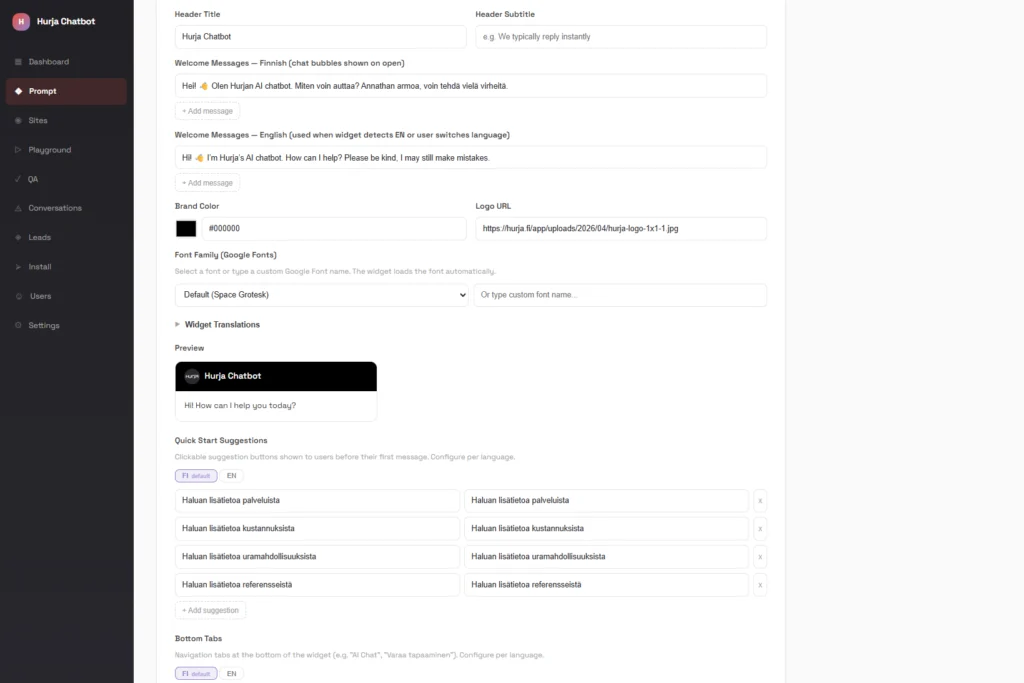
The RAG AI chatbot integrated into the website serves visitors around the clock and draws on the site’s own content in its responses: service descriptions, product information, frequently asked questions, blogs, guides and case studies. When a visitor asks a question, the bot retrieves relevant content from the knowledge base and formulates a response tailored to the specific query, rather than simply offering pre-written answer options.
In practice, a bot can fulfill several roles:
- as a customer service representative who answers questions about products and services without any waiting time
- as a sales assistant who directs visitors in the right direction
- as an initial point of contact who collects contact details where necessary and passes the conversation on to a team members
At its best, a bot shortens the purchasing journey while reducing the workload on customer service. A well-designed backend management system makes the bot genuinely useful for the administrator as well. The admin panel allows you to define what content the bot is permitted to use, which topics it should avoid, and when it should hand the conversation over to a human. At the same time, you can update the knowledge base, add new content and remove outdated information without any manual technical work.
You can also control the bot’s tone via the backend:
- Does the bot respond in a casual or more formal manner?
- how should it sound
- which words or expressions it should favor or avoid
This way, the bot doesn’t sound like generic AI, but acts as an extension of the company’s own brand and customer service.
A website chatbot is ideal for businesses that want to serve their website visitors better and guide them through the process more quickly. The benefits are particularly evident when there are many services on offer, the information is technical, or customers need precise answers before making a purchase decision. A well-designed update process keeps the bot’s knowledge base up-to-date without the need for laborious manual work.
Data security and document quality are crucial
When a RAG AI chatbot starts to use a company’s documents, website content or internal materials, data security and data quality are not secondary considerations. They determine just how reliable and useful the bot will be.
A well-designed solution only uses data to which it has authorized access. It is therefore advisable to consider access rights, data location, logs, management and maintenance right from the start of the project.
Key questions include, for example:
- where the data is located
- Does the data have to remain within the EU?
- what access restrictions are required
- who is allowed to view which materials
- how can we ensure that the data is not used to train models
- how logging, management and maintenance are carried out
These are not usually obstacles, but they do influence architectural choices. The quality of the documentation also has a direct impact on the end result. If the background materials are well-structured and up-to-date, the RAG solution will perform more accurately. If the documentation contains contradictions, outdated information or unclear versions, the chatbot will find the information, but it may not necessarily be what the organization would like to use.
It’s good to realise this early on. A RAG project often reveals the true state of a company’s data.
We help you make the most of scattered data
It’s worth starting the RAG AI chatbot project wherever the search for information is holding things up. Do experts spend time searching for documents? Are the same questions asked repeatedly in sales or customer service? Is product information scattered across different systems? Does onboarding rely too heavily on the right person happens to be available?
Once the pain point has been identified, it is advisable to keep the initial implementation strictly limited. A single use case, a single data source, the right users and a clear metric are sufficient to get started. The RAG AI chatbot can be integrated into environments where data is already in circulation: websites, intranets, document management systems, CRMs or customer service tools. In this way, the solution does not remain a standalone bot, but immediately begins to streamline day-to-day operations where it is needed most.
We have developed RAG solutions for organizations such as specialist consultancies and companies selling technical products. A common feature of successful implementations has been a clear scope: first, a single real-world problem is solved; only then is the solution rolled out more widely.
If your company’s data is scattered across documents, systems and people’s minds, we can help you identify where the RAG AI chatbot will be most beneficial and what kind of pilot project will help you get started quickly.
Shall we get started?
"*" indicates required fields




 New legal requirement coming for online store in June