


Test-driven development delivers quality and stability
Test-driven development enables new software to be developed and brought to market at a rapid pace. However, particularly in the case of larger projects and when resources are limited, there may sometimes be a temptation to cut corners on certain stages of the software development process that are important.
High-quality software development involves many essential stages that ensure a successful outcome (see also Elements of a Successful Software Project). One of these stages of software development is software testing, which must be carried out with great care. It is absolutely vital to prevent, for example, non-functional end products from ending up in the hands of end users, leaving them baffled!
We want our clients’ investment in software services to stand the test of time and also meet their future needs. In this blog post, we highlight the importance of testing and focus in particular on test-driven development. The benefits of test-driven development include, among other things, the stability of functionalities and the high quality of the end product.
It’s worth finding out about test-driven development, even if the topic isn’t particularly relevant to you at the moment: test-driven development (TDD) is one of the popular ‘Extreme Programming’ (XP) methodologies used in software development and also aligns with the principles of agile software development.
Many essential steps
High-quality software development involves many essential stages that ensure a successful outcome (see also Elements of a Successful Software Project). One of these stages of software development is software testing, which must be carried out with great care. It is absolutely vital to prevent, for example, non-functional end products from ending up in the hands of end users, leaving them baffled!
We want our clients’ investment in software services to stand the test of time and also meet their future needs. In this blog post, we highlight the importance of testing and focus in particular on test-driven development. The benefits of test-driven development include, among other things, the stability of functionalities and the high quality of the end product.
It’s worth finding out about test-driven development, even if the topic isn’t particularly relevant to you at the moment: test-driven development (TDD) is one of the popular ‘Extreme Programming’ (XP) methodologies used in software development and also aligns with the principles of agile software development.
Progress in test-driven development
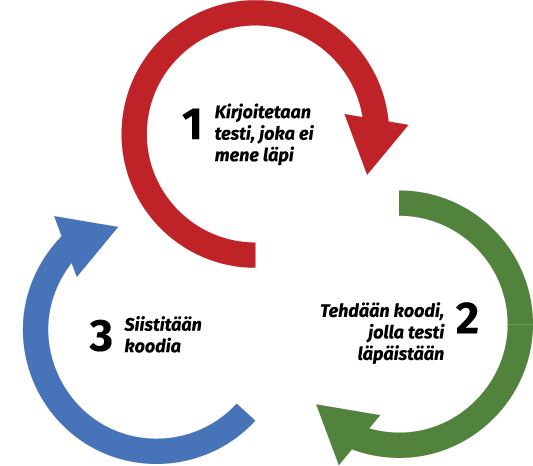
Test-driven development begins with writing a test to verify functionality, so to an outsider, the developers’ work may appear, in the early stages, to be getting off to a slow start and heading in the wrong direction. Nevertheless, development follows a clear three-stage process that progresses systematically:
- We’ll write a test to check the functionality: the new functionality is first implemented in such a way that the test designed to check it fails. This ensures that the test is not faulty and does not automatically pass itself.
- Let’s write a function that passes the test.
- Code that has passed the test is cleaned up – that is, refactored – and tested until it is accepted.
In test-driven development, time is not spent on excessive testing; in other words, tests are not carried out unnecessarily or without careful consideration. It is therefore important to select and write test cases that are best suited to the features currently under development and that focus on the right aspects.
Acceptance criteria do matter
The acceptance criteria for the software and its functionalities guide the design of tests and the test-driven development workflow. Acceptance criteria are derived from the software’s requirements specifications, user stories and quality metrics, which have been devised through collaboration between the project’s stakeholders.
A successful test demonstrates that the software meets the requirements set for it and is in line with the client’s expectations. Unambiguous and clear acceptance criteria also facilitate the monitoring of project progress and internal communication from the perspective of both the client and the developer.
Test-driven development in large-scale software projects
Test-driven development is particularly well-suited to long-term projects and larger-scale client projects. Internal code quality assurance lays a solid foundation for future development. This makes our clients’ versatile software easier to extend and maintain.
For example, new features can be added with confidence, as brand-new code is built solely on top of an existing, tested codebase. Nor can the added functionality introduce bugs or break existing parts of the implementation. Any errors are easier to trace and fix in good time.
Maintaining software developed using a test-driven approach is often easier than with products that are tested retrospectively. Continuous testing of software ensures a high-quality and stable foundation on which even more extensive software can run flawlessly and adapt to users’ changing needs, now and in the future.
Test-driven development is therefore particularly well-suited to large-scale, long-term software projects where several developers work on the code throughout its life cycle. By contrast, during the pilot phase, for example, and when working with various MVP versions (see also “From Idea to Software“), it is often advisable to adopt a methodology that supports faster development.
Quality assurance makes maintenance easier
The outcome of a successful software project is a functional digital product or service that meets users’ needs and provides long-term enjoyment and benefit. A one-off software codebase built on a “just make it work for now” approach is, from a test-driven perspective, a relic of the past, whose further development and maintenance may also consume an unnecessary amount of resources from the client.
Test-driven development is quality assurance at its best. When tests and functionalities are written in accordance with requirements and developers have a firm grasp of good testing practices, the efficiency of the development work is maintained at the highest possible level, regardless of the project’s duration and scope.
Writing quality-assured code is like putting money in the bank: the value of the initial investment becomes apparent over time. Although adopting test-driven development may take time for the development team and requires a stronger commitment from the project team, the end result is a reliable, clear and consistent implementation. In other words, software our clients can be proud of.
Shall we get started?
"*" indicates required fields

You might also like these articles

Further development and modernization of a PHP system – how to go about it the smart way?
Read more

Requirements specification is the cornerstone of a software project
Read more

The elements of a successful software project
Read more

Are you cutting corners at the expense of your business? Cutting corners in software development creates technical debt
Read more
 Accessibility is the starting point for digital services