


The elements of a successful software project
Let’s look at the facts: globally, nearly one in three software projects fails. According to a study by the Standish Group, around 16 percent of software projects succeed in the sense that the end result of the software development is as planned, and the project remains both on schedule and within budget.
Just over 52 percent of projects run behind schedule, exceed their budget, or produce a result which, while functional, does not correspond to the original plan. The remainder – around 32 percent of software projects – fail in the sense that they are discontinued at some point during the project lifecycle.
In this blog post, we’ll look at the most common factors that lead to the failure of a software project and how these challenges can be minimized.
- What is the vision for the software to be developed?
- Requirements specification – the cornerstone of a software project
- The software budget sets the framework for implementation
- The stages of a software project
- Effective communication helps to avoid misunderstandings in a software project
- A successful software project is much more than just a pile of working code
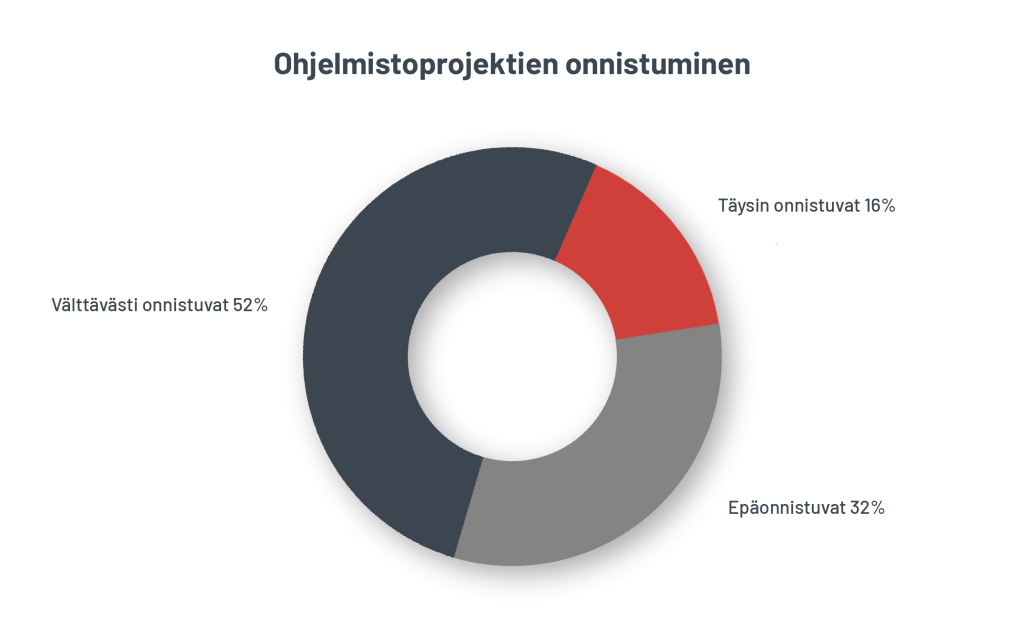
The study includes a broad sample of major players in the software industry, but the same principles also apply to the success of projects in smaller software companies. The most common reasons for the failure of a software project are as follows:
- The project’s vision is not clear
- Changing or poorly defined requirements
- Inadequate budget and resources
- Problems with communication and project transparency
- Insufficient time spent on testing
- Changes in the development team or the departure of key personnel
- Unrealistic expectations regarding delivery times
- Time constraints and premature publications
- Development tools and platforms that are not sufficiently professional
The issues mentioned above often present challenges in the software projects we carry out as well, although I cannot recall a single project that was a complete failure. How can the impact of these challenges be minimized? In this blog post, I’ll be looking at the first four of the most common causes of project failure.
What is the vision for the software to be developed?
In the beginning, there was a vision – software projects should have a clear vision, i.e. a clear understanding of what is being done, for whom and why? What processes will the software streamline, or what problems will it solve? What is the software’s value compared to that of competitors? How will the software’s functionality and productivity be measured? The vision must, of course, be clear to the client themselves, but also to the entire development team.
Without a clear vision, development work can easily become focused solely on implementing individual software functions, without any connection to the end user or various use cases. A clear vision, along with an understanding of the bigger picture and future developments, also makes practical work more efficient in the long term – for example, software components can be designed to be directly compatible with future development initiatives. This will save both time and money in the long run.
Requirements specification – the cornerstone of a software project
It is common in software development for the original specifications to be amended during the course of a project. In an agile software development model, this is actually standard practice. There is a risk that the project will, so to speak, get out of hand if the requirements specification is initially inadequate or has been drawn up at too general a level. However, producing a complete requirements specification before the project begins is labor-intensive and not necessarily even sensible.
Nevertheless, at the very least, the main points regarding the functional requirements (a description of the software’s features and functions) and the qualitative requirements (a description of how the program should operate) should be clear. Useful tools during the specification phase include, for example
- requirements workshops held in collaboration with the client and the software’s end users
- conducting interviews with end users or carrying out user research
- user interface prototypes, or so-called mock-ups
- documenting different use cases
- reviewing requirements as a team (developers, designers, users)
The software budget sets the framework for implementation
Based on the functional and quality specifications of the software, it is possible to estimate the implementation time required for the project, which in turn can be converted into the project’s costs. One aspect of requirements specification is to take into account resource requirements – that is, how much money and time can realistically be allocated to the project. It is advisable to know the available budget right from the start, as this often influences the functionalities to be implemented, the implementation methods and the scheduling.
It is important to assess which requirements are critical and which can be omitted entirely. It is not necessarily essential to implement all the software’s functionalities straight away, and the project as a whole can often be spread out over a longer timeframe. In this case, the costs of the software are also spread more evenly over a longer period.
The stages of a software project
A software project usually progresses in stages — not because bureaucracy demands it, but because good software isn’t created in one go. Each stage helps us understand what we’re doing and why.
Here are the key stages and what happens at each one:
- Defining needs and objectives
- It all starts with a question: why is this software needed?
- At this stage, the problem, users’ needs and business objectives are identified. This is often done through workshops, interviews and research.
- The end result is a shared understanding of what we are trying to solve – though not yet how.
- Design
- During the design phase, a solution is formulated: what functions the software will include, what it will look like and how it will be used.
- At this stage, the following often occurs:
- User interface designs and prototypes (e.g. Figma)
- Architectural description, i.e. how the system is technically structured
- Initial decisions on the technologies to be used
- Good planning saves money and stress later on.
- Development
- At this stage, the plans are turned into actual code. Developers build features, test them and release interim versions.
- In most modern projects, development is carried out using agile methods: the work is divided into smaller sprints, with something being completed in each one.
- This enables continuous feedback and course corrections as you go along.
- Release and roll-out
- Once the software is ready, it is deployed in the appropriate environment – as a web service, a mobile app or an internal tool.
- This stage may involve training, documentation and the transfer of data from the old systems to the new ones.
- Ongoing development and maintenance
- A software project never really ends. Once it has been deployed, the phase of continuous development begins: bug fixes, updates, new features and performance improvements.
- Good software evolves alongside its users – it’s a living thing.
A well-run project moves smoothly through these stages.
The most important thing is not that everything goes perfectly, but that at every stage we pause to reflect on what we have learned and what is needed next.
Effective communication helps to avoid misunderstandings in a software project
Open communication throughout the planning, development and production phases is of paramount importance in a successful software project. Communication breakdowns and misunderstandings are one of the surest ways to cause a project to fail. The larger the project, the more people are involved in different roles. It is important that the project team is assembled from the right people and that each person’s areas of responsibility are agreed upon. It is also essential to agree on the project’s communication channels and methods: what is communicated, at what stage, and who communicates it.
The cornerstones of communication could include, for example, light and quick status meetings held frequently enough among the development team, sprint reviews held after longer development cycles, and interim reviews of the broader project scope carried out jointly with the client. Both the client and the development team must work closely together to ensure that all thoughts, ideas and information regarding requirements are clearly communicated to the developers. Assumptions and underestimating the client’s role in the project usually lead to the end result differing from what the client originally had in mind.
A successful software project is much more than just a pile of working code
A clear vision of the end result, thorough preparatory work, adequate specifications and communication throughout the project help to keep the whole project on the right track. In addition to the points mentioned above, there are many other factors that influence the success of a project, such as
- insufficient time spent on testing
- a change in the development team or the departure of key personnel during the project
- unrealistic expectations regarding delivery times
- software releases at too early a stage
- inadequate development tools and a lack of expertise
Successful software projects often place high demands on professional project management.
Shall we get started?
"*" indicates required fields

You might also like these articles

Purchasing a software project
Read more

Requirements specification is the cornerstone of a software project
Read more

Agile Methods: Lean, Agile and Scrum in Practice
Read more

Effective project management is a prerequisite for the success of IT projects and a way of ensuring the value delivered by the project
Read more
 Google Analytics 4 (GA4)