


Context engineering – guiding LLMs to deliver business value
The use of artificial intelligence in software development is growing rapidly, and large language models (LLMs) in particular are opening up entirely new possibilities. However, simply using AI is not enough if no clear framework is provided for its operation.
The term ‘prompt engineering’ has been used for some time now in discussions about artificial intelligence. Recently, the term ‘context engineering’ has also come to the forefront.
- What is context engineering?
- Prompt engineering vs. context engineering
- Context engineering highlights the developer’s new role in software development
- Use cases, user stories and user journeys as building blocks of context
- Spec-driven development – how context is translated into specifications
- AI tools to provide practical support
- Typical challenges and what we can learn from them
- Context engineering is a new key concept in the use of artificial intelligence in software development
What is context engineering?
Context engineering is an approach designed to ensure that large language models (LLMs) are provided with all the context they need to solve a given task.
This means, therefore, that AI is provided with the correct background information, objectives and parameters so that it can produce results that are useful to the business. Without context, AI can certainly generate text or code, but the end result is often too general and does not meet the actual need. In practice, this means that the human’s role is to define the ‘framework’ within which the AI operates. In this way, the code generated by AI is not only technically functional but also commercially relevant.
In the context of application development, context design combines use cases, user stories and user journeys into a clear roadmap that enables AI tools to build prototypes and application ideas that solve real business challenges.
Prompt engineering vs. context engineering
The term ‘prompt engineering’ has been used for some time now in discussions relating to artificial intelligence. In Finnish, the terms ‘kehotus’ and ‘syötesuunnittelu’ are used. Recently, the term ‘context engineering’ has also come to the forefront. For example, Tobias Lütke, CEO and co-founder of Shopify, wrote that he prefers this term to ‘prompt engineering’, as it better describes the core skill required when working with artificial intelligence.
In other words, prompt engineering involves formulating a single prompt, whereas context engineering involves constructing the whole.
Context engineering highlights the developer’s new role in software development
Artificial intelligence, particularly LLM models, has revolutionized software development. Previously, a large part of a developer’s work was spent writing the code itself. Now, AI is capable of generating functional code from just a few lines of instructions. However, the human role is not disappearing – it is changing. Developers are increasingly becoming problem definers, designers and managers of the overall picture.
TechRadar describes this shift as one in which AI does not replace programmers but frees them up to focus on higher-level issues such as architecture, design and creative solutions. Developers are rapidly becoming coordinators and supervisors rather than actual code writers.
Phil Schmid has summarized that context engineering is no longer simply a matter of entering individual prompts, but rather the systematic construction of a framework. When an LLM is provided with the correct background information, objectives and constraints, it is able to solve the task credibly and in a way that supports the business.
Andrej Karpathy has also spoken about the so-called ‘Software 3.0’ approach. According to him, the focus of programming is shifting from writing code to guiding models and managing context. The core skill of the developer of the future is therefore no longer simply producing code, but the ability to describe a problem, build the right framework and monitor the outputs of artificial intelligence. This way of thinking is also in line with agile methodologies, such as the Lean and Scrum models, as they too emphasize continuous dialogue, rapid iteration and managing the big picture rather than individual technical solutions.
Use cases, user stories and user journeys as building blocks of context
Context engineering is not based on individual commands, but on understanding the bigger picture. The key building blocks are:
- A use case describes the situations in which the application is used and the problems it solves.
- A user story brings a human perspective to a use case. It explains who the user is, what they want to do and why.
- The user journey broadens the perspective to encompass the entire customer journey and the various stages of using the application.
A use case defines the situation in which the application is used and the problem to be solved. A user story highlights the human perspective: who the user is, what they want to do, and why it is important. A user journey, on the other hand, broadens the view from a single situation to the customer’s entire journey and the use of the application at different stages.
When these three elements are combined, the AI is given instructions that enable it to generate application ideas and prototypes that genuinely solve business challenges and improve the user experience.
Spec-driven development – how context is translated into specifications
Context engineering is closely linked to the concept of spec-driven development. In this approach, the implementation of software is based on a precise, pre-defined specification that guides all work. When use cases, user stories and user flows are compiled into a clear ‘spec’, the AI is provided with an unambiguous framework on the basis of which it can generate code, tests and documentation. This ensures that the solutions produced by the AI remain aligned with business objectives.
Spec-driven development came to the forefront particularly through the open-source community, as tools such as Spec Kit and agent-driven IDEs, such as Kiro, began to gain widespread adoption in 2024–2025 alongside AI-native development practices. The method does not have a single clear ‘inventor’; rather, its definition and adoption were significantly influenced by product leaders such as Nikhil Swaminathan and Richard Threlkeld (Kiro) and advocates such as Den Delimarsky (Spec Kit). Their work focused on ensuring that the specification served as a functional focal point for both code generation and software design.
Spec-driven development therefore complements context engineering, as both emphasize the idea that a clear, predefined framework is essential for successful software development.
AI tools to provide practical support
Context engineering is not merely a theory. There are a number of tools available to help build and manage context in practice.
- Codex and Claude Code are coding agents capable of generating comprehensive code solutions based on a complete set of instructions. They are particularly effective when the context is clearly defined: what the application is required to do, which interfaces it must utilize, and what constraints must be taken into account. If the context is missing, coding agents may produce code that is technically functional but of no business value.
- Cursor is an editor designed for programming that integrates AI with code writing. It allows you to give precise instructions to an LLM at the code level. This is particularly useful when you want to quickly test how a specification – such as a function derived from a user story – can be implemented technically. Cursor supports iterative working: the developer can refine the instructions, and the AI modifies the code accordingly.
- Bolt.new, on the other hand, is ideal for rapid prototyping. It generates a demo version of a user interface or application based on a brief description. This works well during the ideation phase, but without a clear context, the results remain generic. When given a precisely defined use case and user journey, the prototype immediately looks more credible and closer to the business need.
- ChatGPT, Claude and Copilot are useful tools during the specification phase. They can be used to write and refine user stories, as well as to clarify use cases. They work well as brainstorming partners: for example, you can ask them, “What alternative user journeys might an application like this include?”. This deepens the context and refines the instructions given to the AI.
Making use of user journeys adds yet another important layer to the overall picture. When a journey is mapped out from start to finish, AI is able to build functionalities that support the user throughout the entire journey – not just at a single stage.
Typical challenges and what we can learn from them
Contextual design can fail if the instructions are too general. In such cases, the AI generates disjointed content that does not meet the user’s actual needs. For example, “create an appointment booking app” may result in a generic solution that fails to take into account the specific characteristics of the business.
Another common mistake is a lack of background data. If the use case or user journey has not been fully thought through, the prototype generated by the AI will not solve the actual problem. Adding background information – for example, details of the circumstances in which the user operates or which other systems the application needs to utilize – makes the end result more usable.
The third challenge is an excessive focus on detail. If you try to include every possible detail in the instructions, the AI gets bogged down in the details and is unable to see the bigger picture. A better approach is to define a clear context and give the AI room to suggest alternatives.
What we can learn from these challenges is that balance is the most important factor. A good context is precise enough, yet open enough to allow artificial intelligence to come up with new ideas.
Context engineering is a new key concept in the use of artificial intelligence in software development
Context engineering shifts the developer’s role from that of a coder to that of a manager of the overall system, and ensures that artificial intelligence operates within a framework that supports business operations.
Use cases, user stories and user journeys form the foundation of the context upon which artificial intelligence can build useful application ideas and prototypes. Spec-driven development reinforces this approach by providing a clear definition of the context.
When these are combined, artificial intelligence is not merely a code generator, but becomes a tool that generates value for the business.
Ready to get started?
"*" indicates required fields

You might also like these articles

6 winning use cases for AI – how to find where it really pays off
Read more

User stories as a tool in app design using artificial intelligence
Read more

No-code and low-code software development, as well as AI, are streamlining application development
Read more
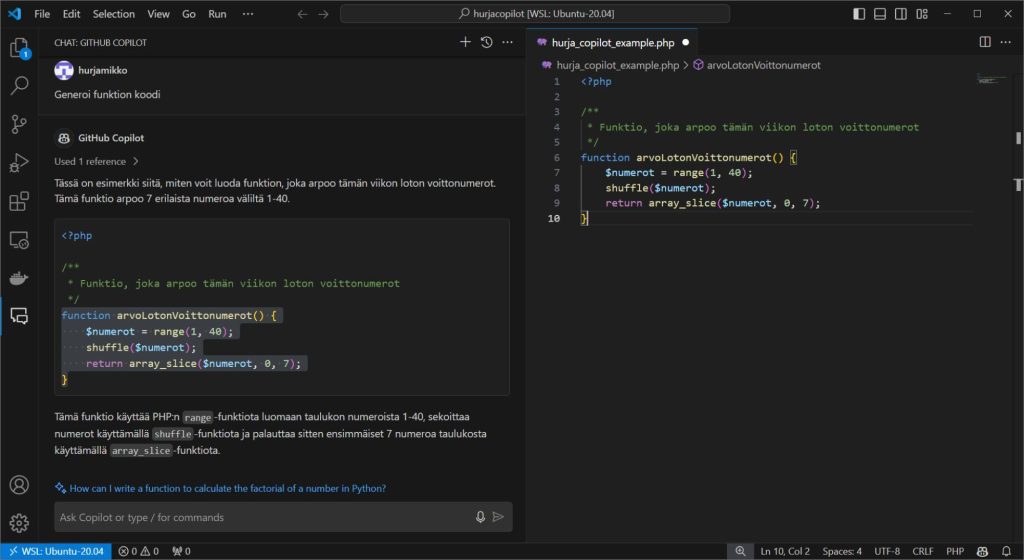
GitHub Copilot – utilizing artificial intelligence in software development
Read more
 Agile Methods: Lean, Agile and Scrum in Practice