

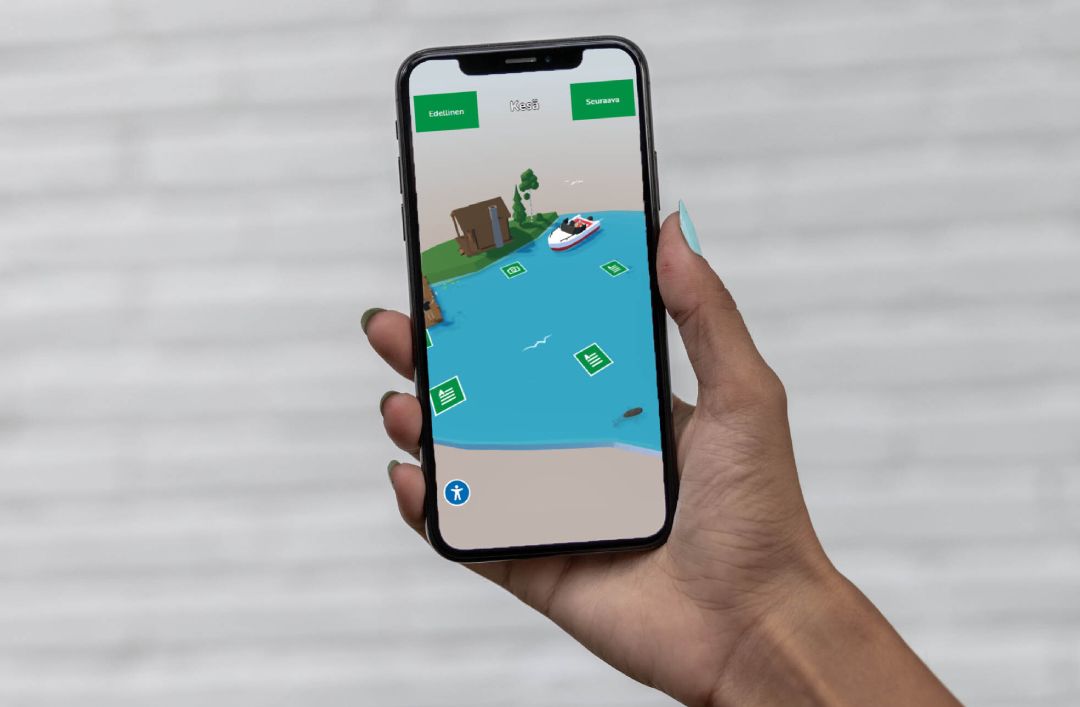
Web AR – a new dimension in online content
Web AR refers to an AR application that runs in a mobile device’s web browser. Users do not need to download a separate app from an app store; instead, they can simply visit a website using their mobile device’s browser to enjoy the AR experience.
The most significant benefit of Web AR is that, from the user’s perspective, AR content is effortlessly accessible via the most common devices and web browsers. However, the implementation and development of Web AR differ from app-based AR in many ways, which is why it is particularly well-suited to lighter augmented reality solutions.
AR, or augmented reality, brings a fresh, modern touch to a company’s communications through digital technology. It is important to stand out from the crowd in such a way that customers are left with a positive impression of the service. Sometimes it’s best to achieve this through more extensive AR content, while at other times a simpler AR feature may be better suited to the company’s specific objectives.
Fancy giving it a go right away? Try out the web AR application we’ve developed for Metsähallitus to support the conservation of the Saimaa ringed seal!
How Web AR works
Developing Web AR is fairly straightforward:
- We produce AR content in line with the company’s brand
- The content is coded using the selected method (e.g. Three.js, A-Frame, AR.js, 8th Wall) to create an AR implementation suitable for web browsers
- The code and content for the AR implementation are uploaded to the website’s server
- The user visits the website using their own web browser and utilizes the web AR feature.
Try out the app
The app is designed for mobile use and to be used with a trigger image, but you can also test the app without a trigger image by clicking the 3D button in the bottom right-hand corner. Testing requires your device to have a camera. Try out the app at norpanvesilla.fi!
The Web AR implementation is hosted on the website’s server
Web AR implementations make use of the web browsers on end users’ own mobile devices. With Web AR technology, a standard web browser is transformed into an augmented reality viewing window, provided the user’s device supports AR functions.
The content and code for a Web AR implementation are hosted on the website’s servers, so the hardware requirements are minimal. It does not require as much storage space or processing power from the user’s device as AR applications that are downloaded onto the device.
It is easy for users to explore web-based AR content wherever and whenever they like, as this web-based AR solution does not require them to download and install a separate AR app from an app store. Quick deployment and AR content that supports the company’s objectives encourage customers to try out services and engage with products. It is also worth noting that an AR project implemented for web browsers does not require resources for separate app development. Furthermore, the publication phase via app stores is completely eliminated in browser-based web AR.
Maintaining an AR implementation hosted on a web server is less resource-intensive than maintaining AR applications and their add-ons that are downloaded onto a user’s own device. Instead of user-specific app updates, it is sufficient to update the source code hosted on the server and ensure that the updates are compatible with web browser requirements.
However, it is important to recognize that web AR implementations come with certain limitations relating to data transfer. The content must be well optimized and sufficiently lightweight to ensure that high-quality AR content loads onto the user’s screen for them to enjoy without unnecessary delays.
The technology is used to detect stimuli and the environment
Web AR technology can be broadly divided into two categories based on how content is anchored. In AR based on trigger image recognition, the content is anchored by scanning a trigger image with the mobile device’s camera, after which the content is superimposed onto the trigger image. In AR based on surface recognition, the mobile device’s camera identifies flat surfaces such as walls or floors, and the user selects the point to which the content is anchored. In this way, content can be attached, for example, to a table, a wall or the floor.
An implementation based on a trigger image is best suited to situations where the display of content is to be linked to a specific environment, or positioned at a specific point in relation to the trigger image. AR based on surface recognition, on the other hand, is best suited to situations where the user is to be given complete freedom in terms of viewing and positioning the content.
The potential of Web AR
It makes sense to approach an AR implementation through the company’s objectives and to select the technologies best suited to the purpose based on genuine needs. Web AR is suitable, for example, in situations where the end user does not need the AR application continuously, familiarisation with the AR content is quick and a one-off process, the AR content to be implemented is technically demanding, or the augmented reality is to be integrated with other web services.
Applications for Web AR include, for example:
- Product instructions, product descriptions and additional content in ads. Augmented reality makes it easy to draw the user’s attention to specific details and create a memorable experience.
- Teaching and induction. Web AR adapted for educational use enables the creation of supplementary instructional materials on a shared web-based platform. The learning experience is memorable when the user interacts with the content being taught.
- Online shops. Various prototypes, as well as 2D and 3D models, which allow customers to view real-world products in their actual size and setting, help them choose the product that best suits their needs.
We create custom AR solutions
AR applications are particularly popular in the gaming world, and best practices are now rapidly being incorporated into other services and marketing. AR content provides the means to offer a wide range of additional information, to learn new things and to understand content, even when several providers of interesting additional information are competing for the customer’s attention at the same time.
We see web AR as a welcome alternative to lighter AR implementations and an excellent tool for delivering various types of content. Augmented reality implementations do not always require a full-fledged AR app; rather, a lighter AR element or an enriched detail can enhance the customer experience at just the right moment.
At Hurja, we create augmented reality solutions tailored to our clients’ needs, using a variety of tools and on different scales, while, of course, keeping up to date with the latest technologies. We are happy to deliver both simpler web AR packages and more comprehensive AR solutions that include a dedicated app.
Find out more about our augmented reality services!
Shall we get started?
"*" indicates required fields

You might also like these articles

AI Applications in Business in 2026: Off-the-shelf tools vs custom solutions
Read more

Digital quality assurance in industry – less paper, more transparency
Read more

Good software isn’t created by chance – a service design workshop can help
Read more
Application development as an enabler of business growth and digitalization – cost, benefits and implementation
Read more
 How much does software development cost?