

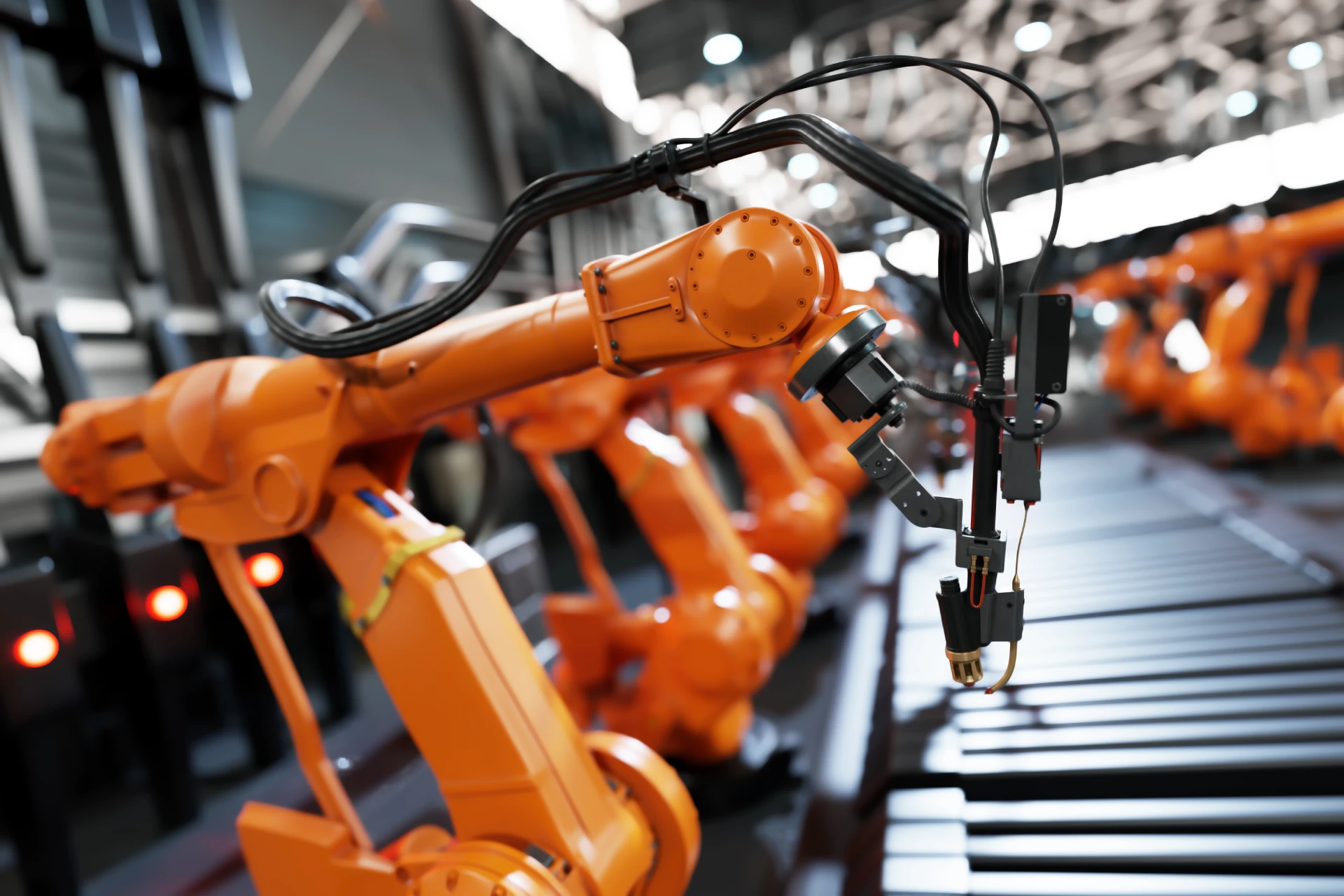
The potential of artificial intelligence for industry – efficiency, precision and cost savings in production processes
Artificial intelligence is gradually establishing itself in industry, and it is not just a matter of technological sophistication – it enables companies to streamline their processes, save time and money, and improve quality.
In practice, this means that even complex tasks, which used to be time-consuming and nerve-wracking, can now be smoothly automated with the help of artificial intelligence. Digitalization is generating huge amounts of data in industry, which AI can analyze efficiently, enabling rapid and accurate decision-making. AI helps companies make better use of this data, which can lead to significant savings and improved operational efficiency.
Artificial intelligence is not just a technology, but a strategic tool that transforms the way your company operates and opens the door to new business opportunities. With the help of artificial intelligence, it is possible to implement customised solutions that scale to meet companies’ specific needs – solutions we could not even have imagined before.
In this article, we’ll look at how artificial intelligence is revolutionizing industry and how we at Hurja can help businesses harness its potential.
- The digitalization of industry is leading to smarter and more efficient processes
- Artificial intelligence is taking industrial digitalization to a new level
- The use of artificial intelligence in order processing – Case study: Odoo AI Order Processor
- The application of artificial intelligence in predictive maintenance
- Optimizing production using artificial intelligence
- Quality control and error reduction using artificial intelligence
- Artificial intelligence in improving energy efficiency
- Artificial intelligence as part of a company’s strategy
- The role of artificial intelligence in reducing cognitive load and unleashing creativity in the workplace
- First steps in utilizing artificial intelligence
- Artificial intelligence as a driver of industrial growth and efficiency
The digitalization of industry is leading to smarter and more efficient processes
The accelerating digitalization of industry has opened up enormous opportunities to improve efficiency, competitiveness and innovation. The shift from traditional manual and paper-based processes to digital solutions has already significantly transformed working practices. Today, digital platforms enable real-time data collection, analysis and decision-making, generating vast amounts of data. This data has become one of the most important assets, helping companies evolve towards smarter and more efficient operating models. Previously, production and logistics often operated on separate systems, but now integrated solutions link the entire supply chain, ensuring that processes run seamlessly and optimally from start to finish.
IoT devices, cloud services and smart software have opened up new opportunities for industry in terms of process management and optimization. Technological advances have laid a solid foundation for the adoption of artificial intelligence, which is the next step on the path to industrial digitalization. Artificial intelligence is capable of utilizing vast amounts of data and takes optimization, automation and decision-making to a whole new level. By combining the opportunities offered by digitalization with artificial intelligence, companies can reduce manual labor, increase accuracy and further speed up processes – which in turn enhances their competitive advantage in rapidly changing markets.
Artificial intelligence brings a new dimension to digitalization and enables process optimization on an entirely new level. This is reflected in tangible improvements across various areas of business, such as the streamlining of processes and services. For example, the Finspection App we have developed – which utilizes artificial intelligence technologies – has helped to digitize many of the inspection body’s business processes.
Another interesting possibility is, for example, the integration of artificial intelligence into mixed reality, such as the Microsoft Dynamics 365 Guides app. Guides provides real-time guidance to industrial workers using holograms and natural language. This technology reduces errors, speeds up workflows and optimizes processes, while providing AI-based decision-making support directly to front-line workers. In this way, digitalization and artificial intelligence work together to streamline industrial processes, resulting in improved operational efficiency and business performance.
Artificial intelligence is taking industrial digitalization to a new level
Artificial intelligence brings enormous additional benefits to the digitalization of industry, particularly in the manufacturing, process and logistics sectors. Its ability to analyze and utilize large amounts of data in real time takes optimization and automation to a whole new level. The data collected through digitalization is no longer just a passive repository of information; rather, it becomes the driving force behind AI-based systems that identify process bottlenecks, detect anomalies and predict potential problems before they have a chance to escalate. This enables faster, more accurate decisions and more efficient, error-free production.
In the manufacturing industry, for example, artificial intelligence analyzes sensor data from production lines, detects even the slightest deviations and suggests the necessary optimizations. This helps to reduce production line downtime and improve product quality. Siemens, for example, has implemented artificial intelligence in predictive maintenance, where IoT sensors collect real-time data on machine performance and AI analyzes this data to identify potential faults before they have a chance to cause major disruptions.
Artificial intelligence therefore does not merely bring efficiency; it enables smart solutions that allow industrial processes to be optimized even further. This combines the opportunities offered by digitalization with the advanced analytics and decision-making capabilities of artificial intelligence, laying the foundations for competitive industrial solutions of the future.
The potential of AI solutions is best realized when seen in practice. That is why we use the AI Sandbox right from the very first discussions to bring the possibilities of AI to life.
The use of artificial intelligence in order processing – Case study: Odoo AI Order Processor
One concrete example of the application of artificial intelligence in industry is the automation of order processing. In many companies, orders are still received by email, and entering them into the ERP system is a slow and error-prone process. At Hurja, we built an AI agent that automatically processes email orders and transfers the data directly to the Odoo enterprise resource planning system.
The solution can read orders in a variety of formats – as text in messages, PDF attachments, Excel files or even images – and standardizes them into a uniform format. Orders are displayed to the user in a clear, easy-to-check view, and once approved, the data is transferred to the ERP system without the need for manual data entry. This transforms order processing from a multi-step task into a one-click process.
The benefits are quickly evident in day-to-day operations: processing times are reduced from minutes to seconds, errors are minimized, and staff have more time to devote to other tasks. At the same time, the customer experience improves as orders are processed more quickly and delivery reliability increases. This is a good example of how artificial intelligence can solve practical problems in industrial processes and deliver clear cost savings.
The application of artificial intelligence in predictive maintenance
Optimizing production using artificial intelligence
Quality control and error reduction using artificial intelligence
Artificial intelligence in improving energy efficiency
Artificial intelligence as part of a company’s strategy
The successful implementation of artificial intelligence in industry requires strategic planning and strategic leadership. This is because integrating AI into a company’s existing systems requires both technological investment and internal organizational change. Company management must identify at which stage AI can deliver the greatest benefits and which functions will benefit from automation and analytics.
At Hurja, we want to help businesses utilize artificial intelligence as part of their long-term strategy. We offer custom-built software solutions that can be integrated into a company’s existing systems. Our aim is for our clients to derive tangible benefits from the use of AI. Implementing AI does require planning, but the benefits it brings – such as improved efficiency, optimized production and cost savings – are significant.
In companies, the roll-out of artificial intelligence can take place gradually, starting, for example, with trials of predictive maintenance or the optimization of quality control. When AI solutions are integrated into existing systems, their benefits can be extended across the entire production chain.
The role of artificial intelligence in reducing cognitive load and unleashing creativity in the workplace
The use of artificial intelligence in work processes brings significant benefits, not only in terms of improving operational efficiency but also in reducing the cognitive load on people. It streamlines decision-making, particularly when dealing with repetitive and precision-demanding, yet simple, tasks. This speeds up processes and frees up employees to focus on more complex tasks that require creativity and strategic thinking.
It has been estimated that modern humans make as many as 35,000 decisions every day, which drains the brain’s resources, particularly the prefrontal cortex, which plays a key role in decision-making. When the brain becomes overloaded by a constant stream of minor decisions, such as routine information processing, the build-up of glutamate in the brain begins to reduce decision-making capacity. The more decisions are made, the less energy the brain has left for making complex, energy-intensive decisions.
Artificial intelligence makes it possible to hand over simpler, precision-intensive tasks to automation. This frees up employees to focus on tasks that have a greater impact on the company’s success. When routine decision-making is handled by artificial intelligence, employees have more scope to use their creativity and analytical skills on the challenges where their expertise is most crucial.
Furthermore, decision-making fatigue – which arises from the mental strain caused by constantly having to make small decisions – can be reduced with the help of artificial intelligence. When artificial intelligence handles a large proportion of these decisions, employees’ cognitive resources are freed up for more significant decisions and value-adding activities.
Artificial intelligence therefore not only improves operational efficiency, but also supports employees’ wellbeing and performance throughout the working day.
First steps in utilizing artificial intelligence
The transition to artificial intelligence in industrial companies, too, can begin with small, controlled trials – for example, in support functions – by automating simple tasks.
- No-code and low-code platforms, combined with artificial intelligence, can be used for pilot projects that do not require in-depth programming skills. For example, these tools can be used to streamline invoice processing and email management.
- With the help of ChatGPT, customer service teams can answer customers’ questions quickly and accurately, freeing up staff to deal with more complex issues.
- Google APIs, such as the Vision API and the Natural Language API, can be integrated into various applications to enable image recognition and natural language processing. Google Sheets, on the other hand, can be used to automate spreadsheet tasks and integrate them with other business processes.
For example, these tools enable companies to take their first steps towards utilizing artificial intelligence, which improves efficiency and makes day-to-day work easier, without having to embark on large-scale AI projects straight away.

Artificial intelligence as a driver of industrial growth and efficiency
The potential of artificial intelligence is virtually limitless, and its application in industry offers significant benefits, such as the optimization of production processes, cost savings, improved quality and a reduction in the cognitive load on us as humans. By working together, we can identify how artificial intelligence could best serve your company’s needs and objectives.
Artificial intelligence can provide solutions for, for example, optimizing production, predictive maintenance or improving quality control. Real-time data analysis and the predictions provided by artificial intelligence enable more efficient use of resources, as well as the anticipation and management of problems. This makes decision-making more accurate and faster, which improves the efficiency of the entire production chain.
The most important thing is to identify the areas where artificial intelligence can bring clear added value, and to start with smaller-scale trials. This helps to develop solutions that improve the efficiency of your operations and support competitiveness in the long term.
Let’s work together to find the ways of using artificial intelligence that are best suited to your business!
Shall we get started?
"*" indicates required fields

You might also like these articles

Smart remote management in industry – up to 30% savings on maintenance
Read more
Digitalization of production management and reporting – efficiency and growth
Read more

Digital quality assurance in industry – less paper, more transparency
Read more

6 winning use cases for AI – how to find where it really pays off
Read more
 Software integration