
Website redesign – goal-oriented website design
It is worth starting a website redesign by considering what you want to achieve with the site. A website is often a company’s most important digital touchpoint, so its role is to support the business’s objectives.
Growth, profitability and competitiveness are key objectives, and in most cases the purpose of a website is to boost sales. Exceptions to this are associations and non-profit organizations, which have their own specific objectives.
How a website actually helps to achieve these objectives depends on the nature of the business. On a successful website, the right visitors find what they’re looking for and carry out the actions the company wants them to, such as making a purchase or getting in touch. When redesigning an online store, the focus is often on how to make the site better support the purchasing process. If sales do not take place directly on the site, the design should focus on making it as easy as possible for visitors to get in touch. In the digital world, these objectives are referred to as conversions.
Be that as it may, a successful website redesign always requires an understanding of the target audience’s needs. In this blog, we’ll share our top tips and practical examples to help you achieve better results online.
When designing websites, the objectives and the target audience are key
Goal-oriented website design begins with setting objectives and understanding the target audience. A good website answers your clients’ questions, solves their problems and is built around content that interests them.
For this reason, when embarking on a website redesign, we should bear in mind the website’s primary objective and focus on the target audience.
- Why does my website exist?
- Who do I want to reach?
- What information can I provide to encourage them to visit my website?
- How can I encourage visitors to get in touch or make a purchase on the website?
Set measurable targets for the website
However, there is no point in setting targets if they cannot actually be measured.
You can use the SMART method (Specific, Measurable, Achievable, Relevant, Time-bound), for example, when setting targets.
- Specific
- If you don’t have an online shop and the aim of your website is to generate leads, first define what counts as a lead. A lead could be, for example, an inquiry received via your website. When redesigning your website, your objective in this situation is therefore likely to be increasing the number of leads.
- Measurable
- And can enquiries from the website be tracked? You could, of course, keep a record of the number of leads in Excel, for example, but in the long run that becomes a bit of a hassle.
- It makes more sense to monitor website traffic using a web analytics tool, such as Google Analytics or, alternatively, Matomo, for example. This will allow you to find out not only the number of leads but also, for example, which channels they come from. At the same time, you’ll gather other useful information for developing your marketing and sales.
- Achievable
- If the aim of the website revamp is to increase the number of leads, it is also worth considering what level of growth is realistic.
- Relevant
- If a company generates business through enquiries, increasing the number of leads is also a relevant business objective.
- Time-Bound
- How long will it take to achieve the set target, and when is it intended to be achieved? If the website has not been using web analytics, this is difficult to assess. In that case, it may not be known how many leads have been generated in the past or from which sources they originated.
In any case, it is not worth relying too heavily on an increase in organic traffic if search engine visibility is not taken into account when designing a website.
If your aim is to improve your website’s search engine visibility, it’s worth starting your website revamp with an SEO audit of your existing site, which includes, among other things, keyword research.
For example, reverse keyword research can be used to ensure that content which is already performing well and driving traffic is retained during the revamp. This prevents the site’s current search engine visibility from being inadvertently compromised.
Website Content Plan
The importance of website design cannot be overstated. Before planning the structure or layout, it is important to assess the current situation: what content is needed, who it is aimed at, and what its purpose is.
Our website redesign process begins with us gaining an understanding of your company’s objectives, target audiences and the various stages of the customer’s purchasing journey. At the same time, we identify what information a potential customer needs to move towards making contact or a purchase. You don’t have to figure these things out on your own: we’ll help you with the analysis, and if necessary, we can do this together through a workshop.
A content plan is drawn up on the basis of the audit. The plan includes, as a minimum, an outline of the required pages, images, text, language translations and downloadable materials. This ensures that all necessary content is taken into account right from the start. At the same time, it provides a clear to-do list for producing any missing content.
The content plan also serves as the basis for designing the website’s structure. Once it is clear what content the site needs and what it is intended to achieve, the UX/UI designer can begin to outline user journeys, wireframes and the site’s structure. In this way, content, usability and business objectives are integrated into the design process right from the start.
Content production is an essential part of a website project
Your website should contain the content your customers need to progress through the purchasing process. This information must also be easy and quick to find. High-quality content also boosts search engine visibility, as the content that performs best in search engines is that which meets the user’s needs.
Content production can refer to website texts written to meet a company’s needs. These texts can be supplemented with images, highlights and other visual elements to ensure the website serves its users as effectively as possible. AI tools, such as ChatGPT, can speed up the production of draft texts, but the final content should always be carefully polished. The content must reflect your company’s voice, appeal to the right target audience and support the objectives set for the website.
In website projects, content production is, all too often, a stage where the workload is underestimated. The entire project can grind to a halt at this stage if content production is left entirely to the client. At Hurja, we’re here to help you with our own expertise and that of our partners, including in search engine optimization and content production. We help you identify the content you need, plan its structure and produce the text so that your website revamp proceeds as planned and your new site boosts your visibility on search engines right from the moment it goes live.
Website design: structure
Structural design is one of the most important stages of a website project, as good usability determines whether a visitor can find the information they need on the site and proceed to the desired action. Once the content plan has been drawn up, it can be used as a basis for outlining the site’s structure, user journeys and key views.
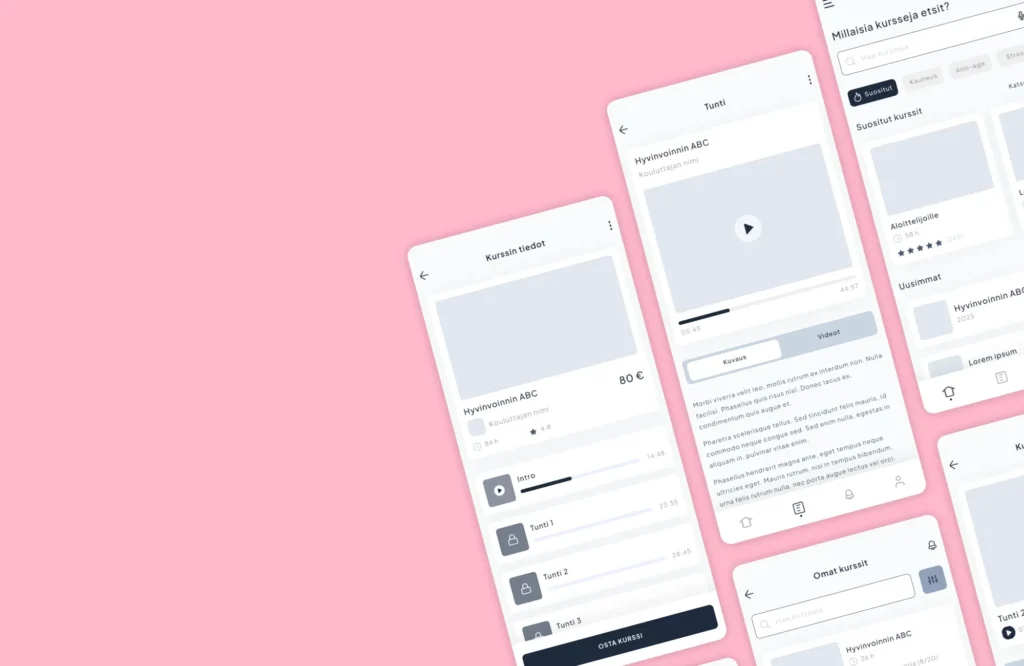
Our UX/UI designer takes the content plan as a basis and turns it into a concrete design. First, the overall structure is outlined using a wireframe, after which the design is refined into a more visual layout. At this stage, we define in more detail how the pages are linked to one another, where the most important content can be found, and how visitors navigate the site.
Once you have a clear idea of what the website will look like, that’s the best time to ensure that it guides visitors in the right direction and supports your business objectives. At this stage, changes are still quick and inexpensive to make, as the actual development work has not yet begun.
The structure should support conversions. It must be clear to the visitor what they are expected to do: for example, get in touch, make a purchase or move on to the next step. Unnecessary clicks and distracting features should be removed so that the website guides the user forward as clearly as possible.
The most important pages should be accessible with as few clicks as possible. The design of the site structure is always based on the customer’s needs. A visitor’s journey can be thought of as a path that runs through the main pages and branches off into smaller paths, i.e. sub-pages.
A preliminary structure can be sketched out using artificial intelligence or, for example, in Google Sheets, but the final design of the structure should be left to a UX/UI designer. The designer uses Figma in their work, which allows the structure, user flows and key screens to be tested and approved before development begins.
UX and UI design go hand in hand. Work is carried out simultaneously on both the user experience and user interface design fronts. A top-class designer combines graphic design skills with an understanding of web development. This ensures that the user interface works both visually and technically, and that the websites meet the objectives set for them.
The structure of a website is designed on the basis of the content plan. The structure defines the order of the pages, user paths and how the site guides visitors towards the desired action.
- The content plan is used as the foundation for the structure
The content plan helps determine which pages are needed for the site, what topics they will cover, and how the overall entity should be structured.
- User journeys are outlined
During the design phase, we map out how visitors navigate the site, where they find the information they need, and how they are guided forward.
- Key pages are highlighted for easy discoverability
The structure ensures that the most important content can be found in as few clicks as possible and that the site is easy to navigate.
- The structure is designed to support conversions
The site structure should make it clear to visitors what action they are expected to take. The goal could be, for example, getting in touch, making a purchase, or moving to the next step.
- A wireframe and layout design are created from the structure
The UX/UI designer refines the structure first into a wireframe and then into a more visual layout plan.
- The structure and views are approved before development begins
Using the Figma design, the structure, user journeys, and key views can be reviewed prior to implementation. At this stage, changes are still fast and cost-effective to make.
Choosing a publishing system
When planning a new website, it is also worth carefully considering your choice of content management system. It is generally safer to choose a widely used system rather than an unknown or rarely used platform. The most popular website platforms in Finland are WordPress, Drupal, Liferay and Episerver. There are several reasons why these content management systems are so popular. This means that, in the future, you will not be tied solely to the service provider that originally built the site.
When choosing a content management system, it is worth ensuring that the platform is user-friendly. In future, you’ll need to be able to make changes to the website yourself, so that you don’t have to rely on external help for every minor update. When making your choice, also take scalability and potential integrations into account.
Here at Hurja, our main tool is the open-source WordPress website platform. WordPress enables us to create high-quality websites that meet today’s standards for design, usability and accessibility. Of course, where necessary, we also use other technologies and tried-and-tested open-source solutions in our work.
WordPress is a popular open-source web publishing system that is constantly being updated and developed. This makes WordPress a modern, secure and reliable platform, which is also used by many large international companies.
We usually build websites using the traditional approach, where the backend and frontend are part of the same system, such as WordPress. However, we also create headless implementations.
A headless implementation can be a good solution, for example, when you want to optimize a website’s performance with particular precision. In this case, the backend and frontend are built separately from one another and communicate via APIs. The frontend can be coded using React, for example, while the content management system could be WordPress or Contentful.
We’ll help you make a success of your website revamp
Website design is a complex process that is best carried out with care. Here are a few tips to help you successfully revamp your website. At Hurja, we can help you plan and implement a website revamp that supports your objectives through both functionality and visual design.
So, if you need a new website or your current one needs updating, please get in touch with us. You can also take a look at some of the websites we’ve created here.
Shall we get started?
"*" indicates required fields

You might also like these articles

An easy-to-maintain website – WordPress Gutenberg
Read more

How do we at Hurja create effective WordPress websites for businesses?
Read more
UX and UI design – what are they, and what role do they play in website and software projects?
Read more

How does UX affect the productivity of an online service?
Read more
 Software testing using artificial intelligence