


AI Applications in Business in 2026: Off-the-shelf tools vs custom solutions
Artificial intelligence has transformed the day-to-day operations of businesses by speeding up decision-making, streamlining processes and automating tasks that previously required a great deal of manual labor. There are more ready-made AI applications available than ever before, and these make it possible to start utilizing AI quickly and at a reasonable cost.
But how far do these tools go without custom application development? Every company has its own needs and systems, and no off-the-shelf AI application can be perfectly adapted to all business processes.
In this article, we will look at specific examples of AI applications, examine agent-based development and consider when a custom AI application offers the greatest benefit for business use.
- Ready-to-use AI applications across various business sectors
- Personal AI applications – AI agents
- A model for broader AI applications
- The agent model in knowledge work – Antropic’s Cowork
- When is a custom AI application the better option?
- Integrating artificial intelligence into a company’s systems and business operations
- When artificial intelligence is integrated into systems, accountability and data security play a key role
- Customized AI applications that adapt to your business needs
Ready-to-use AI applications across various business sectors
Ready-made AI applications can make everyday life easier for businesses and professionals in many ways. Below, we present a few examples of how AI is being utilized in various business sectors.
Information retrieval and analysis – ChatGPT Deep Research
Conducting research takes time, but what if it could be done in a matter of minutes? ChatGPT Deep Research is an AI application developed by OpenAI that carries out multi-stage and wide-ranging information retrieval tasks on the internet quickly and efficiently. It analyzes and combines hundreds of online sources, filters out the relevant information and organizes it into a clear report complete with source references. It is therefore capable of carrying out tasks that would take a human hours, days or even weeks to complete.
Deep Research is particularly well suited to situations where a comprehensive understanding of a new topic or market is needed quickly.
How is Deep Research useful?
- For business leaders and decision-makers: Speeding up market research, competitor analysis and entering new sectors.
- For B2B salespeople: Gaining an in-depth understanding of customers and markets before sales discussions.
- For strategic planning: Quickly getting to grips with complex subject areas and identifying new business opportunities.
- For consumers: Making well-informed purchasing decisions, for example when comparing cars or other major purchases.
Deep Research is by no means a substitute for critical thinking, but it reduces routine work and frees up time for analysis and decision-making.
How is Deep Research used?
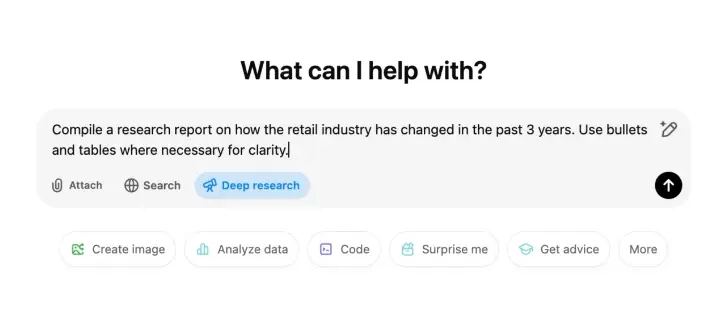
The Deep Research feature allows users to carry out in-depth research using ChatGPT. Once activated, the user simply enters their topic or question, and the AI takes care of the rest.
Deep Research searches for information from a wide range of online sources, analyzes the findings and compiles them into a clear report. The process usually takes 5–30 minutes, and the user receives a notification when the report is ready.
The final report includes:
- Summaries of the key findings
- Detailed source references
- A summary of the conclusions drawn by artificial intelligence
The report helps users to quickly grasp the subject and verify the accuracy of the information without having to browse through and sift through a large number of sources.
Future development prospects for Deep Research
At present, Deep Research utilizes the open internet as well as files uploaded by users. In future, it is intended to gain access to more specialized data sources, such as subscription-based databases and a company’s internal information systems. This will enable more accurate and personalized reports, which will help companies make strategic decisions based on reliable data.
Artificial intelligence does not merely search for information; it also understands, organizes and summarizes it. ChatGPT Deep Research offers a significant competitive advantage to those who know how to harness its full potential.
Document Processing and Automation – Parseflow
Processing documents is often slow and prone to errors. Parseflow is an AI-powered tool that automates the extraction of data from documents and its export to various systems. It uses optical character recognition (OCR) to identify and extract key information, such as amounts, dates and supplier details, from invoices, contracts and emails.
Parseflow is useful for businesses that handle large volumes of documents and wish to reduce manual work and the risk of errors.
How is Parseflow useful?
- For finance teams: Automatic invoice processing and data transfer to financial management systems.
- For Customer Service: Quick search for documents relating to customer enquiries.
- For logistics: Automated processing of order confirmations and freight documents.
Reducing manual work saves both time and resources and, above all, minimizes human error. This makes data processing faster and more efficient, without the need for manual data entry.
How do you use Parseflow?
Getting started is straightforward. Parseflow works in three stages:
Importing files – Users can import documents in a variety of ways. Files can be uploaded manually, sent as email attachments to Parseflow’s own inbox, or by entering a web address from which data can be extracted.
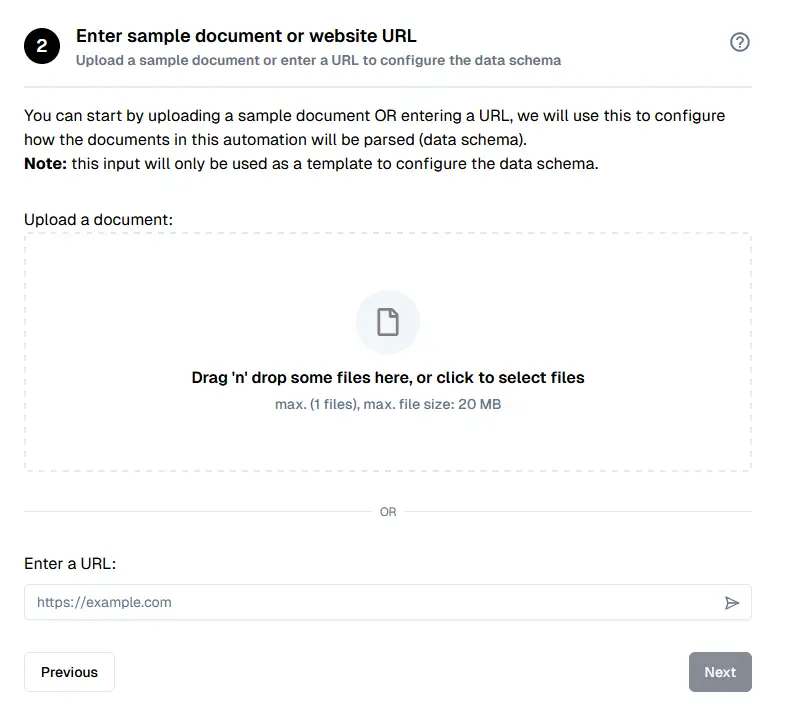
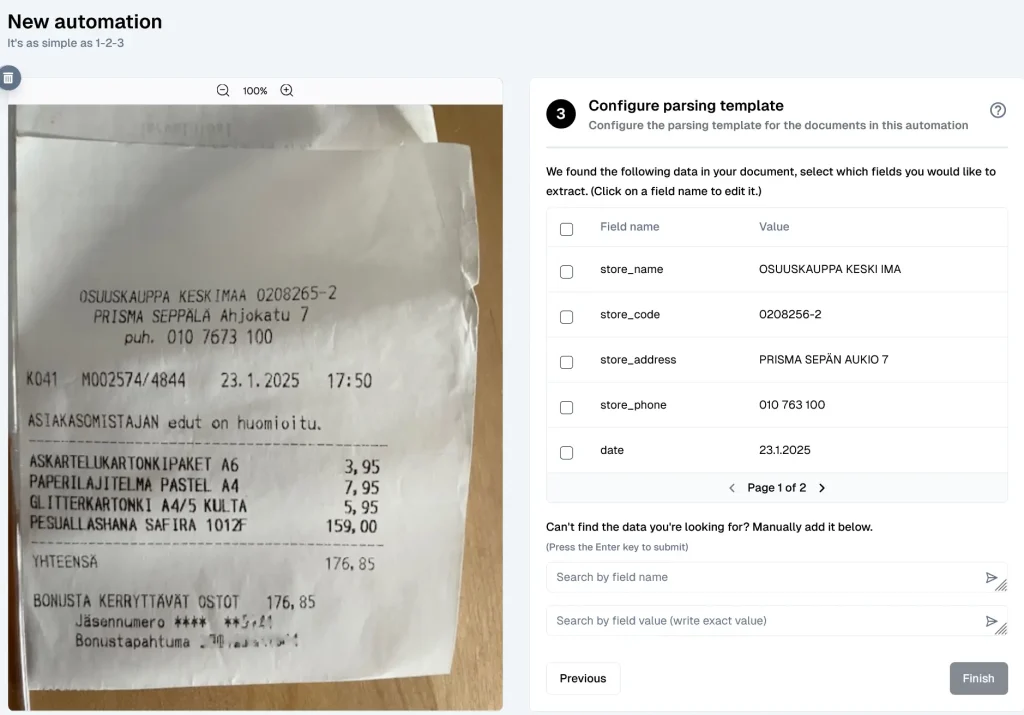
Data extraction – The user specifies which data they wish to identify. The AI and OCR technology then extract the data automatically.
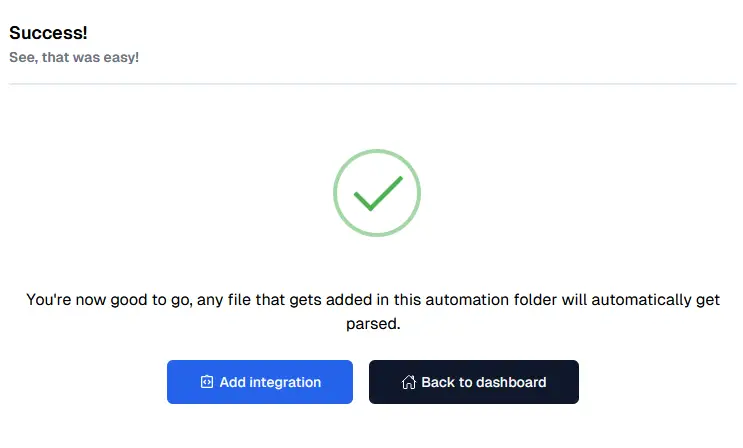
Data export – Extracted data can be exported to various software programs, such as Google Sheets, or downloaded in Excel format for further processing. The AI application Parseflow also supports export to CRM systems, cloud storage services and other third-party applications via Zapier integrations.
Future development prospects for Parseflow
Parseflow supports over 60 languages and can process a wide variety of file types, such as scanned documents, handwritten texts and images. In the future, the aim is to provide even better support for different document types and deeper integration with business systems, such as ERP and BI tools.
In Parseflow, artificial intelligence recognizes, understands, structures and filters out the essential information. Parseflow offers businesses a significant competitive advantage by eliminating unnecessary manual steps and ensuring the accuracy of the data.
Visual communication and guidance – Trupeer
Creating guidelines and training materials can take days, if not weeks. Trupeer automates the process by turning simple screenshots into professional videos and user guides.
How is Trupeer useful?
- For SaaS companies: Quick and clear user guides for customers.
- For the education sector: Creating learning materials with AI-powered voice-overs in various languages.
- For marketing: Product presentations without the need for separate video production.
A quick and easy way to produce high-quality visual content that helps users understand your product or service
How is Trupeeria used?
Trupeer works using a simple process:
- Saving screenshots: Users can save screenshots of their work, for example, using a Chrome extension.
- Artificial intelligence analyzes the recording: The platform automatically generates a video and a text-based guide.
- Editing the content: If necessary, the user can edit the script and add further details before final processing.
- Finishing touches: The user can choose the AI-generated voice, background music and image, as well as the language.
- Final export: The finished video and documentation can be downloaded in various formats for further use.
Trupeer also enables automatic voice-overs in various languages, which makes it easier to reach an international audience and ensures that content is accessible in multiple languages.
Trupeer’s future development prospects
Trupeer’s artificial intelligence edits and modifies videos, as well as enhancing their quality. In the future, its features will be further developed, and Trupeer aims to introduce a wider range of editing tools.
Artificial intelligence makes Trupeer accessible and efficient, as it enables businesses and experts to produce high-quality visual content without the need for dedicated video editing resources.
Personal AI applications – AI agents
Most of the AI applications we have seen so far have been reactive in nature. The user asks a question or gives a command, and the AI responds. Although the quality of the responses has improved significantly, the operating model has remained largely the same.
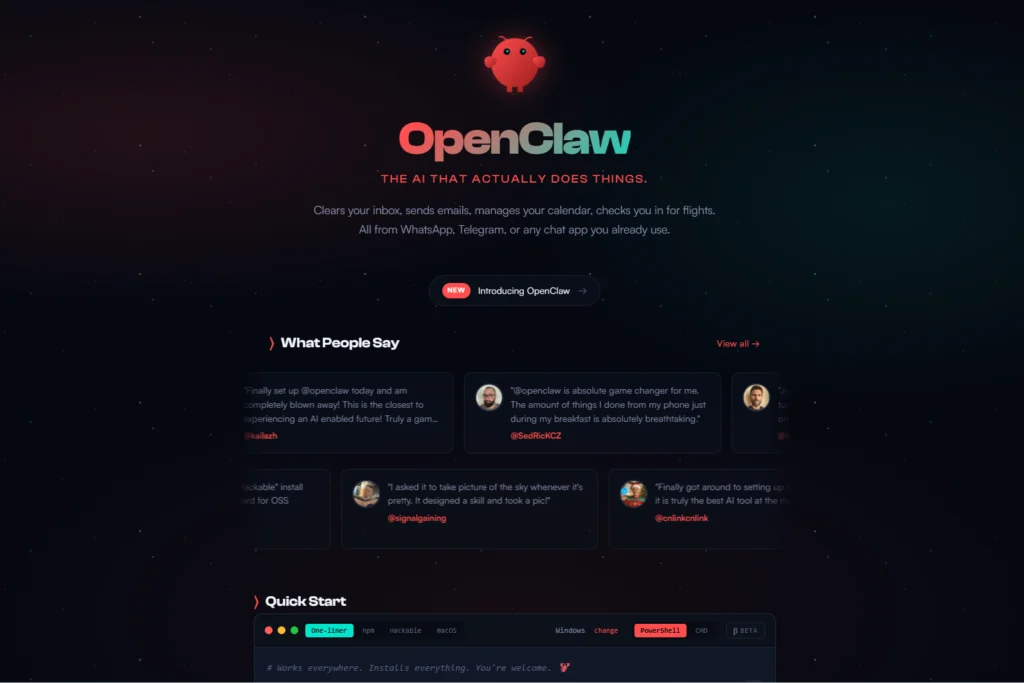
OpenClaw, for example, represents a clear shift towards functional AI applications, in which an AI agent performs tasks on the user’s behalf.
Persistent tasks and scheduled actions – OpenClaw
OpenClaw is an example of a personal AI agent to which you can assign recurring and scheduled tasks. For example, the agent can check emails every weekday morning at a specific time, identify relevant messages and prepare draft replies to them. The user does not need to initiate the task separately or repeat the request day after day; instead, the agent operates according to the agreed workflow as part of the user’s daily routine.
This sets OpenClaw apart from traditional chatbot solutions and standalone automation tools. The agent does not merely react to a trigger, but carries out its task continuously and proactively.
An AI application as the functional core
The central idea behind OpenClaw is that artificial intelligence is not merely a user interface or a background component, but the functional core of the entire application. The agent combines several basic AI capabilities into a single entity:
- the use of large language models to interpret messages and content
- maintaining context and memory of previous actions
- compliance with user-defined rules and limits
- the use of functional interfaces to carry out specific tasks
Thanks to this, the agent is able to carry out the right actions across different systems, rather than simply explaining what it could do.
A step towards a truly “functional Siri”
OpenClaw brings to life what has long been expected of voice assistants such as Siri. The idea of a personal digital assistant that handles tasks independently has been around for a decade. In practice, however, voice assistants have remained limited to simple commands and restricted integrations.
In solutions such as OpenClaw, this promise is beginning to be realized. Generative AI, context management and functional interfaces have developed in parallel to the point where an agent is able to carry out agreed tasks independently, yet in a controlled and supervised manner.
A model for broader AI applications
From the perspective of artificial intelligence applications, OpenClaw is of interest because it serves as an example of a broader trend. The same operating model is suitable not only for personal assistants but also for specialist work, internal support processes and, in the future, enterprise-level agent solutions.
This is a model that illustrates the direction in which AI applications are developing: towards agents that operate continuously in the background and carry out agreed tasks without constant human supervision.
The agent model in knowledge work – Antropic’s Cowork
Personal agents, such as OpenClaw, demonstrate how artificial intelligence can proactively handle repetitive tasks on behalf of an individual user. However, the same operating model is already in use in more demanding specialist work, particularly in software development.
A good example of this is Claude Code, an agent-based development environment developed by Anthropic, which we use at Hurja every day in AI-enhanced software development. In Claude Code, development work is divided among several specialized agents, which can write code, perform refactoring, create tests and check quality in parallel. This significantly speeds up development and frees up developers’ time for architecture, design work with the client and decisions that are essential to the business.
Anthropic’s recently launched Cowork extends the same agent model beyond software development to everyday knowledge work. Whereas Claude Code acts as a developer’s work partner when coding, Cowork applies the same concept to documents, files and expert work. The agent is granted limited access to a folder, where it can read, edit and create files independently in accordance with the task assigned to it.
In practice, this means, for example, compiling draft reports from scattered notes, organizing files, creating tables or formatting documents correctly, without the user having to oversee each step of the process individually. The process is more akin to delegating a task than to a traditional conversation with artificial intelligence
This illustrates a broader shift in AI applications: the same agent model that initially streamlined software development is now being used to optimize personal time management and general knowledge work. AI no longer merely supports work, but actively carries it out on the user’s behalf, within defined limits and under supervision.
When is a custom AI application the better option?
Off-the-shelf AI applications can deliver rapid benefits, but they are not always sufficient. Every business is different, and off-the-shelf AI tools may not necessarily integrate seamlessly with a company’s systems or make the best possible use of company-specific data.
Artificial intelligence is developing rapidly, and new tools are constantly being released. Existing solutions are also evolving at such a pace that even this article has had to be updated several times since its publication. It is impossible for companies to stay at the forefront of developments simply by using off-the-shelf tools. For AI to truly support business operations, it must adapt to the company’s needs, not the other way round.
For example, in customer service:
- A ready-made tool: ChatGPT, which is trained on a pre-existing dataset, can answer general questions, but it does not know your company’s customers, products or systems.
- Custom AI solution: Integrates with your company’s database and systems, enabling you to provide customers with personalized and accurate responses.
The same applies to many other areas of AI application. When AI is integrated into business processes, it not only improves efficiency but can also offer entirely new opportunities for business development. At the same time, it becomes easier to take into account the ethical, legal and security issues associated with the use of AI.
Customized applications can also be developed using low-code and no-code platforms, which speed up software development and lower the barrier to adopting artificial intelligence.
Integrating artificial intelligence into a company’s systems and business operations
Case: Spoken
AI tailored to a company’s needs can bring significant benefits, particularly when it is integrated into the company’s own system. For example, our client Spoken, a language services company, implemented AI as part of its software with our assistance. Spoken already had an existing system in place, which we took over and began to manage its further development.
As part of our ongoing development, we have, among other things, implemented an OpenAI Whisper integration, which brought artificial intelligence to Spoken’s services. This improved the accuracy of speech recognition and significantly streamlined processes. AI is utilized both to assist staff and to provide services to customers, saving time and resources.
Case: Odoo AI Order Processor
Another practical example of the use of AI agents is the Odoo AI order processor you have implemented. In many organizations, customer orders still arrive via email as free-form messages, attachments or even images, which makes processing slow and prone to errors.
In this solution, an AI agent reads incoming messages, identifies the key details of orders and converts them into a structured format. Before saving, the user is shown a preview, which allows them to check and approve the details. Once approved, the order is automatically recorded in the Odoo ERP system as a sales order.
Artificial intelligence is utilized specifically for interpreting and structuring data. Business rules, validations and integrations are confined to the system level, which ensures manageability, data security and scalability. As a result, manual work is reduced, the risk of errors is minimized and the ordering process is significantly accelerated, without the user losing control over the process.
When artificial intelligence is integrated into systems, accountability and data security play a key role
As artificial intelligence becomes an integral part of a company’s systems and business processes, accountability and data security take on greater importance. AI often processes sensitive information, such as customer and personal data, contracts or business-critical decisions, which means its operations must be predictable and controlled.
Off-the-shelf AI applications enable rapid deployment, but they also carry risks. In particular, access rights and integrations can become a problem if the user does not fully understand which application they are granting access to and what data is involved. Many information security risks arise from human error, such as overly broad access rights or carelessly approved integrations, which can grant access to confidential data.
The EU’s AI Act establishes clearer rules for the use of artificial intelligence and defines different risk levels for AI systems. The legislation promotes responsible use, but does not remove companies’ own responsibility for managing risks.
The safe use of artificial intelligence requires that its use is transparent, access rights are properly restricted, and the human role is maintained in critical decision-making. When AI is integrated in a controlled manner into a company’s own systems, it reliably supports business operations without posing an unseen risk to information security.
Customized AI applications that adapt to your business needs
Off-the-shelf AI applications can deliver rapid benefits, but the real competitive advantage arises when AI is tailored to form an integral part of a company’s own processes and systems. A custom AI application enables more efficient automation, a better customer experience and more in-depth use of data.
When artificial intelligence is designed to meet your company’s specific needs, its potential increases significantly.
Here are a few examples:
- Data analysis and forecasting: for example, quality control in industry and modeling customer behavior.
- Smart customer service: an AI bot that knows your company’s customers and can provide personalized responses.
- Personalized recommendations: online shops and content services can use artificial intelligence to identify customers’ interests.
- Predictive maintenance and fault diagnosis: Remote monitoring and sensor data can be used to identify problems before they arise.
Would you like to utilize artificial intelligence in a way that supports your company’s specific objectives? A custom AI application ensures that artificial intelligence integrates seamlessly into your business processes.
Please get in touch so we can discuss how AI applications can be developed to support your business in practice.
Ready to get started?
"*" indicates required fields

You might also like these articles

6 winning use cases for AI – how to find where it really pays off
Read more

Context engineering – guiding LLMs to deliver business value
Read more

User stories as a tool in app design using artificial intelligence
Read more

Smart remote management in industry – up to 30% savings on maintenance
Read more
 Smart remote management in industry